
A moment of truth is any interaction in a purchase journey where a customer forms or revises a judgment about your brand, product or service, and acts on it. To identify them, map the buying journey stage by stage, flag the points where money, risk or reputation hang in the balance, test each against behavioral evidence, then score impact against vulnerability to decide what to fix first.
The whole exercise takes a small team about two weeks, and most of the work is sorting evidence you already own rather than commissioning new research. Teams that skip the scoring step usually end up fixing whatever generates the loudest complaints instead of whatever actually changes buying behavior.
Table of Contents
- What You Need
- Step-by-Step
- Map the purchase journey and its emotional transitions
- Flag high-stakes interactions and decision points
- Test the importance of each interaction
- Score each moment for impact and vulnerability
- Choose the moments that need immediate attention
- Validate the findings with customers and behavioral evidence
- Turn each moment into an action and a measure
- Common Mistakes
- Frequently Asked Questions
- What is a moment of truth in a purchase journey?
- How do I know which touchpoint is a moment of truth?
- Are moments of truth the same as moments of delight?
- Which customer journey moments should researchers test first?
- How can I measure whether a moment of truth improved performance?
- Conclusion
What You Need
You need five inputs before you start, and none of them require new software.
- A defined purchase journey. Pick one specific journey to analyze rather than the whole customer lifecycle. Choosing an unfamiliar purchase, such as a first order from a brand the customer has never bought from, keeps the analysis sharp.
- Existing evidence. Pull support transcripts, product reviews, chat logs, return reasons, session recordings and survey verbatims. These already exist in most teams and usually contain more signal than a fresh survey.
- Business and brand evidence. Know your positioning, your typical objections and where you lose people. Without this, you will flag moments without knowing which ones are yours to fix.
- A stakeholder decision. Know what the analysis informs: a service redesign, a messaging change, a staffing plan or a product change. Analysis without a decision produces a beautiful map nobody reads.
- A simple scoring framework. A spreadsheet with six scoring criteria and a prioritization rule is enough. A purpose-built tool is optional.
The method works the same for physical products and services. The examples here lean toward a broadly applicable consumer purchase, but a software renewal or a clinic appointment follows the same emotional shape: uncertainty early, commitment at the point of payment, judgment at first use, and memory at the point of praise or complaint.
Step-by-Step
Map the purchase journey and its emotional transitions
Start by breaking the purchase journey into five stages: trigger, consideration, selection, use and post-purchase. Under each stage, list what the customer is doing, what they are feeling and what question is in their head.
The trigger stage begins when a need becomes conscious. Consideration is research, where expectations start to form. Selection is the comparison and commitment phase. Use is the first real contact with what was bought, and post-purchase covers support, repeat buying and referrals.
The part most journey maps skip is the emotional line. Plot perceived risk and emotional intensity alongside the stages, and mark where expectations shift, because those shifts are where the interesting moments live.
Success check: someone who was not in the mapping session can read your map and describe the customer’s emotional state at each stage in their own words. If they cannot, the map describes your process rather than theirs.
Flag high-stakes interactions and decision points
A high-stakes interaction is any point where the customer makes a meaningful judgment about the brand, the offer, the price or the service. Five categories recur across most purchase journeys: first exposure, evaluating alternatives, committing to payment, receiving or first using the product, and resolving a problem.
Within each category, look for the interaction that would hurt most if it went wrong. For an unfamiliar online purchase of a household appliance, that is usually the moment a customer compares total cost of ownership against a rival on the results page, and the moment the delivery window slips twice.
Success check: you have a list of six to ten interactions, each written as a specific scene with a time and a place, not as a stage name. “Checkout” is a stage; “paying by card on a phone at 11pm with two carts open” is a moment.
Test the importance of each interaction
Not every memorable touchpoint is a moment of truth, and plenty of genuine moments of truth are boring to describe. Test each flagged interaction against five things: behavioral evidence, customer language, emotional intensity, consequence and influence on what happens next.
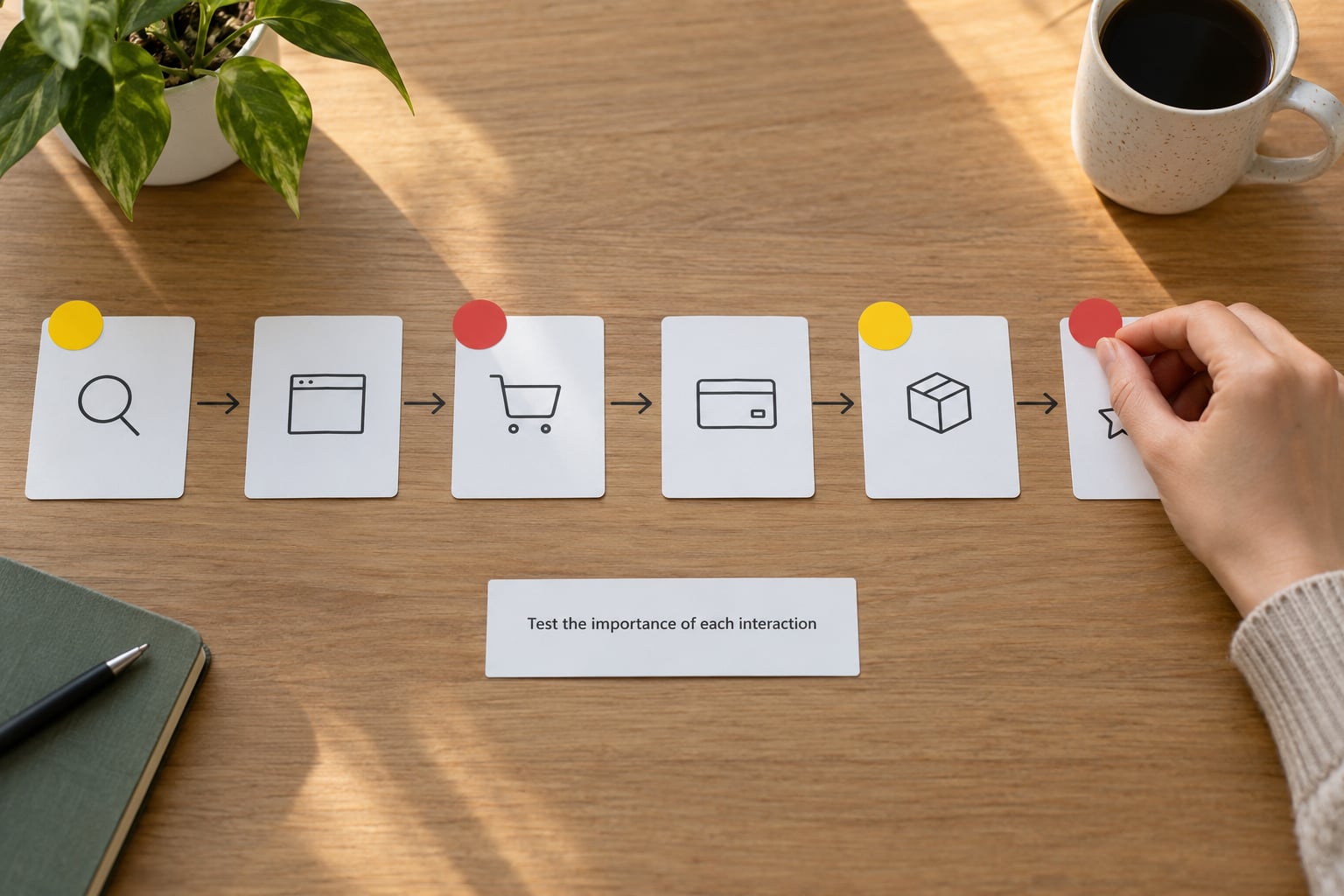
Behavioral evidence means finding the action that follows. A support conversation that ends in a cancellation matters more than a cheerful greeting that leads nowhere. Customer language means checking whether people describe the moment unprompted. Emotional intensity shows up as hesitation, checking or reassurance-seeking behavior rather than in survey scores alone.
Consequence asks what breaks if the moment fails, and influence asks whether it changes the next step. A moment that is painful but followed by a complete fix can score lower than an unremarkable step that quietly ends the purchase.
Success check: every flagged moment has at least one piece of evidence attached and at least one piece of evidence that argues against it. Moments with no counter-evidence are usually assumptions wearing a label.
Score each moment for impact and vulnerability
Score each moment from one to five on six criteria: consequence of failure, emotional load, size of the expectation gap, how much control the customer has, how reversible the decision is, and influence on later behavior.
Consequence and emotional load usually dominate. Vulnerability picks up the rest: high perceived risk and low reversibility raise the score, low customer control raises it further, and a large expectation gap raises it again because unmet expectations damage trust fastest.
Do not treat the totals as a mathematical threshold. The value of the score is comparison and conversation, not a magic number that decides by itself. A moment scoring 24 out of 30 that nobody owns is worth less than one scoring 19 with a named team and a deadline.
Success check: you can defend any two scores in one sentence each, using evidence rather than intuition. If the reasoning takes a paragraph, the score is hiding a weak argument.
Choose the moments that need immediate attention
Prioritize moments with high impact and high vulnerability. Those are the ones where a modest fix changes the outcome, and they split into two groups: quick wins you can address this quarter, and structural problems that need deeper research and budget.
Consider a customer buying an unfamiliar brand of kitchen appliance online. First exposure scores moderately, because one bad ad costs little. The comparison moment scores high, because the customer cannot verify quality and is calculating running costs. Delivery scores high on impact and higher on vulnerability, because the customer has no control at all once the order is placed.
In that example, a clear running-cost comparison on the product page is a quick win, while delivery communication is structural. Treating both as one item on a list is how teams get stuck for months.
Success check: you have a ranked shortlist of no more than five moments, each labelled quick win or structural, with a named owner for every one.
Validate the findings with customers and behavioral evidence
Now test the ranked list rather than arguing about it. Review support transcripts and mined reviews first, since they cost nothing and surface the language customers actually use. Then run short interviews focused on the shortlist, asking customers to walk through the last purchase in detail and mark where they hesitated.
Behavioral analytics confirm what interviews hint at. Look at drop-off between comparison and payment, at repeat contact on the same order, at return reasons, and at whether second purchases happen after a clean first experience. Diary studies are worth the cost for high-consideration purchases, where the evaluation runs for weeks.
Guard against recall bias, because customers describe the ending of a purchase far more vividly than the middle. Ask about specific recalled moments, not about satisfaction in general, and check the answer against what the data shows.
Success check: at least two shortlisted moments are confirmed by both customer language and behavioral evidence. Moments confirmed by only one source move to a watch list, not to the plan.
Turn each moment into an action and a measure
Each validated moment becomes four things: a research question if you still do not understand it, an experience principle that states the intended behavior, an operational change with a team attached, and a metric that would move if the change worked.
For the appliance example, the comparison moment turns into a question about which running-cost information customers actually use, a principle that the total cost of ownership is visible before checkout, an operational change to the product page, and a metric of comparison-to-payment drop-off. The delivery moment becomes a principle that the delivery date is confirmed at order and again at dispatch, an operational change owned by fulfillment, and a metric of repeat contact on the same order.
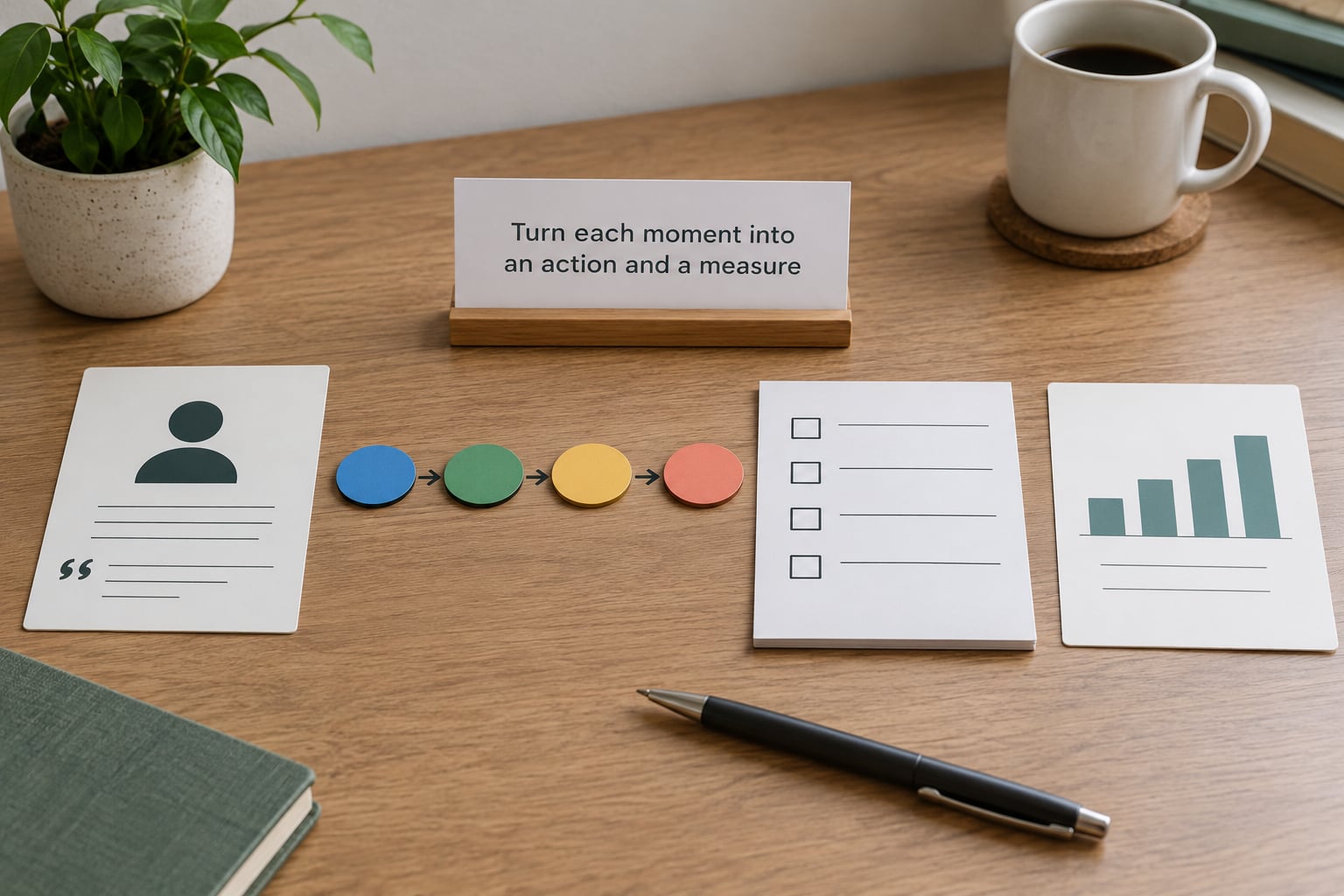
Keep the four on one line per moment in a shared sheet. It prevents the common failure where a well-supported insight becomes a vague intention nobody can measure.
Success check: every moment on the plan has an owner, a change with a date and a metric that exists in a report someone already reads. Anything missing a metric is a preference, not a priority.
Common Mistakes
Treating frequency as importance. The most-visited touchpoint is often the least decisive. Fix: score on consequence and vulnerability, and check what behavior follows each touchpoint rather than how many people saw it.
Assuming the biggest complaint is the biggest moment of truth. Complaints cluster where customers are already annoyed and have an easy route to complain. Fix: compare complaint volume against purchase value and against how many silent abandoners never complained at all.
Confusing positive delight with purchase influence. Delight that happens after the decision changes loyalty, not acquisition. Fix: check where the moment sits in the purchase journey and whether anyone who experienced it was still undecided.
Drawing conclusions from one channel. A journey reconstructed from web analytics alone misses the phone call and the store visit that closed the sale. Fix: join support, CRM, review and web data at the order level, accepting that some journeys will stay partially unjoined.
Ignoring differences between customer groups. A first-time buyer and a repeat buyer pass through the same stages with different stakes. Fix: run the scoring twice, once per group, and look for moments that rank high in both before committing resource.
Assigning actions without owners or measures. Recommendations that belong to everyone belong to nobody. Fix: one team, one change, one metric, one date per moment.
A few habits keep this work honest. Keep the evidence file with the map, not in someone’s inbox, so a colleague can rerun the analysis later. Revisit the shortlist each quarter, because a fixed moment stays fixed while competitors and customer expectations move. Write your assumptions down, especially the ones about segments and channel coverage, and mark which ones are still untested. And treat the moments as a working list rather than a verdict, because the purchase journey keeps adding stages of its own.
Frequently Asked Questions
What is a moment of truth in a purchase journey?
A moment of truth is any touchpoint where a customer interacts with your brand and forms or revises a judgment that shapes whether they buy, stay or recommend. It can be an ad, a product page, a checkout, a delivery or a support reply. What makes it a moment of truth is the consequence attached to it: what the customer concludes there, and what they do next, is disproportionate to the time spent.
How do I know which touchpoint is a moment of truth?
Test each touchpoint against five things: what behavior follows it, whether customers describe it unprompted, how emotionally loaded it is, what breaks if it fails, and whether it changes the next step. A touchpoint becomes a moment of truth when those five line up. If you cannot find evidence either way, treat it as an assumption and go and collect some rather than arguing about it in a meeting.
Are moments of truth the same as moments of delight?
No, and mixing them wastes budget. A moment of delight is designed to feel good and usually sits after the decision. A moment of truth is defined by consequence rather than feeling: it is where the customer judges whether the brand is worth what they are about to spend or risk. Delight can support trust, but it rarely changes whether a particular purchase happens, and it cannot repair a comparison page that hides the running costs.
Which customer journey moments should researchers test first?
Start where perceived risk is highest and customer control is lowest, usually the comparison step, the payment commitment and the moment the customer first receives or uses the product. For an unfamiliar purchase, delivery communication usually outranks first exposure. Validate with support transcripts and mined reviews before commissioning anything new, because those records carry the language customers actually use.
How can I measure whether a moment of truth improved performance?
Tie each moment to a metric that already exists in a report someone reads: drop-off between comparison and payment, repeat contact on the same order, return reasons, first-contact resolution or second-purchase rate. Combine the metric with a behavioral check such as a holdout group or a before-and-after comparison. A metric that moves while the moment improves is evidence; a satisfaction score that drifts upward on its own is not.
Conclusion
A moment of truth is any consequential interaction that changes customer confidence, trust or behavior. Identifying them is mostly a discipline of separating consequence from volume, which is where most analysis goes wrong.
Start today by mapping one purchase journey and marking the high-stakes interactions inside it. Score each one for impact and vulnerability, take the top three, and validate them against support transcripts, reviews and a handful of customer interviews before spending anything on new research. Then give each surviving moment an owner, a change and a metric that already sits in a report.