
To measure purchase intent accurately, tie every score to a specific purchase event, combine at least two kinds of evidence, and then check that score against what people actually bought. A single survey question cannot do that job, and it is where most intent measurement goes wrong.
The awkward part is the gap. People report enthusiasm for products they never buy and buy quietly for reasons they never mention. Marketing researchers call this the intention-behavior gap, and it means any method used on its own will mislead you.
The good news is that the fix is procedural rather than expensive. Most of the work happens before the survey goes out: deciding what you are predicting, for whom, and by when.
Table of Contents
- What You Need
- Step-by-Step: How to Measure Purchase Intent Accurately
- 1. Define the Purchase Decision and Time Frame
- 2. Choose the Right Intent Measures
- 3. Ask Better Questions to Measure Purchase Intent Accurately
- 4. Combine Stated and Behavioral Signals
- 5. Segment the Results
- 6. Validate Intent Against Actual Purchases
- 7. Report a Decision-Oriented Intent Score
- Common Mistakes
- Asking vague questions
- Leading with loaded wording
- Treating intent as behavior
- Ignoring the time frame
- Overreading small samples
- Never validating
- Frequently Asked Questions
- What is the best scale to measure purchase intention?
- How do you turn purchase intent scores into a purchase probability?
- Is purchase intent a reliable predictor of actual purchases?
- How many survey responses do you need for purchase intent?
- Should I use behavioral data or surveys to measure intent?
- What is a purchase intention questionnaire?
- Conclusion
What You Need
You need five things before you pick a measurement method. Missing any one of them is why an intent study ends up as a number nobody can act on.
- A named purchase event. Not “interest in the category”. A specific action by a specific person: a first order of the 40 dollar bottle, a demo booked, a quote requested.
- A decision window. The period in which that action happens, stated up front. Thirty days and six months produce completely different intent signals.
- Defined segments. Which customers you care about, and which you are excluding on purpose.
- Two or more evidence types. Ideally one stated measure (a survey) and one revealed measure (site behavior, CRM history, test data).
- Access to later sales records. You need purchase data from after the measurement to validate anything you produce.
That last one is the most commonly skipped, and it is the one that turns an opinion survey into a measurement.
Step-by-Step: How to Measure Purchase Intent Accurately
1. Define the Purchase Decision and Time Frame
Start by writing the prediction as a sentence with a date attached: “a first-time household buyer purchases Product A within 30 days of the campaign.” Everything downstream inherits the precision of that sentence.
The same product generates completely different intent levels depending on the window. Someone pricing a mortgage for six months is not a near-term buyer, and a five-point scale asked today cannot tell them apart from someone ordering tomorrow. In B2B this matters even more, where a contract can sit in legal review for a quarter before anyone signs.
Define “purchase” the same way your finance team does. If finance records revenue on a subscription start date, do not measure intent against a demo request and call it a conversion.
2. Choose the Right Intent Measures
Four families of measure exist, and each captures something the others miss. Most accurate programs combine a stated measure with a behavioral one rather than picking a winner.
- Behavioral (revealed) intent. Product page views, pricing page engagement, cart additions, quote requests, demo bookings, repeat visits. Real actions, but ambiguous: the visitor may be comparing you against three rivals.
- Stated intent. A direct question about likelihood of buying. Cheap, fast, and easy to segment, but sensitive to how the question is worded.
- Attitudinal intent. Interest, relevance and consideration questions. Useful for brand work and new categories where no behavior exists yet.
- Comparative choice. Constant sum, conjoint, maxdiff and similar trade-off devices. These force respondents to compete for a limited budget of points, which is closer to how a real decision works.
| Method | What it captures | Weakness | Cost and turnaround | Best used for |
|---|---|---|---|---|
| Five-point intent scale | Stated likelihood for one concept | Inflates; crowds at the top of the scale | Low, days | Quick concept screening |
| Constant sum | Relative preference across named rivals | Needs a real set of alternatives | Low, days | Share of preference in a known market |
| Purchase probability scale | Percent-chance-of-buying judgments | Demanding for respondents to imagine | Medium, one to two weeks | Forecasting new products |
| Conjoint or maxdiff | Trade-offs driving choice | Design and analysis expertise required | High, three to six weeks | Pricing and attribute trade-offs |
| Behavioral analytics | Real actions in real time | Signals are ambiguous, not predictive alone | Medium, ongoing | Lead scoring and journey triggers |
| Test market or virtual shopping | Choice under real shelf conditions | Slow and expensive, small geography | High, months | Launches where the stakes justify it |
For fast-moving consumer goods, concept testing stays common precisely because virtual shopping and test markets cost more and take longer, even though stated intent predicts in-market success poorly. One virtual-shopping vendor reports that only 25% to 85% of shoppers notice a brand on shelf at all, which is a different problem from whether they liked it.
3. Ask Better Questions to Measure Purchase Intent Accurately
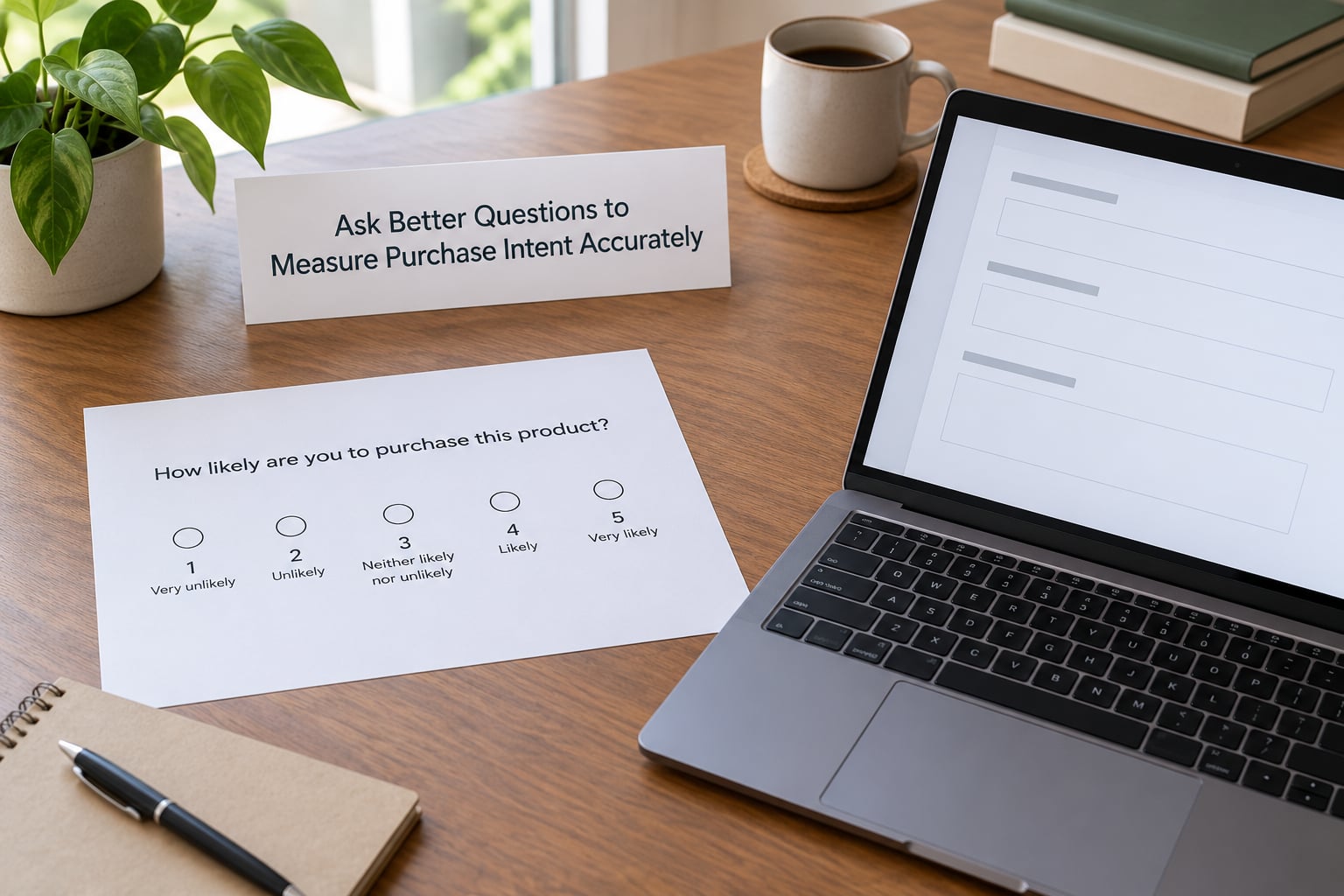
The classic item reads “how likely would you be to purchase this product”, followed by definitely will, probably will, might, probably not, definitely not. Three problems sit inside it: the top two categories are wide and vague, there is no time frame, and no price or availability context.
Rewriting it fixes most of that in one line.
- Add the window. “How likely are you to buy this in the next three months?”
- Add the context. “at the price shown” or “assuming it is available in your area”, so the respondent is not answering about a hypothetical product that costs nothing and arrives tomorrow.
- Neutral labels. “Extremely unlikely” through “extremely likely” gives two real anchors instead of four shades of maybe.
- Follow with an open question. “What would have to happen for you to buy this?” The answers tell you which of the four evidence types you actually need next.
- Add a commitment question. “Would you like us to email you when it launches?” Behavior beats statements and it is easy to compare against clicks.
Report the top-two box, the share answering 4 or 5, rather than the average. Averages on skewed scales drift with the sample and mean very little.
4. Combine Stated and Behavioral Signals
Accuracy comes from triangulation. A survey tells you why, behavior tells you what, and only the overlap is worth forecasting on.
Three practical rules help. First, weight revealed behavior more heavily for near-term windows, because past actions are harder to fake than stated plans. Second, when stated and behavioral evidence conflict, treat the respondent as undecided rather than as a liar; the open-ended answer usually explains which one is about to change. Third, score research behavior and transactional behavior separately, because a visitor comparing three vendors in one week looks identical to a visitor ready to order from you.
Practitioners working with web intent data argue this split constantly, and they report the same failure elsewhere: web behavior alone over-credits a visitor early in the journey and under-credits them months later.
5. Segment the Results
One average score across everyone hides the only thing you need. Segment by category need, category familiarity, price sensitivity, lifecycle stage, region or channel, and your own customer versus prospect status.
The segments behave differently enough that averages mislead. Brand-loyal customers show high stated intent and low switching probability. Non-users with high stated intent and no behavioral trail are usually curious. Existing buyers with rising browsing and no cart activity are usually replenishing.
That middle group, movable between brands, is often where intent data pays for itself, because it is the only group where a change in message or offer realistically moves a sale.
6. Validate Intent Against Actual Purchases
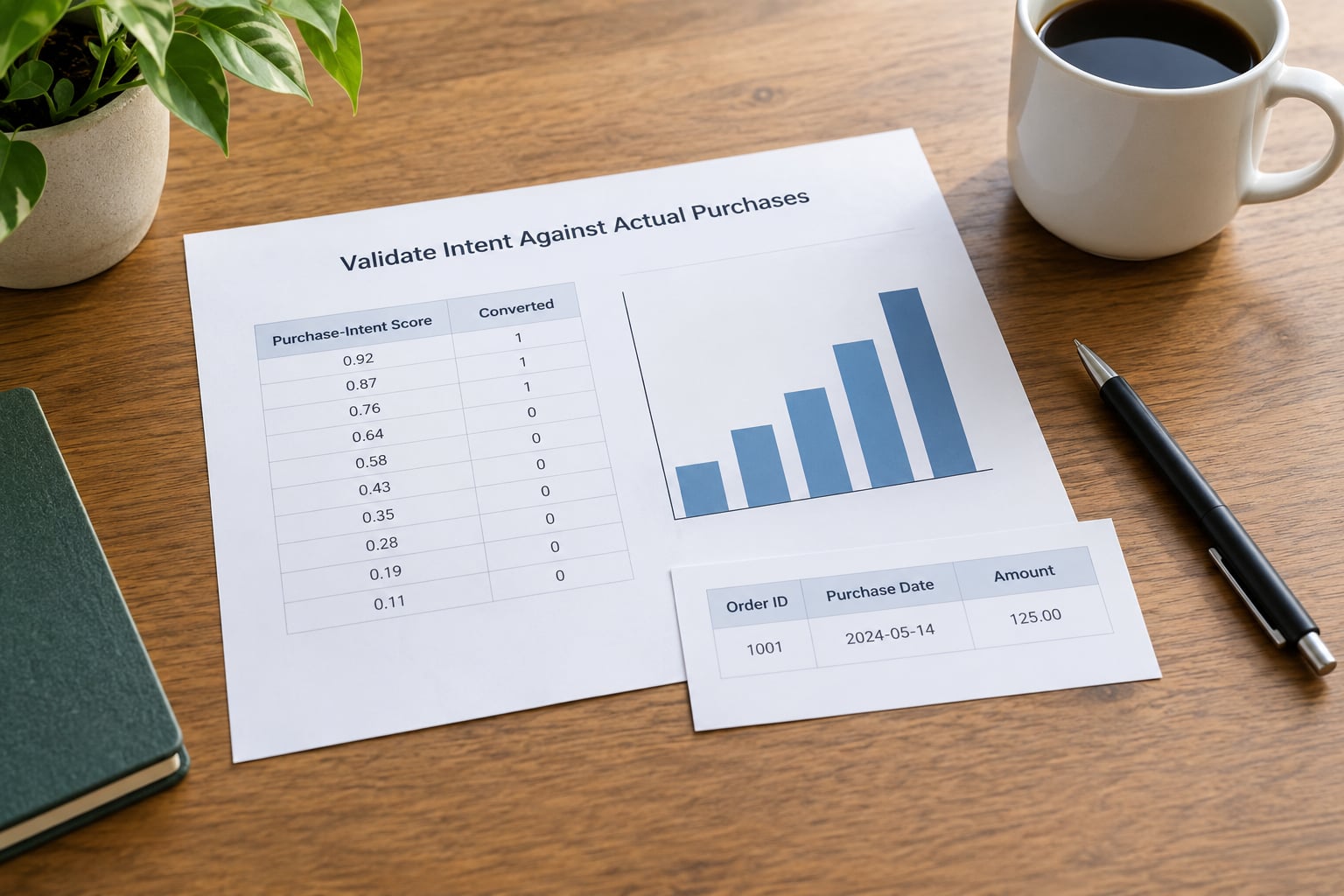
Validation is the step that separates measurement from opinion. It is simple and most teams skip it: after the survey or scoring window closes, join each record to actual purchases and see what happened.
Work through four checks. Build a conversion table by intent tier, so a 5 and a 4 predict the same rate. Calculate the correlation between score and purchase, and treat a weak one as a finding rather than an embarrassment. Hold out a group the model never saw and check that the forecast still holds. And back-test the whole instrument on a past launch where you already know the outcome.
If intent scores do not separate converters from non-converters, you have a wording problem, a time-frame problem, or a segment you should be measuring differently.
7. Report a Decision-Oriented Intent Score
Convert the raw results into one documented number or probability, and write down what it cannot tell you.
A workable format: the score, the sample and segment it came from, the evidence types behind it, the observed conversion rate in that band once validated, and the action the band supports. High bands justify spend, mid bands justify a second touch, low bands justify suppression. The uncertainty goes in the sentence beside it, not in a footnote.
Once you have that, intent becomes usable for forecasting, media targeting and lead prioritization instead of being a survey deck.
Common Mistakes
These six errors account for most bad intent measurement, and each has a straightforward fix.
Asking vague questions
“How interested are you in our new range?” collects mood, not intent. Fix: name the product, the action and the date in the question itself.
Leading with loaded wording
Words like “improved”, “affordable” or “exclusive” push answers toward the top of the scale. Fix: describe the product plainly, and split the benefit claims into a separate question so you can see which ones actually move intent.
Treating intent as behavior
Stated intent systematically overstates buying likelihood because respondents answer the question easily and the purchase is not. People say probably will buy to many brands in the same sitting. Fix: always pair stated measures with revealed behavior, and publish the conversion rate for each band.
Ignoring the time frame
An intent score with no date attached cannot be forecast with. Fix: ask the likelihood question at two horizons and report them separately, then match each to its own outcome window.
Overreading small samples
With a few hundred responses you can separate a large difference, but not a small one, and small samples let confident segments appear out of noise. Fix: report the interval around each estimate, and avoid segments under roughly fifty respondents unless you are only describing them.
Never validating
Teams adopt an intent score and never check it against purchases, so a broken instrument keeps running for years. Fix: schedule the validation as a recurring review, and kill any score whose observed conversion does not differ from the next band down.
Frequently Asked Questions
What is the best scale to measure purchase intention?
A purchase probability scale, where respondents state the percent chance they would buy, usually beats a five-point scale for forecasting. It forces a concrete number instead of a vague feeling and lets you convert answers straight into expected volume. Keep a five-point scale for fast screening, and add a time frame and a price reference to either one.
How do you turn purchase intent scores into a purchase probability?
Collect scores and outcomes for the same population, sort respondents into intent bands, and measure the actual purchase rate inside each band. Those observed rates are your probabilities. Apply a calibration curve so the predicted and observed values line up, and refit it whenever the category, price or season changes.
Is purchase intent a reliable predictor of actual purchases?
Alone, no. Stated intent runs ahead of real buying behavior, and many respondents describe several brands in the same warm terms in one sitting. It becomes reliable when you segment the results, attach a time frame, weight revealed behavior for near-term decisions, and validate each band against recorded purchases before acting on it.
How many survey responses do you need for purchase intent?
For a total-market read, a few hundred completed interviews is the usual working minimum, and you need more for any segment or subgroup you plan to act on. Treat segments under roughly fifty respondents as description only. If you need to detect a small difference between concepts, either enlarge the sample or accept that the study cannot answer it.
Should I use behavioral data or surveys to measure intent?
Use behavioral data for near-term windows and surveys for reasons, brand work and new categories where no behavior exists. Behavioral signals show actions but not motivation, so pricing page visits look identical across someone ready to buy and someone comparing rivals. Surveys show motivation but not action. Most programs score better when both feed one number.
What is a purchase intention questionnaire?
It is a short, ordered set of questions that captures how likely a respondent is to buy, for which product, by when, and what stands in the way. A good version pairs a likelihood question with a time frame, a price reference, an open-ended obstacle question and a commitment request. Scoring rules are fixed before fieldwork so results stay comparable across waves.
Conclusion
Start with the purchase event, not the survey. Write down exactly what you are predicting, for which segment and by when, then combine a stated measure with a revealed one and check the result against recorded purchases before anyone spends money on it.
Everything else in this guide is refinement on those three moves.