
Loyalty programs change spending patterns in four measurable ways: they make people buy more often, they raise what goes in the basket, they push customers toward higher-value items, and they bunch purchases into tighter windows around bonus categories and expiry dates. The shift is not always a preference change. Sometimes the program just pays a customer for spending they were already doing, and telling those two things apart is the hard part of the whole discipline.
This guide is written for marketers, loyalty managers and consumer researchers, but the shopper side of the story matters too. Updated for October 2026.
Table of Contents
- What Do Loyalty Programs Change About Spending?
- Why Do Loyalty Rewards Encourage More Purchasing?
- How Does the Design of a Program Shape the Effect?
- What Spending Patterns Do Points, Tiers, and Cash Rewards Create?
- How Loyalty Programs Change Spending Patterns: The Mechanisms Behind the Shift
- Endowed progress turns future rewards into current possessions
- Loss aversion protects the balance, not the brand
- Effort reduction makes repeat visits automatic
- Status aspiration makes spend visible and social
- Sunk cost creates lock-in that looks like loyalty
- Promotion dependency replaces preference with timing
- Can Loyalty Programs Increase Both Spending and Customer Retention?
- When Do Loyalty Programs Encourage Wasteful or Unsustainable Spending?
- How Can Researchers and Marketers Measure the Change?
- Frequently Asked Questions
- Do loyalty programs make customers spend more money?
- How do points and rewards affect what people buy?
- What is the difference between loyalty rewards and VIP tiers?
- Can a loyalty program increase purchases without increasing customer loyalty?
- How can a business tell whether a loyalty program caused extra spending?
- Why do customers buy more just to reach a spending threshold?
- Conclusion: Start With the First Behavioral Change
What Do Loyalty Programs Change About Spending?
Short answer: four shifts, each with a different mechanism and a different way to prove it happened.
Frequency moves first, and it is the easiest to see. A program with a visible progress bar shortens the gap between purchases, because the next reward sits a fixed distance ahead. Basket size moves next, since a basket that was going to happen anyway gets padded to reach a threshold or unlock free delivery. Product choice shifts when reward rates differ by category, which pulls customers toward whatever is currently earning most. Timing is the least obvious: purchases concentrate into promotion windows, bonus-category quarters and points-expiry deadlines.
What stays flat matters as much as what moves. Total category spending, share of wallet, and the products a customer buys when no program signal is present usually do not change. If those move, you are watching a preference change, not an incentive response.
| Spending shift | Behavioral mechanism | Metric that proves it |
|---|---|---|
| More frequent visits | Endowed progress toward a visible reward | Days between transactions, control group vs members |
| Larger basket | Threshold effect and basket padding | Average order value, units per transaction, item mix |
| Higher-value products | Differentiated earn rates by category | Share of spend in bonus categories vs baseline |
| Concentrated timing | Expiry, bonus windows, tier qualification | Variance of purchase dates, redemption before expiry |
One more shift sits outside the retail basket entirely: where the payment comes from. Credit card rewards pulled a lot of previously non-rewards spend onto cards, which is a change in instrument rather than in total consumption. Researchers who merge those two categories will overstate what a program did.
Why Do Loyalty Rewards Encourage More Purchasing?
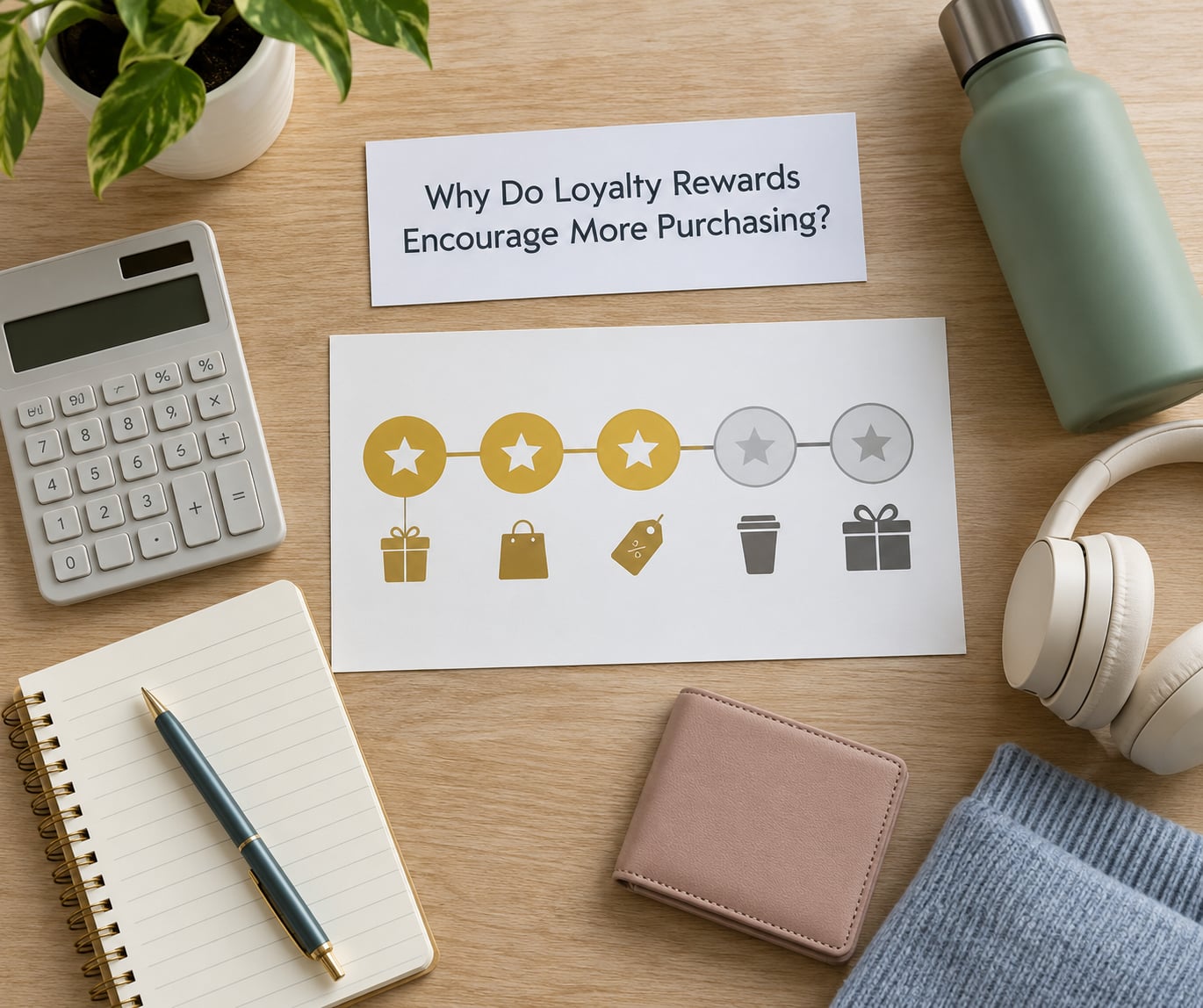
The core mechanism is that a reward changes the effective price of the next purchase, not the sticker price of this one. Nobody thinks of a coffee as cheaper because of a punch card. They think the next one is closer.
Jalili and Pangburn’s 2021 paper in Decision Sciences modelled exactly this and produced a result that surprises most marketers: delayed discounts outperformed immediate discounts. A program that takes 20% off today’s basket hands over the value now, and the shopper treats it as a deal they would have taken anyway. A program that credits the purchase and pays out later creates an account, and an account creates a reason to come back. The paper’s segmentation work also found something else useful: alongside the price-sensitive shopper and the brand-loyal shopper, a third group emerged, the rewards shopper, who sorts offers by reward value rather than by base price.
The net-price walkthrough makes it concrete. Take a basket a customer was always going to buy, 40 dollars of goods. Under a delayed program, the basket costs 40 dollars today and returns credit later, so the customer’s current outlay is unchanged and the future outlay is lower. Under an immediate program, the same basket costs 32 dollars, and the customer’s budget for today expands by 8 dollars with no relationship built. The first option creates a balance; the second creates a good feeling.
Behind that sit familiar psychological levers. Effort is reduced by remembering purchases automatically. Loss aversion kicks in when a balance exists to protect. Endowed progress makes a partly completed chart feel like something already owned. Status adds a social layer, since tier names are public in ways points are not.
US card data shows how large this has become. CFPB analysis of general-purpose credit cards from 2019 to 2022 found rewards earnings up 58%, from 26.1 billion dollars to 41.1 billion dollars. Typical earn rates rose from about 1.4 to 1.6 cents per dollar, redemptions rose 44% to an average value near 167 dollars, and sign-up bonuses accounted for roughly 7% to 9.1% of earnings, averaging around 326 dollars.
How Does the Design of a Program Shape the Effect?
Same headline offer, different mechanics, different spending pattern. Design is the variable that decides whether you shift frequency, value or timing.
| Design choice | Likely behavioral effect | Possible unintended consequence |
|---|---|---|
| Points per dollar, tiered by category | Purchase concentration in bonus categories and windows | Customers wait for promotions and spend less off-peak |
| Spend threshold for a reward | Basket padding to cross the line | Small unneeded add-ons that customers regret |
| Status tiers with annual qualification | Steady spend to protect tier status | Overspending near the qualification date to save a perk |
| Expiring rewards | Redemption spiking before the cliff | Points spent on things the customer would not otherwise buy |
| Welcome or sign-up bonus | A first purchase that happens sooner | Card cycling: opening accounts for the bonus, closing them |
| Pay with points at checkout | Faster earn and redeem loop, higher earn rates | Rewards treated as cash, so redemption value is ignored |
| Personalized offers based on history | Larger baskets on categories the customer already buys | Confirmation of habits rather than change in them |
| Streaks, levels and challenges | Daily engagement, especially coffee and quick-service retail | Participation in a game rather than in the brand |
The pattern worth noticing: the strongest levers act on the customer’s sense of a running balance, and the weakest act on the price of a single item. That is why design decisions about expiry and thresholds move behavior more reliably than a modest across-the-board discount.
What Spending Patterns Do Points, Tiers, and Cash Rewards Create?
The three common formats pull spending in different directions, and the difference is worth keeping straight before a program is designed or judged.
| Format | Primary motivation | Frequency effect | Basket and category effect | Best fit | Backfires when |
|---|---|---|---|---|---|
| Points | Accumulating a balance | Mild lift, strongest in short cycles | Threshold padding and category targeting | Retail with repeat weekly cycles | Redemption value is opaque |
| Tiered status | Protecting earned standing | Concentrated near qualification windows | Shift toward what advances the tier | Travel, fuel, premium retail | Requirements climb faster than member spend |
| Cash back | Getting a share of spend returned | Little effect on its own | Moves spend toward the highest rate category | Broad, low-friction programs | Rate is so low nobody changes behavior |
Points create an account, and accounts are sticky. Cash back is a rebate, and a rebate rarely changes what somebody buys unless the rate differences are large. Status is the most theatrical of the three: it produces visible effort, and it also produces visible anger when the status is cut back.
How Loyalty Programs Change Spending Patterns: The Mechanisms Behind the Shift
Think of it as six mechanisms, each of which changes a different part of the decision. Naming the mechanism tells you which metric will move if your theory is right.
Endowed progress turns future rewards into current possessions
A progress bar with nine of ten slots filled feels different from an empty one, and the difference shows up as a shorter return interval rather than a bigger spend. The mechanism predicts frequency lift, so measure days between transactions.
Loss aversion protects the balance, not the brand
Customers do not want to lose 40,000 points. That fear keeps them inside the program, but it is not the same as preferring the product. Program members with a large unredeemed balance are among the most predictable spenders and also the most likely to feel trapped.
Effort reduction makes repeat visits automatic
Stored payment, a linked card and automatic accrual remove the small friction that used to break a shopping habit. This explains why a rewards card changes where a customer buys even when the reward rate is unremarkable: the default changed.
Status aspiration makes spend visible and social
Tier names are legible to other people, which turns a private transaction into a public signal. The spending shift is toward whatever advances status, and it concentrates near annual qualification dates.
Sunk cost creates lock-in that looks like loyalty
Once a customer has spent heavily to build a balance, leaving means writing it off. That is behavioral lock-in. It is durable for the program and fragile for the brand, and it unwinds sharply when a devaluation makes the balance worth less than the customer expected.
Promotion dependency replaces preference with timing
When discounts arrive reliably, customers stop asking whether the product is good and start asking when the offer lands. Spending then follows the calendar rather than the need, and it collapses quickly when offers pause.
Can Loyalty Programs Increase Both Spending and Customer Retention?
Yes, but the two outcomes have different causes and different failure modes, and a program can deliver one while losing the other.
The retention economics are why the industry exists. Bain & Company reports that a 5% improvement in customer retention is associated with 25% to 95% profit growth, and that acquisition costs 5% to 25% more than retention. Those are big numbers, and they are also the numbers most often quoted without the caveat that they describe profitable retention, not loyalty of any kind.
Short-term spend lift and durable retention part ways in three places. Redemption friction decides whether a balance is ever cashed: high friction leaves points stranded, and stranded points produce a member who has never experienced the payoff. Reward value decides whether the return felt worth it, and a devalued program converts loyalty into resentment. Program relevance decides whether the reward is something the customer actually wanted, or a discount on a category they already buy.
Signs that a program is producing profitable loyalty rather than subsidized volume: retention holds after offers pause, members buy at normal rates outside promotion windows, and margin per member stays positive after reward cost. Signs of the other thing: engagement tracks discount depth, members only appear during campaigns, and the program carries customers whose baskets are large but unprofitable once rewards are deducted.
One honest limit. Observational retention models measure whether members stay, not why they stayed, so a program can look successful while merely subsidizing customers who were never going to leave.
When Do Loyalty Programs Encourage Wasteful or Unsustainable Spending?
Some of the spending a program produces is not what the customer would have chosen without it. That is the uncomfortable half of the research, and it is the half most coverage leaves out.
- Basket padding to reach a threshold. A customer adds an item they did not need because the reward triggers at a spend number. The transaction shows as growth and nobody labels it as waste.
- Buying to protect a tier. Annual qualification dates produce a short, intense spending window that can leave a customer worse off financially than the perk was worth.
- Spending against the expiry clock. Expiring balances push people toward redemptions they would not otherwise make, and toward spending they would not otherwise do to earn something in time.
- Debt-financed accumulation. On credit cards the reward is treated as a discount rather than as debt service, which is how ordinary spending turns into revolving balances. Cardholders describing this on r/personalfinance and r/CreditCards describe paying off one card with another to protect a points balance.
- Promotion dependency. When every purchase is optimized against an offer calendar, normal-priced demand fades. A program can manufacture a spending pattern that disappears the month the offers stop.
- Backlash after devaluation. Cutting status benefits or point values produces an emotional response well beyond the money involved. On r/delta, long-tenured members described status reductions as a personal betrayal after years of concentrated spending, and the predictable result is disengagement rather than recalculation.
Loyalty fatigue is the quieter version of the same problem. Customers hold memberships in dozens of programs, and at some point none of them is distinctive enough to act on. Forum discussions about whether tracking points is even worth the trouble point at the trade-off members accept without naming it: reward value in exchange for transaction data and attention.
Two warning signs matter most for a program manager. First, a rising share of redemptions for items outside the customer’s normal purchase history. Second, a widening gap between member spend and member margin after reward cost.
How Can Researchers and Marketers Measure the Change?
Measurement is where most loyalty claims fail. The number to protect is incremental margin: reward cost subtracted from the margin the program actually generated.
Start with a baseline. Compare members against non-members on prior purchase frequency and value, before the program existed. Unmatched members will look better for reasons that have nothing to do with rewards.
Then use a holdout. Keep a randomly selected slice of eligible customers out of the program and measure the difference in their behavior. This is the only design that cleanly separates behavior the program created from behavior it merely subsidized. Without it, every member’s incremental spend is an estimate built on assumptions, and the assumptions are usually generous.
On the transaction side, watch five things. Repeat-purchase interval, not purchase count, since frequency and value move independently. Basket composition, so basket padding is visible as a change in item mix rather than a change in order value alone. Redemption rate and time to redemption, which separate a working program from a stockpile. Bonus-category share, which shows whether the category incentives actually redirected spending. And incremental margin per member, which is the only figure that survives a finance review.
Cohorts matter too. A program that lifts first-year spend but depresses year-three retention has traded future margin for present volume, and a blended average will hide it.
Selection effects are the trap. Customers who join are already more frequent, more deal-seeking, or both. Field experiments answer what would have happened to those same customers without the program; observational lifetime value models describe who stayed. Both are useful, and only one answers the causal question.
Frequently Asked Questions
Do loyalty programs make customers spend more money?
Usually yes for participating members, but the increase is smaller than program dashboards suggest. Members were already more frequent buyers before joining, so a straight member versus non-member comparison overstates the effect. The credible number comes from holdout testing, where a slice of eligible customers stays outside the program. What you are looking for is incremental margin after reward cost, not extra order value.
How do points and rewards affect what people buy?
They redirect spending more than they grow it. Differentiated earn rates pull purchases toward the categories paying most, and a spend threshold encourages customers to pad a basket rather than plan a trip. The evidence from US general-purpose credit cards between 2019 and 2022 points the same way: rewards earnings rose 58% and redemptions rose 44%, which is a lot of movement in where value accumulates.
What is the difference between loyalty rewards and VIP tiers?
Rewards are transactional: you earn value on purchases and redeem it later. Tiers are status-based: a spend threshold earns a standing that unlocks benefits for a period. Rewards mainly change basket size and return frequency, since they create a balance to protect. Tiers change timing, because members concentrate spending near qualification dates to keep the status they already have.
Can a loyalty program increase purchases without increasing customer loyalty?
Yes, and that outcome is common. Discount-funded volume can lift transactions during a promotion window and evaporate once offers pause. The tell is whether retention holds when rewards are withdrawn. If members disappear when the earn rate drops to ordinary levels, the program subsidized purchases rather than building preference. Retention economics only apply to profitable retention, not to loyalty of appearance.
How can a business tell whether a loyalty program caused extra spending?
Run a holdout test with a randomly selected group of eligible customers excluded from the program, then compare their spending against participating members over the same period. Back the test with pre-program baselines to remove selection effects, since people who join are already more deal-seeking. Track incremental margin after reward cost rather than revenue, since a program can grow sales and shrink profit at the same time.
Why do customers buy more just to reach a spending threshold?
Because the reward is framed as nearly earned. A partly completed progress bar reads as a loss about to happen, so the extra spend feels like protection rather than spending. Thresholds also work through simple arithmetic: the customer is already buying, and the small addition needed to cross the line looks cheaper than the reward is worth. That framing is also why the behavior can produce genuine regret afterwards.
Conclusion: Start With the First Behavioral Change
Understanding how loyalty programs change spending patterns comes down to four shifts and one discipline: decide which shift you are buying, then measure that shift against a baseline. Frequency, basket size, product choice, timing. Pick one, name the mechanism that should produce it, and test it honestly.
If a program lifts order value but not repeat intervals, the extra spend is probably discount-funded volume that will fade. If it moves intervals but not margin, the reward is too small to matter. The honest answer, more often than the dashboards suggest, is that a program subsidizes habits it did not create. That is still worth having, as long as you know which one you are buying.