Gamification lifts app engagement most when a reward marks progress on something the user actually cares about. Add points, streaks or badges carelessly and you usually get a short spike in opens, a plateau, and a layer of interface users learn to ignore.
That is the honest version of the answer, and it matters more in 2026 than it did five years ago, because nearly every product team has shipped at least one rewards system and most can point to a moment when it stopped pulling its weight. The mechanics themselves are not the problem. A mechanic works when it makes a real action easier to start, easier to finish, or easier to repeat. It stalls when it becomes a layer of confetti on top of a product the user was never that keen on.
This piece walks through the behavioural mechanisms that produce engagement effects, the metrics each one actually moves, where the lift comes from and where it leaks away, and how to run a test that tells you the truth instead of a launch-week high.
Table of Contents
- What Does Gamification Do to App Engagement?
- How Gamification Changes User Behavior
- Which Engagement Metrics Does Gamification Affect?
- What Gamification Mechanics Work Best?
- Points and Badges
- Streaks and Daily Goals
- Progress and Levels
- Challenges and Missions
- Leaderboards and Social Proof
- Rewards and Unlocks
- When Can Gamification Reduce Engagement?
- How Do You Test Whether Gamification Works?
- How Should Product Teams Design Gamification Responsibly?
- Frequently Asked Questions
- How much does gamification increase app engagement?
- Are streaks effective for improving app retention?
- Do points and badges actually change user behavior?
- How long should an app gamification A/B test run?
- When is it better to remove gamification from an app?
- Conclusion
What Does Gamification Do to App Engagement?
Gamification can lift app engagement in the short term and, in some categories, in retention, by attaching points, badges, streaks or challenges to actions people already value. The lift is not automatic. Novelty decay, punitive rules and rewards unrelated to the product’s core job can push engagement down instead, and the effect usually looks bigger in the first weeks than it is at 90 days.
Three levers do most of the work:
- Frequency. A daily goal or streak creates a scheduled reason to open the app, which raises daily active users and, mechanically, the DAU/MAU ratio.
- Depth. Levels, missions and progress bars stretch a single session, pushing users through more of the product than they would on their own.
- Return probability. Unfinished progress and lost streaks give a reason to come back tomorrow, which is the lever that touches retention and churn rather than just this week’s numbers.
Those levers pull in different directions, and that is where most analysis goes wrong. Longer sessions are not automatically good news. A session that runs twenty minutes because someone is working through three missions and one that runs twenty minutes because they cannot find the settings screen are indistinguishable in a session-length chart and completely different for the business.
So I separate engagement volume from engagement quality. Volume is time and frequency. Quality is whether the user completed the thing they came to do, took a valuable action, or would miss the product if it disappeared. Gamification reliably moves volume. Whether it moves quality depends almost entirely on what the reward is attached to.
A practical test: if you removed the whole reward layer tomorrow, would behaviour change much? If the honest answer is no, the mechanic is decoration. Most products have at least one of these.
How Gamification Changes User Behavior
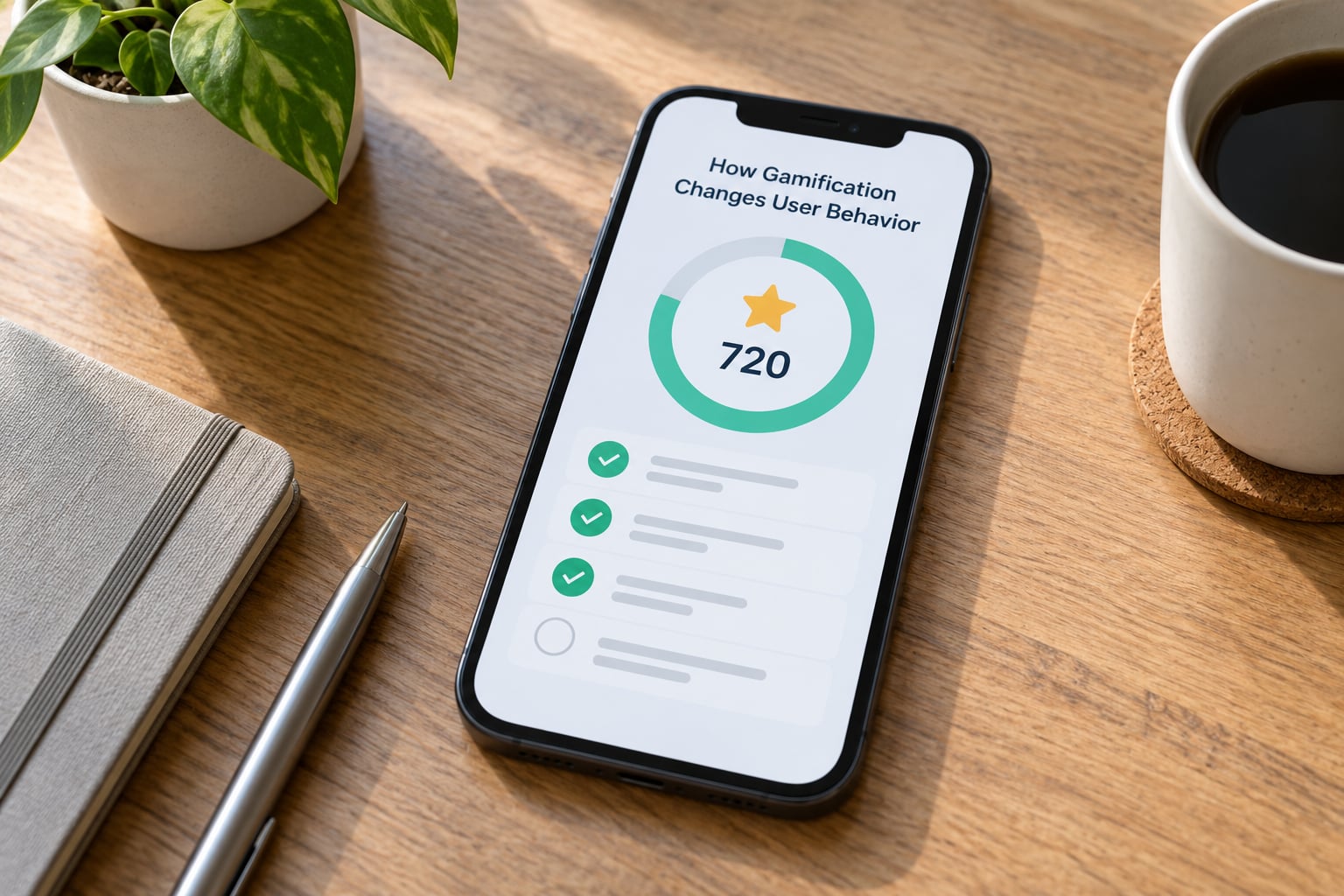
Game mechanics do not create motivation. They reorganise it. What a mechanic provides is structure around a behaviour that was already weakly motivated: a visible goal, immediate feedback, a record of past effort, and in some cases a reason to care what other people are doing.
Goal setting and clear targets help because an unformed intention fades. “Log three workouts” survives a busy Tuesday in a way that “get more active” does not.
Immediate feedback is what keeps the loop closed. Every action produces a visible result within seconds, and that short latency is the reason points and progress bars outperform anything that pays out on a monthly cycle.
Variable rewards work differently from fixed ones. A badge you know you will earn on your fourth run is pleasant and predictable. An unpredictable drop is what pulls people back through an uncertain interval, which is also why the same design pattern shows up in slot machines and in retention screens.
Loss aversion is the sharpest tool and the most misused. A user who has built something over weeks feels the loss of it more strongly than the pleasure of gaining a similar amount, which is exactly why streaks work so well and why punitive resets land so badly.
Social comparison gives solitary activity a witness. Practitioners consistently report that shared mechanics, leaderboards and group challenges convert a private habit into a social one, and that this does more for repeat usage than solo rewards do. The comparison works in both directions: some people are pulled up by a ranking, others are pushed away by it.
Competence and autonomy decide whether the effect lasts. Users want to feel they are getting better at something real, and they want choices inside the system. Mechanics that widen choice keep intrinsic motivation alive. Mechanics that replace it with a single score to optimise tend to hollow it out.
That distinction matters because extrinsic rewards can quietly displace intrinsic ones. Pay people for an activity they already enjoy and, in lab studies on this effect, the interest tends to drop once the payment stops. Apps rarely collapse that dramatically, but the pattern shows up as users who complete rewarded actions and abandon un-rewarded ones.
Which Engagement Metrics Does Gamification Affect?
Here is the honest version of the effects table. The direction of change is well established. The magnitude is not, because most published numbers come from vendors selling the feature and almost none disclose a baseline or a control group, so treat them as directional rather than as something to put in a forecast.
| Metric | Typical effect of adding gamification | How solid is the evidence | What to watch |
|---|---|---|---|
| Onboarding completion | Strong increase when the first-run flow is framed as a short quest | Consistent across vendor case studies, rarely published with a control | Day-1 retention, not just completion rate |
| Daily active users | Rises in the first weeks after launch | Strong short-term, weak long-term | DAU/MAU after week six |
| Session frequency | Clear increase where a daily or weekly loop exists | Strongest and most consistent effect of the bunch | Frequency split by cohort, not blended |
| Session length | Usually rises, and the rise is ambiguous | Weak as a health signal on its own | Task completion inside the session |
| Task or feature completion | Rises when progress is visible | Moderate; depends on whether the task is meaningful | Whether the completed task was the one the user came for |
| Day-7 and day-30 retention | Mixed; improves when the loop matches the product, flat or worse when it does not | The weakest and most overclaimed area | Cohort retention against a non-gamified control |
| Referral and sharing | Rises when status is shareable | Moderate; depends on social mechanics rather than rewards | Invites sent and accepted, not shares |
| Lifetime value | Rises when retention rises, falls when reward cost outruns the gain | Directional only | Cost of rewards per retained user |
The metric most worth watching at each stage changes as the user moves. Early on, activation and onboarding completion tell you whether the mechanic is even understood. In the middle, session frequency and feature adoption tell you whether it is pulling its weight. Late, retention and lifetime value are the only numbers that pay the bills.
Stickiness, calculated as DAU divided by MAU, is widely quoted and rarely interpreted. A high ratio usually means your users come back often, but it can equally mean your app is a narrow tool people open once a week and leave. Read it next to session length and task completion before drawing conclusions.
What Gamification Mechanics Work Best?
Every mechanic trades one thing for another. The useful question is not which mechanic is best but which behaviour you need to move, because the same mechanic can lift retention in a language app and flatten a meditation app.
Points and Badges
Points give an immediate, countable return for every action, which shortens the feedback loop and makes small behaviours feel worth repeating. Badges mark a milestone and give the user something to display or remember. Together they are the cheapest mechanic to build and the easiest to over-use.
The common failure is points that accumulate with no use. A balance nobody can spend is a scoreboard, not a reward, and users notice quickly. The other failure is badge inflation, where forty badges for a routine week means none of them signify anything.
Best fit: early habit formation and onboarding, where you need volume of completed actions rather than depth of attention.
Streaks and Daily Goals
A streak is the strongest single driver of return frequency most apps have access to, because it converts an app from something useful into something with a schedule. The behaviour it produces is genuinely valuable in categories with a daily habit at the centre, like language practice or medication reminders.
It is also the most fragile. Streak loss triggers the strongest negative response of any mechanic, and the design choice of whether a missed day wipes the counter is the whole ballgame. Freeze tokens, grace days and partial-credit models exist for a reason.
Best fit: habits that genuinely belong in a daily rhythm. Poor fit: irregular usage patterns such as travel, shopping or project work, where a broken streak is normal rather than a failure.
Progress and Levels
Progress bars and levels make a long task feel bounded. They show how much is left, they create a sense of movement even on slow days, and they give a structure that scales as the user gets more experienced.
The failure mode is a bar that fills too fast. If a level arrives in a day, users reach the ceiling in a week and then sit at maximum level with nothing left to chase. Slow, well-paced progression is the entire craft here.
Best fit: learning, skill-building and habit apps where the user is genuinely progressing toward something.
Challenges and Missions
Challenges give a bounded goal with a deadline and often a small reward. Missions are the same idea with more structure, sometimes generated per user and sometimes rotated on a schedule.
They work because they convert an open-ended product into a specific plan. They fail through choice overload, or when the same three challenges repeat and users learn that completion no longer requires effort.
Best fit: activation and re-engagement, and any product with enough content to keep the challenge list fresh.
Leaderboards and Social Proof
Leaderboards put a user in relation to other people, and the social element is what converts a private habit into a shared one. Shared group goals work similarly with less exposure, which matters for a lot of products.
Rankings demotivate fast when the top of the board is unreachable. A beginner watching professionals sit above them gets the message that the game is not for them, and many apps quietly remove the leaderboard for exactly that reason. Keeping competition optional and letting people compare against their own past self instead avoids the problem.
Best fit: communities, team features and categories where the user base already has a social identity.
Rewards and Unlocks
Real rewards, whether a discount, a feature or an item, tie the game layer to something the user wants outside the app. This is the mechanic with the strongest link to actual value and also the most expensive to run.
When the reward is valuable enough and rare enough it can hold engagement on its own. When it becomes routine, the reward trains users to expect it, and removing it later causes a churn spike that would have happened anyway, only later and more expensively.
Best fit: loyalty, commerce and subscription products where the reward can be tied to something you already give value for.
When Can Gamification Reduce Engagement?
The failure cases are not edge cases. They show up in almost every app I look at that has shipped more than one mechanic, and they usually present the same way: a spike, a plateau, then a slow decline that gets blamed on something else.
Novelty decay is the big one. A new badge collection gets attention because it is new, not because the behaviour behind it is valuable. Expect the first two weeks to be unrepresentative and judge the mechanic at 60 to 90 days, not at launch.
Punitive streak resets are the most vivid failure. The story practitioners repeat is a user who built a long streak, missed a single day because they were ill, and watched the counter reset to zero. That user does not usually complain about the feature; they quietly stop opening the app. If your streak design has no recovery path, you are running this experiment on your most committed users.
Leaderboard demotivation takes the users who are least confident and pushes them out quietly, which is why a leaderboard can improve average numbers while making the experience worse for beginners. Offer a private or opt-in view, and let people compete with their own history instead.
Artificial scarcity and reward farming create the wrong behaviour. A countdown that resets, or a points system worth farming, teaches users to optimise the reward rather than the product, and the two are rarely aligned once someone looks for the angle.
Notification fatigue is quieter and just as destructive. Badges push alerts, alerts get muted, and a muted user is functionally churned even though the retention curve has not caught up yet.
Too many mechanics at once creates choice overload and a cluttered interface. Four well-designed loops beat twelve, and the twelfth one usually costs you the clarity the first four were built on.
Finally, rewards that compete with the core job. If your app’s value is calm, focus or speed, decorating it with confetti works against the thing that made someone install it. Overjustification is the name for that: reward an activity enough and people start doing it for the reward.
One more distinction worth keeping, since it changes how you read every chart you own: engagement volume is not engagement quality. Sessions that rise while completed tasks stay flat usually mean confusion, not enthusiasm.
How Do You Test Whether Gamification Works?
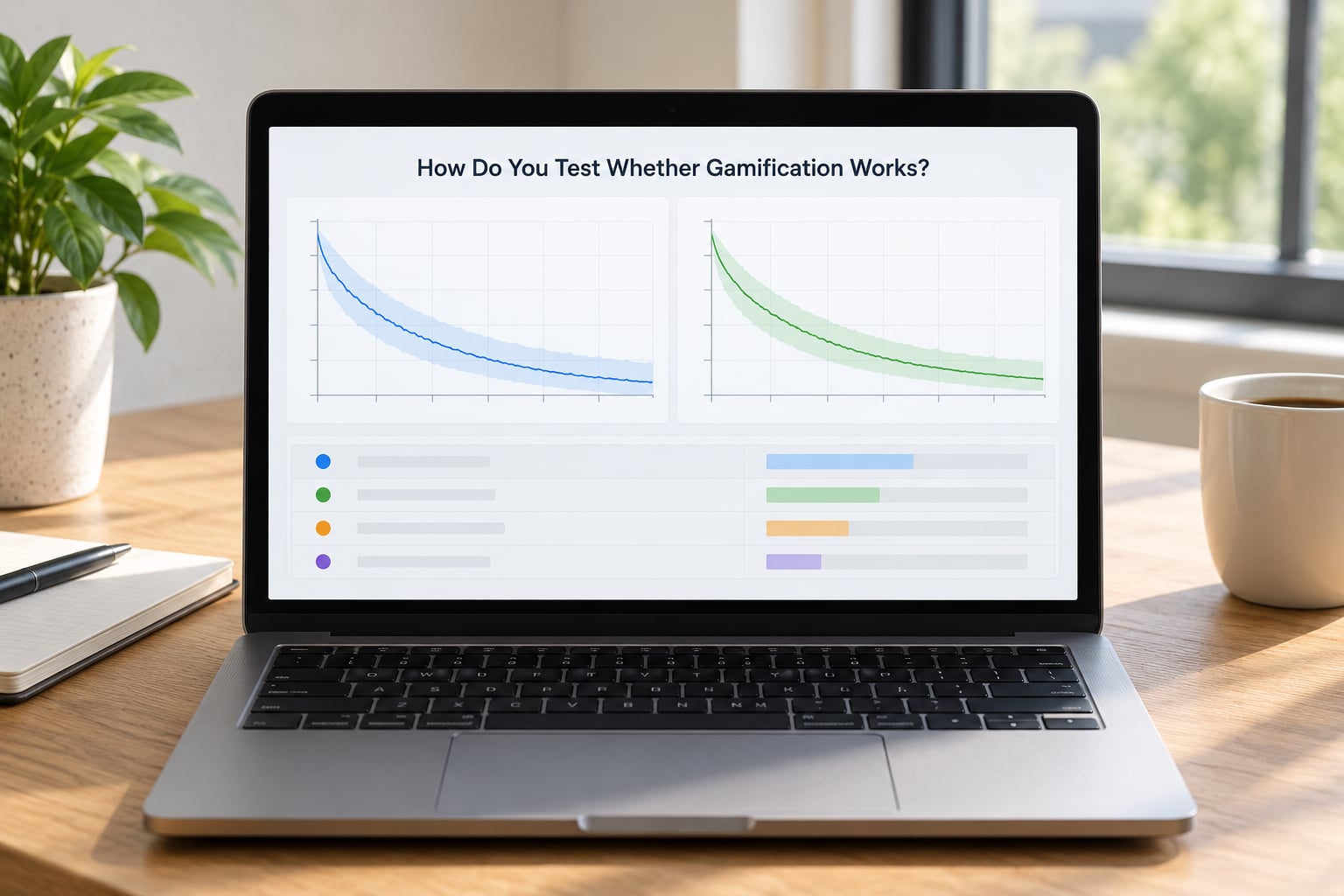
Most teams evaluate gamification by launching it and watching the dashboard, which tells you almost nothing because every metric moves at once for other reasons too. A proper test is not hard, it just takes longer than anyone wants to schedule.
- Define the behaviour. Pick one action, not a feeling. “Users log three workouts in their first week” beats “users find the app engaging.”
- Write the hypothesis. State the metric, the expected direction and the size worth caring about before you look at any data.
- Establish a baseline. You need at least four weeks of pre-launch cohort data, split by channel, or you cannot tell a mechanic apart from a marketing spike.
- Hold back a control. Randomise at the user level, not by device or by campaign, and make sure the control group keeps a usable product rather than a crippled one.
- Run the test long enough to see past novelty. Two weeks measures the spike. Eight weeks minimum is the honest floor; longer if your retention window is monthly.
- Segment before you celebrate. New and existing users, new and experienced players, and by acquisition channel. Mechanic effects are rarely uniform, and an average can hide a group it actively harmed.
- Check statistical significance and practical significance. A result that clears confidence thresholds but moves retention by a fraction of a percent is noise dressed up as a win. Set your minimum effect size first.
- Watch the guardrails. Complaint rates, notification opt-outs, support tickets, unsubscribe rates and any signs that users are spending money for the wrong reasons.
- Decide in advance. Iterate, redesign or remove. Writing the removal threshold down before launch is what stops sunk cost from keeping a mechanic alive.
A note on peeking: checking the results every morning and stopping the moment the chart looks good is the most common way to ship a false positive. Fix the sample size and the end date before you start.
How Should Product Teams Design Gamification Responsibly?
Good gamified design is mostly restraint. The mechanics that hold up longest are the least noisy ones, and the line between engagement and manipulation is easier to cross than most teams assume.
- Attach rewards to value. If the reward marks something the user would want anyway, you are reinforcing a real habit. If it marks a metric nobody cares about, you are manufacturing clicks.
- Keep the rules learnable. Users should be able to explain the system after one session. Hidden rules and surprise penalties destroy trust faster than any missing feature.
- Leave a recovery path. Grace days, freeze tokens and partial credit cost almost nothing and prevent the single worst outcome in the whole category.
- Reward progress, not only speed. Reward the improvement, not just the fastest person in the room, or you select for people who already had the advantage.
- Make competition optional. Let users hide rankings without losing the rewards attached to them.
- Personalise difficulty. Adaptive targets keep the loop meaningful for both a first-week user and someone two years in.
- Disclose what you are doing. Say plainly that a streak exists, what it resets on, and what the app gets from it. Transparency costs a little persuasion and buys a lot of trust.
- Design for accessibility. Timed mechanics exclude users with attention differences, screen readers cannot follow a leaderboard, and colour-coded rarity means nothing to a colourblind user. Any mechanic that only works for a subset is leaving retention on the table.
- Keep privacy intact. Sharing achievements and rankings should be opt-in and never leak another user’s activity.
The dark pattern boundary is fairly simple to state: if the mechanic would make you uncomfortable if a product manager described it out loud to a journalist, redesign it. Manufactured urgency, hidden penalties and reward loops that pull users toward spending money they did not intend to spend all sit on the wrong side of that line.
Frequently Asked Questions
How much does gamification increase app engagement?
Short-term lifts are common and easy to measure: session frequency and daily active users usually rise once a daily or weekly loop exists. Long-term effects are far less predictable, and most published percentages come from vendors without a published control group. Judge any mechanic on 60 to 90 day retention against a non-gamified cohort rather than on the first two weeks.
Are streaks effective for improving app retention?
Streaks are the strongest return-frequency mechanic most apps have, and they work best where the behaviour genuinely belongs in a daily routine, such as language practice or medication reminders. They fail when a missed day wipes the counter with no recovery, because the loss hits your most committed users hardest. Grace days and freeze tokens cost little and prevent the worst outcome.
Do points and badges actually change user behavior?
They do, mainly through immediate feedback. A visible count after every action shortens the feedback loop, which is why points outperform rewards that arrive on a monthly cycle. They work best during onboarding and early habit formation. Points nobody can spend and badges for routine milestones both lose meaning quickly, because a large number of badges signals that none of them matter.
How long should an app gamification A/B test run?
At least eight weeks for most retention mechanics, because two weeks measures novelty rather than durable effect. You need four weeks of pre-launch baseline data, a randomised control group that keeps a usable product, and a fixed sample size decided in advance. Check results on a schedule rather than daily, and write your removal threshold down before launch.
When is it better to remove gamification from an app?
Remove it when the mechanic no longer changes behaviour, when its retention lift disappears after 90 days, or when it actively pushes people toward actions they did not intend to take. A quick test is to imagine deleting the reward layer tomorrow and asking whether anything you care about would change. If the honest answer is no, the mechanic is decoration and the complexity it adds is not earning its place.
Conclusion
The chain that holds up to scrutiny runs mechanic, psychological driver, metric moved, durability. Progress and immediate feedback lift frequency. Loss aversion and social comparison lift return probability. Retention only moves when the reward sits on an action the user already values, and durability decides whether the effect survives past the novelty window.
Where the evidence is strong: session frequency, daily active users, onboarding completion, immediate feedback. Where it is directional at best: day-30 and day-90 retention, lifetime value, and every percentage quoted in a vendor case study.
Start with one meaningful behaviour, map it to one mechanic, and run it against a control cohort long enough to see past the first two weeks. Watch retention and one quality metric, not just sessions, before you build the second mechanic on top of it.