
Framing a message changes consumer response because people judge what they read against whatever reference point the words set up. Describe the same fact as a gain and you get one reaction; describe it as a loss and you get another, with no change to the underlying facts. The framing effect is well documented in consumer psychology, which is why copywriters test phrasing rather than assume the offer is what sells.
That is the whole idea in two sentences, but the useful part is knowing which frame fits which decision, where the ethical floor sits, and how to test a frame without fooling yourself.
Table of Contents
- What Is Message Framing?
- How Does Framing Change Consumer Response?
- How Framing a Message Changes Consumer Response
- Common Framing Techniques and When to Use Them
- Examples of the Same Message Framed Differently
- A health-conscious food product
- A shopping offer
- A public service campaign
- A subscription
- A B2B offer
- Positive Framing and Negative Framing: Which Works Better?
- Ethical Framing vs. Deceptive Framing
- How to Choose and Test a Frame
- Frequently Asked Questions
- What is framing in consumer psychology?
- Is positive framing always more effective than negative framing?
- Can message framing manipulate consumers?
- What is the difference between framing and selective presentation?
- How can a marketer test which message frame works best?
- Does message framing work across different cultures?
- Conclusion
What Is Message Framing?
Message framing is the practice of presenting the same underlying information through a different lens, using different words, emphasis or context, so that consumers interpret it differently and respond differently as a result. Nothing about the facts has to move. Only the presentation does.
The cleanest illustration is the one a lot of customer feedback programs use. If a survey asks whether you are satisfied with our service and only 90 percent say yes, that reads as a fairly ordinary business. If the same survey instead asks about the 10 percent who were not satisfied and gets a comment about how the reply happened, the same underlying data now reads as an urgent problem. Both numbers are correct. The response you get depends on the window you show.
One distinction worth making early, because people search for it constantly: this is not Goffman’s framing theory. Erving Goffman wrote about frame analysis in sociology, where a frame is the interpretive structure a situation is organized around. Message framing borrows the word but lives in decision research and advertising, and it operates on the wording of a single message rather than on the meaning of a whole situation.
How Does Framing Change Consumer Response?
Framing changes consumer response through a small set of documented mechanisms, and they stack. The most important is reference dependence: people evaluate outcomes against a baseline, and the frame decides which baseline gets used.
Prospect theory, set out by Tversky and Kahneman in 1979, is why that matters. In it, losses weigh roughly twice as heavy as a gain of the same size. So a message that puts the reader’s attention on what they stand to keep pulls one way, and a message that puts it on what they stand to lose pulls the other, even when nothing changed except the sentence.
Four other mechanisms sit on top of that one:
- Attribute salience. A frame highlights one feature and pushes others out of view. Leading with battery life and saying nothing about weight makes weight stop being a comparison criterion.
- Goal orientation. Promotion frames ask people to think about gains, prevention frames ask them to think about avoiding a loss, and the two pull on different kinds of behaviour.
- Risk perception. The identical option can read as cautious or bold depending on whether the surrounding words imply safety or speed.
- Elaboration. When people have the motivation to think, they scrutinize the argument. When they do not, they take the frame itself as the message, and it sticks harder because it was never argued.
How Framing a Message Changes Consumer Response
The sequence runs in three steps, and it repeats every time someone reads your copy. First, attention: the frame picks which feature or consequence enters the reader’s head at all. Second, interpretation: the reader places that fact against the reference point the frame supplied. Third, response: an emotion or a behaviour follows from that reading, not from the raw fact.
The practical consequence is that a frame acts upstream of persuasion. Change the first step and the third step moves without your having made a stronger claim, which is exactly why framing feels cheap to some marketers and like lying to others.
Common Framing Techniques and When to Use Them
There are eight framing moves that account for most of what marketers actually do. Each carries a different risk, and the caveat column is the part to read twice.
| Technique | Underlying message | Use it when | Likely response | Ethical caveat |
|---|---|---|---|---|
| Gain framing | What you get | New products, low involvement, upbeat brand voice | Approach and aspiration | The gain has to be real and reachable |
| Loss framing | What you avoid losing | Prevention, health, security, compliance | Caution and protective action | Do not invent a threat to sell a product |
| Attribute framing | One feature, up front | Differentiated specs in crowded categories | Attention on that attribute only | Omitting the trade-off is deceptive once it is material |
| Time-horizon framing | Short term or long term | Subscriptions, savings, durability, health habits | Different patience, different commitment | Long-horizon claims need to survive contact with real use |
| Social proof framing | Others already chose this | Unfamiliar categories, unfamiliar brands | Lower perceived risk | Counts have to be accurate and current |
| Goal framing | Detect a problem or prevent one | Testing, monitoring, insurance, care | Detection drives action, prevention drives routine | Severity claims need sourcing |
| Choice framing | Defaults, bundles, limited sets | Plans, menus, checkout flows | Fewer decisions, easier default | A default that hides cost or data use is a dark pattern |
| Question framing | Ask rather than tell | Subject lines, headlines, research instruments | Curiosity or irritation | Loaded questions skew answers and reviews |
Examples of the Same Message Framed Differently
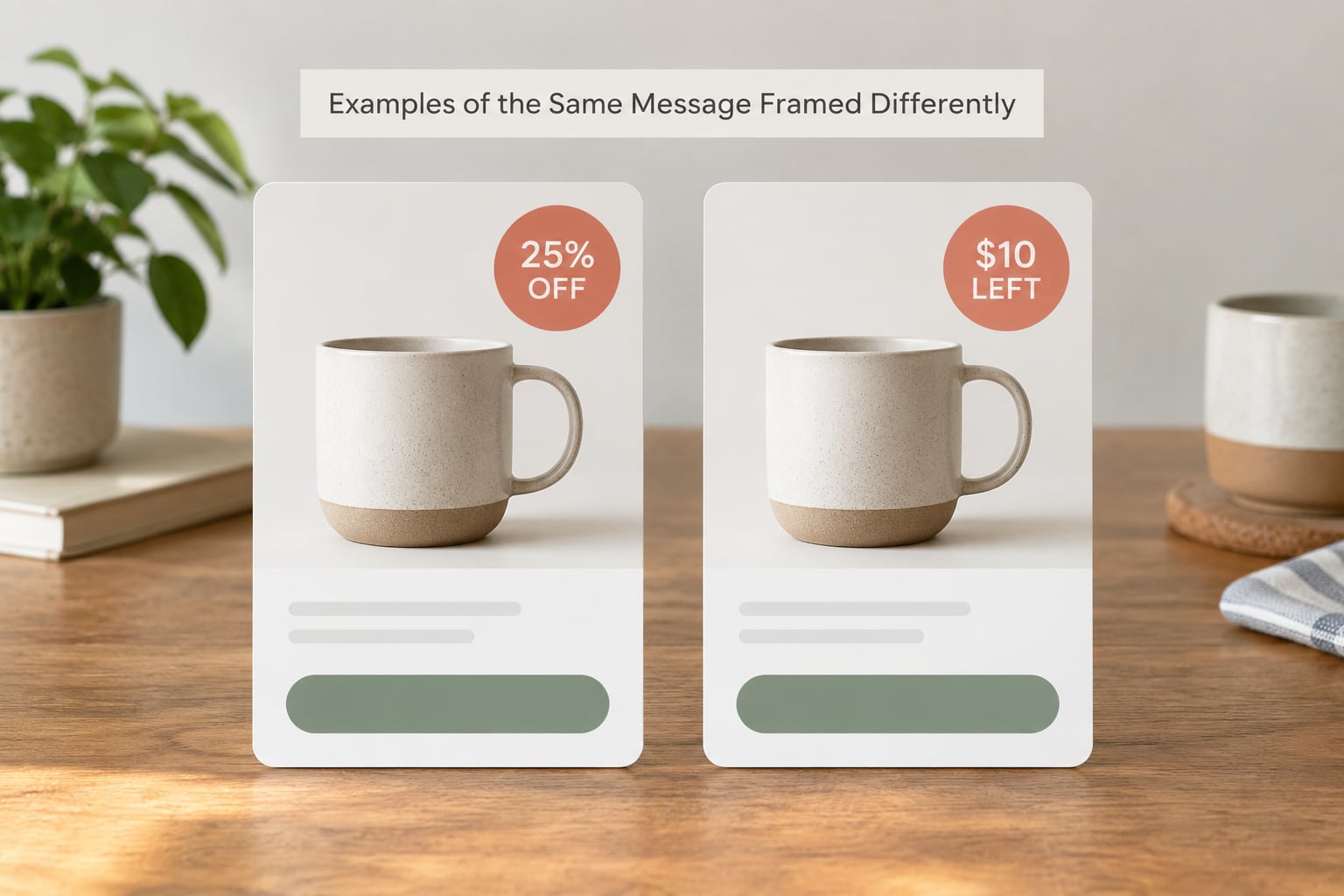
In each pair below the offer is identical. Only the wording changes, and the likely reading changes with it.
A health-conscious food product
Version A: High in fibre, with no added sugar.
Version B: Everything you look for on a label, nothing you have to compromise on.
Version A gives two checkable facts. Version B gives a feeling that cannot be verified from the pack, which is why it travels well in a caption and poorly in a spec sheet.
A shopping offer
Version A: 50 percent off everything this week.
Version B: Half your order is already paid for.
Both describe the same reduction. The second anchors it to what the shopper has already committed, which is why per-order value framing tends to sit better on a cart that is not empty.
A public service campaign
Version A: Most people smoke because they started young.
Version B: Smoking still kills more people than any other preventable cause in this country.
The first builds solidarity and a sense of normality. The second builds urgency. Health agencies often run both deliberately, spaced apart, because they produce different actions.
A subscription
Version A: Cancel whenever you want.
Version B: Keep it for a full year and save 20 percent.
The first reduces perceived risk at signup, which matters most for a new brand. The second raises commitment and average lifetime, and works better once trust already exists.
A B2B offer
Version A: Save 15 percent on your first year.
Version B: Cut the manual reporting hours your team spends every month.
The percentage version talks about money and gets compared against other vendor quotes. The hours version talks about the buyer’s actual problem and tends to survive contact with procurement.
Positive Framing and Negative Framing: Which Works Better?
Neither wins by default. Positive framing tends to work when the audience has low involvement and no strong prior belief, and negative framing tends to work when the audience is already motivated and the cost of inaction is real and concrete.
The classic finding is a behaviour split inside a single person. Loss framing pushes detection behaviour: screening, checking, inspecting. Gain framing pushes prevention behaviour: maintaining an existing good state. Both are appropriate, just not to the same person at the same moment.
Involvement is the moderator that matters most in practice. Maheswaran and Meyers-Levy showed in 1990 that personal relevance changes which frame survives scrutiny; Levin and Gaeth in 1988 showed attribute framing behaves differently again when the product is unfamiliar rather than familiar. High-involvement audiences also process the source of the message, so a weak claim in a strong frame gets discounted faster than it would in a neutral one.
The cleanest counter-example is recent. A 2025 study of consumer preferences for gene-edited food, published in the Canadian Journal of Agricultural Economics, found both frames reduced aversion and the gain frame carried the stronger effect, the opposite of the usual expectation for a risk topic. Framing is a moderator, not a switch.
Ethical Framing vs. Deceptive Framing
Ethical framing selects a true emphasis. Deceptive framing selects an implication the facts do not support. The distinction is not how clever the wording is, it is whether the reasonable reader who reads only your version would be misled.
Five patterns cross the line:
- Accurate emphasis. True, complete, and the reader still gets the full picture. Fine.
- Selective disclosure. Every sentence is true, but a material cost, limit or condition is buried where nobody will reach it.
- False equivalence. Implying that two things are comparable when the comparison only holds because a relevant dimension has been removed.
- Exaggerated urgency. A deadline that is real but manufactured, or a scarcity claim that describes the present moment rather than the actual stock of the thing.
- Technically true, materially misleading. The most common one. A per-unit price that hides the total, or a percentage that flatters only because the base was inflated.
Before anything ships, run four checks: is every claim factually checkable, is the missing context material, is the balance the frame creates proportionate, and can you evidence the comparative claim. Then apply the side-by-side test. Would you be comfortable if the customer saw your framed version and the neutral version next to each other? Practitioners who get this wrong usually describe something as a strategy when it is only defensible as a tactic.
How to Choose and Test a Frame
Choose the frame from the decision, not from the list of tricks. A seven-step method that holds up:
- Name the decision. One specific choice by one specific audience, written as a sentence. Ambiguity here invalidates everything downstream.
- Identify the reference point they already hold. What are they comparing you to, and what do they currently believe about that comparison?
- Pick exactly one frame. Two frames at once reads as noise and you will not learn which element did the work.
- Write a neutral control. Same facts, plainest possible wording, no emphasis. Without this you cannot attribute anything.
- Define the behaviour before you run it. Click, add to cart, start trial, reply. Decide the primary metric and the minimum effect that would matter to your business.
- Test comprehension alongside action. Ask a control group to restate the offer. If comprehension does not move, a conversion difference is noise, not framing.
- Check subgroups and deploy. Split by involvement, existing customer or prospect, channel. Roll out only where the frame holds up and trust indicators such as complaints and unsubscribes are flat.
Two practical cautions. Keep the copy identical apart from the frame, because bundling a headline rewrite with a frame change is the most common reason teams conclude that psychology does not work. And give the test long enough to cover at least one full buying cycle for the product, since B2B and considered purchases do not behave like an afternoon of web traffic.
Frequently Asked Questions
What is framing in consumer psychology?
Framing in consumer psychology is the tendency to evaluate the same information differently depending on how it is presented. When the facts stay constant and only the wording, emphasis or reference point changes, the response can still shift in measurable ways. The effect is best explained by prospect theory: people judge outcomes against a reference point, and losses tend to weigh more heavily than equivalent gains.
Is positive framing always more effective than negative framing?
No. Positive framing tends to work well for low involvement purchases, new products and upbeat brand voices, while negative framing works better when the cost of inaction is real and the audience is already motivated. Within one person, gain frames tend to encourage prevention behaviour and loss frames tend to encourage detection behaviour. A 2025 gene-editing study even found the gain frame performed strongly on a risk topic.
Can message framing manipulate consumers?
It can, which is why the practice has an ethical side. Framing decides which reference point a reader uses, so it shapes evaluation before any argument is made. That influence is ordinary and unavoidable in all communication. What is manipulative is using it to create an implication the facts do not support, such as a manufactured deadline or a buried material cost.
What is the difference between framing and selective presentation?
Framing chooses a lens for information you do present and is ethical when every claim is accurate and the omission is not material. Selective presentation keeps some relevant information back in order to steer the conclusion, which becomes deceptive once a reasonable reader would have decided differently had they seen it. The practical test is whether you would be comfortable showing the framed and neutral versions side by side.
How can a marketer test which message frame works best?
Pick one frame, write a neutral control with identical facts and no emphasis, and change nothing else. Define the target behaviour and the minimum effect worth acting on before the test starts. Measure comprehension alongside the conversion metric, run the test for at least one full buying cycle, then split results by involvement and channel. Bundling a copy rewrite with a frame change is the usual reason frame tests appear to fail.
Does message framing work across different cultures?
Partly. The mechanism is general, because reference dependence and loss sensitivity are widely shared, but the strength varies. Risk preference, uncertainty avoidance and communication norms all shift how readily a loss frame is accepted rather than resented. Testing frames separately in each market beats importing a frame that won elsewhere, and a frame that reads as care elsewhere can read as pressure somewhere else.
Conclusion
Framing works because interpretation depends on context, and the frame is the context. Wording decides which reference point a reader uses, which decides how the fact feels, which decides what they do next.
Start with the audience’s actual decision, not with a list of techniques. Pick one frame, keep every claim true, and test it against a neutral control before you believe it did anything. If the framed version survives the side-by-side test and holds up across your subgroups, deploy it. If it does not, you learned something worth more than the click.