The halo effect is a cognitive bias in which an overall impression of a product, brand or person bleeds into judgments of individual attributes that were never actually evaluated. One positive signal pushes every score upward; one negative one drags them down. That is how how the halo effect distorts product ratings becomes a data problem, not just a quirk of individual reviewers.
It matters because a halo-contaminated rating is not random noise. It leans in a predictable direction, aggregation hides it, and shoppers trust the resulting average precisely because a number looks objective.
If you have ever read a five-star review that praised nothing specific, or a three-star review that spent its length criticising the manufacturer rather than the product, you have already seen the bias at work. This guide covers the mechanism, the four pathways it travels, the statistical fingerprint it leaves in rating data, and a set of checks you can apply to any listing before you trust it.
Table of Contents
- What Is the Halo Effect in Product Ratings?
- How is halo different from just liking something?
- How the Halo Effect Distorts Product Ratings
- What halo does to the statistics of a rating
- What Makes Consumers Apply the Halo Effect?
- How Does the Halo Effect Change Ratings Over Time?
- How Can You Tell Whether a Product Rating Is Skewed?
- How Can Researchers Reduce Halo Bias in Ratings?
- How Does the Halo Effect Differ From Other Rating Biases?
- Frequently Asked Questions
- Does a high average product rating prove that the halo effect is present?
- How can a brand reduce halo bias without changing the product itself?
- Should online reviews be treated as objective product measurements?
- What is the difference between the halo effect and the horns effect in ratings?
- How do researchers measure halo bias in survey data?
- Can attractive packaging or a familiar brand affect a product’s perceived quality?
- Conclusion
What Is the Halo Effect in Product Ratings?
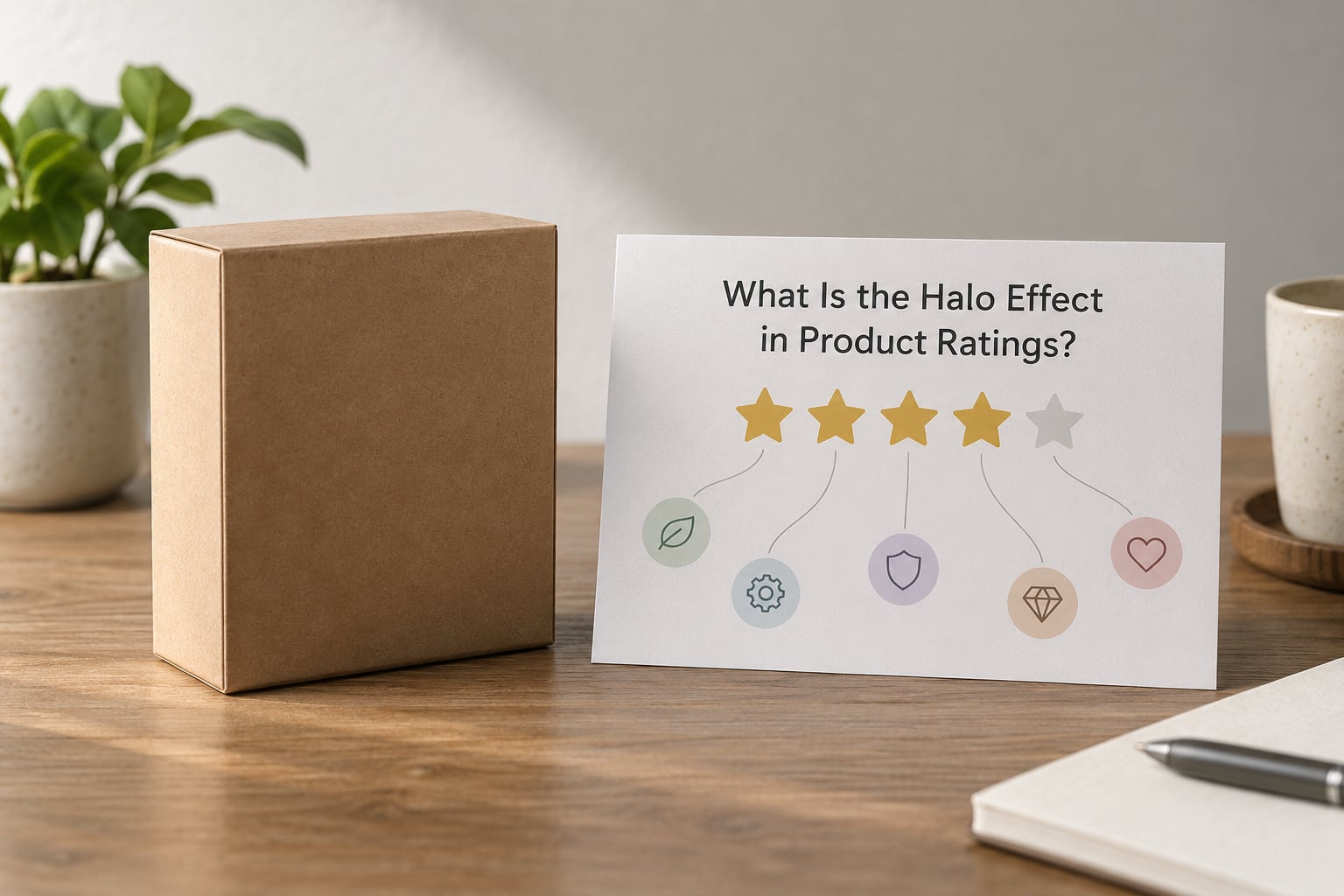
The halo effect is the mind’s habit of letting a general feeling about something stand in for a specific judgment it has not made yet. You did not test the battery life. You did not compare the noise floor against a competing pair. What you did notice was that the box looked considered, the brand name is one you recognise, and the listing photo is good. That global impression then fills the gap for every attribute you skipped.
Psychologist Edward Thorndike named it in 1920 while studying army officers, describing a pattern he called the error of constant readiness: officers rated highly on one physical or character trait tended to receive high marks on unrelated ones. The finding stuck because the mechanism is cheap. Assessing one attribute costs effort; accepting a ready-made impression costs nothing.
Two phrases do most of the explaining here. An implicit attribute is one the rater never consciously assessed but scored anyway. A global affective judgment is the fast overall feeling that gets substituted for the missing evaluation. Halo is the transfer between the two.
Worth separating from two things that look similar. Ordinary review variation is noise: two people notice different things and describe them differently, with no shared direction. A genuine quality difference means the product really is better on that attribute, and it will show up for raters who have no prior impression to import. Halo is specifically the case where the score tracks the carrier — the brand, the packaging, the price, the first review — rather than the thing being scored.
How is halo different from just liking something?
Liking is legitimate. A well-made product deserves a good score, and enjoyment is real evidence. Halo enters when a positive feeling about something unmeasured leaks into a score for something measured. The tell is that the rating moves without new information, and moves the same way on attributes the rater could not have observed.
How the Halo Effect Distorts Product Ratings
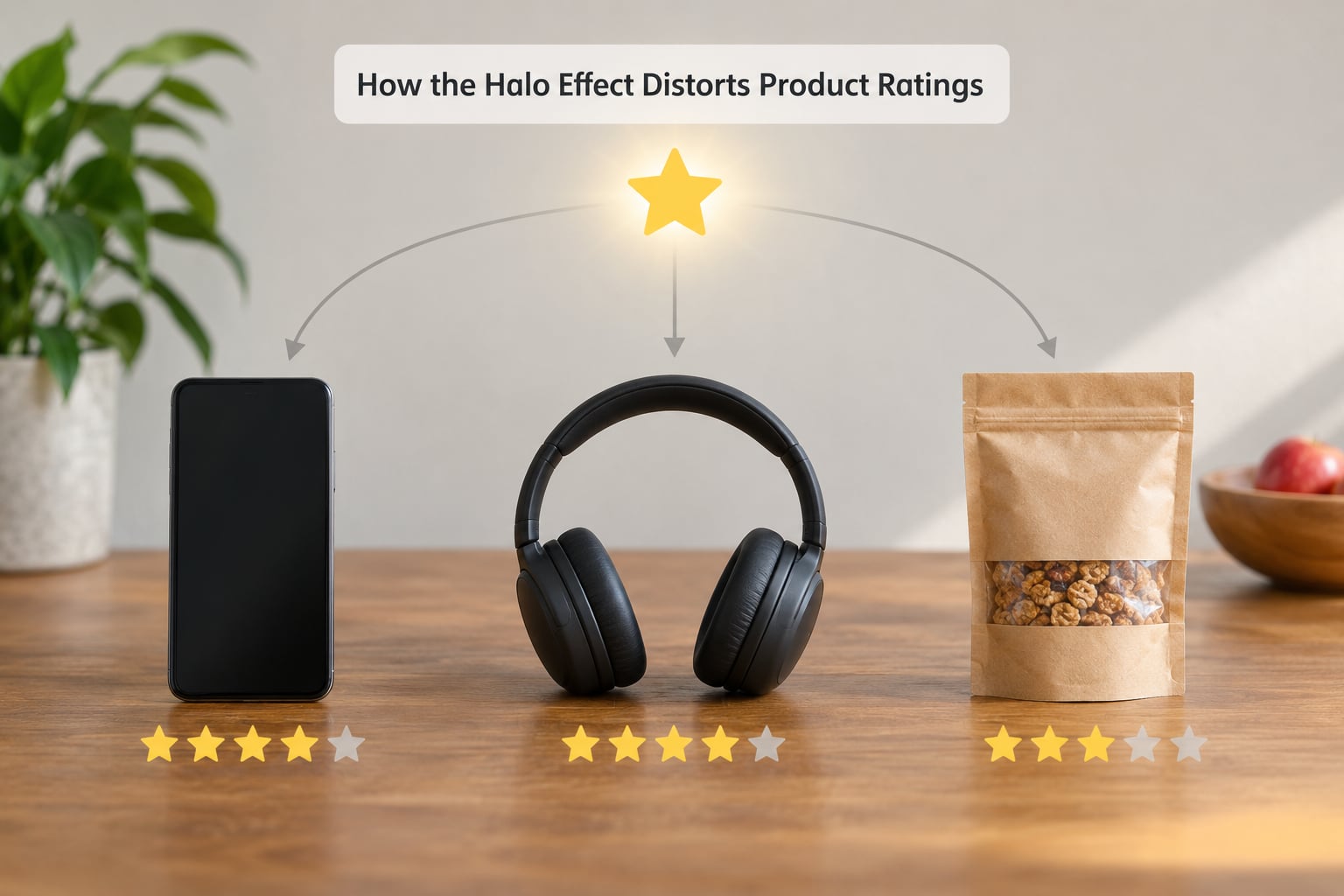
Understanding how the halo effect distorts product ratings comes down to four transfer pathways. Each has a different carrier, and each leaves a different trace in the numbers.
| Pathway | What carries the halo | Which rating moves | Direction | Worked example |
|---|---|---|---|---|
| Global impression carryover | The rater’s overall feeling, formed before any attribute scoring | Every attribute, including unmeasured ones | Up or down, following the feeling | A reviewer rates a slow kettle five stars and never opens the temperature-control section |
| Flagship spillover | A brand’s best-known or best-received product | Ratings of newer or lesser-known siblings | Usually up | A second device from a premium brand starts life at four stars before any hands-on review exists |
| Packaging to quality | Design, weight, materials, legibility of the label | Judgments about performance and durability | Usually up | A well-designed supplement bottle lifts the rating of the formula inside it |
| Premium price signal | The price itself, treated as a quality cue | Expected and reported quality | Up | A higher-priced variant scores better in blind comparisons when raters are told the price |
The packaging and price pathways are the ones people argue about most, and for good reason: they are treated as information. A heavier glass bottle or a stiffer carton really can signal better materials. The problem is not that the signal is wrong. The problem is that raters use it as a substitute for testing the attribute in question.
What halo does to the statistics of a rating
Four effects show up in aggregate data, and they matter more than any single odd review.
Compressed variance. Halo pulls independent attribute scores toward one another. When real differences between products shrink, ratings bunch in the middle-to-high range and the scale stops discriminating between a good product and a very good one. Research on rating scales in language testing found the halo tendency reduces reliable variance in single-hearing scales by roughly three percent, which sounds trivial until you realise the point: the loss is systematic, not random.
Inflated means. Because the pull is mostly upward in consumer settings, average ratings drift higher than the underlying attribute scores justify. Star averages bunch in the four-to-five region and the midpoint of the scale empties out.
Weakened inter-rater reliability. Halo-contaminated raters agree more for the wrong reasons. They share a brand prior, not a measurement, so the agreement reads as consistency to anyone checking the numbers. Sahoo and Callan’s 2012 work on multicomponent ratings showed how overall impressions contaminate the component scores that are supposed to measure distinct things, and Lance’s 1990 examination of negative halo error showed the reverse case: a single low global impression dragging attribute scores down and breaking the expected accuracy pattern.
Review text that does not match the score. When halo drives the number, the written review tends to justify rather than describe. Look for five-star reviews that praise the brand, the delivery or the packaging and stay vague about the product itself. That mismatch between score and content is one of the more reliable surface signals.
What Makes Consumers Apply the Halo Effect?
Five triggers account for most of what you will see in the wild.
Brand familiarity. Recognition lowers the cost of the global judgment. A name you have seen on a shelf for years produces a settled feeling faster than an unfamiliar one, and that settled feeling is what gets carried into the attribute scores. Practitioners describe exactly this when a lesser-known model from a premium brand is assumed to be premium simply by being on the same product line.
Processing fluency in design. A package that reads clearly, uses balanced spacing and has an obvious hierarchy feels easier to process. That ease is registered as quality. The rating moves even though nothing about the contents changed.
Prestige and social proof. A large review count and a stream of five-star ratings function as evidence rather than as the thing being evaluated. On marketplaces the effect is sharper because the rating sits right next to the purchase decision.
Ambiguous or multidimensional products. The more attributes a product has, the more chances to skip one, and the more opportunities for the global impression to fill in. A single-attribute product gives the rater nowhere to hide. A supplement with fifteen label claims gives them plenty.
Speed of the decision. Fast, automatic judgement draws more heavily on the global impression than slow deliberate comparison does. The same shopper who compares carefully in a shop will rate on autopilot at home.
The health halo makes the point neatly. Labelled a high-protein item, a food tends to be judged as more healthy overall by raters who did not check the rest of the panel. The bias is operating on interpretation of attributes, not on simple liking.
How Does the Halo Effect Change Ratings Over Time?
Ratings are a sequence, and the halo grows a memory.
The first reviews set an anchor. Later raters see an average, infer that the product is at least that good, and rate accordingly, which pushes the average further. On a thin-volume listing the effect is dramatic: two or three reviews carry the whole average, and if those early reviewers were haloed by the brand or packaging, the listing starts from an inflated base that new evidence erodes slowly or not at all.
Order matters too. Raters who see a wall of identical five-star reviews before they read any text have already formed a position, and the text is interpreted to fit. The most helpful reviews are often the ones buried below the fold and read out of order.
Time can cut the other way as well. A recall, a safety notice or a widely reported failure collapses a listing, and the negative halo spreads just as efficiently across attributes the reviewers never tested. The pattern looks identical in the data, which is why direction alone does not tell you whether a score is trustworthy.
The countervailing force is real experience. Once a product has been used for months, the global impression tends to be rebuilt from actual performance, and the halo weakens. That is why the earliest reviews in a product’s life carry less weight than the accumulated record does.
How Can You Tell Whether a Product Rating Is Skewed?
Five warning signs, in rough order of how often they show up.
1. High average, vague features. The overall score is strong while per-component feedback is thin or unremarkable. Where honest attribute-level feedback exists and disagrees with the average, trust the attribute scores.
2. Stars and component scores diverge. A four-and-a-bit overall average sitting above component ratings is the signature of a global impression carrying more weight than the measurements.
3. Scores track brand cues more closely than experience. Newer or less-known products from a strong brand open high. A listing whose rating sits well above what its age, volume and detail would predict has probably been carried by a prior.
4. Very little review text. One-line reviews that name the brand rather than the product usually encode a halo, not an assessment.
5. Ratings cluster with no middle. A bimodal-looking set of complaints buried under a high average is the review-platform version of the compressed-variance problem: real disagreement exists, but the aggregate smooths it away.
One honest caveat. Prior experience is legitimate evidence. If a brand has served you well three times, treating the fourth product cautiously is not a bias error, it is a rational update from a real track record. Halo distortion is when the prior overrides evidence you actually have in front of you, or stands in for evidence you never gathered. On forums, reviewers describe this accurately when they talk about their tendency to hope for the best on a brand that has previously let them down.
How Can Researchers Reduce Halo Bias in Ratings?
If you design rating instruments, most of the damage is avoidable at the questionnaire stage.
Collect attribute ratings before the global one. Ask for component scores first and the overall score last. The sequence matters: a global rating given first becomes the anchor for every item that follows.
Randomise attribute order. Fixed ordering lets the first item contaminate the rest consistently across respondents, which is the worst case for both bias and variance.
Mask the carrier. Where the study permits, hide brand identity or use unbranded stimulus material. It is blunt and it reduces ecological validity, but it is the cleanest way to separate the product from its reputation.
Use behavioural rather than recalled measures. Completion time, willingness to continue in a task, or a choice made under constraint carry less halo than a self-report star, because they are harder to fake in the direction of the prior.
Force specification. Require raters to say what happened before asking how good it was. Open-ended experience descriptions placed ahead of the closed scale pull the rating back toward observed evidence.
Measure and report it rather than assuming. Flag respondents whose overall score departs sharply from the mean of their own attribute scores, inspect those cases, and report inter-rater reliability alongside average ratings. A scale with a high mean and a low reliability is telling you about its raters, not its products.
Marketplace moderators face the same problem in a harder form: reviews arrive carrying context the platform cannot remove. Flagging, weighting by review history and separating verified-purchase text from headline scores are the available levers.
How Does the Halo Effect Differ From Other Rating Biases?
Several biases show up in rating data. Knowing which one is operating tells you what to fix.
| Bias | Mechanism | Typical trigger | Direction | What reduces it |
|---|---|---|---|---|
| Halo effect | Global impression substituted for unmeasured attributes | Brand, packaging, price, prestige | Usually up | Masking the carrier, attribute-first scoring |
| Horns effect | One negative trait contaminates unrelated scores | Failure, recall, poor service, bad review | Down | Same instrument changes as the halo |
| Central tendency | Raters avoid scale extremes regardless of evidence | Scale design, discomfort with absolutes | Toward the middle | Forced-choice items, anchored scales |
| Recency bias | Most recent experience outweighs the rest | A recent order, a recent contact | Both | Asking for the full usage period |
| Popularity bias | Existing volume or rank is read as quality | Sort order, review count | Up | Randomising display order, hiding counts |
| Satisficing | Raters satisfy the task rather than perform it | Survey length, fatigue, low stakes | Any | Attention checks, shorter instruments |
| Confirmation bias | Evidence is read to support a position already held | Prior belief about the brand or claim | Both | Pre-registering expectations, blind analysis |
| Affect heuristic | Emotional reaction substitutes for reasoning | Appeal of the product or its presentation | Usually up | Slow, attribute-first tasks |
Confirmation bias and the halo often overlap. The difference is direction of travel: the halo transfers an impression into attributes that were not evaluated, while confirmation bias filters the evidence that does exist to protect an existing position. A dataset can show either one alone.
Frequently Asked Questions
Does a high average product rating prove that the halo effect is present?
No. A high average has many causes, and a genuinely excellent product produces one honestly. The halo shows up in the gap between the score and the evidence: strong overall numbers sitting above thin or mixed attribute-level feedback, reviews that praise the brand rather than the product, and variance compressed toward the high end. Judge the process, not the number.
How can a brand reduce halo bias without changing the product itself?
You cannot remove the halo from ratings you do not control, but you can stop feeding it. Ask reviewers for attribute-level detail before an overall score, keep the request neutral about the brand, encourage reviewers who disliked the product to write too, and report component scores alongside the average. The last one matters most, because it makes the aggregate interpretable.
Should online reviews be treated as objective product measurements?
Treat them as self-selected impressions rather than measurements. Reviewers are not a random sample; they are people with motives, a brand prior and a mood at the time of writing. Reviews are good evidence about how a product feels, weaker evidence about how it performs on a given attribute, and nearly useless as numbers until you know how they were collected.
What is the difference between the halo effect and the horns effect in ratings?
The halo is the upward transfer, where one strong positive trait lifts ratings of attributes the rater never assessed. The horns effect, sometimes called negative halo, is the mirror image: one salient failure drags unrelated scores down. Both distort the same way mechanically, which is why a collapse after a recall looks statistically identical to an inflation after a redesign.
How do researchers measure halo bias in survey data?
Compare each respondent’s overall rating with the mean of their own attribute ratings. A systematic positive gap indicates halo, a negative gap indicates horns. Researchers also check whether overall scores correlate with a brand familiarity measure more strongly than with measured performance, and they report inter-rater reliability, which falls when raters agree through shared priors rather than shared evidence.
Can attractive packaging or a familiar brand affect a product’s perceived quality?
Yes, and it is one of the better-documented pathways. Clear design and heavier-feeling materials register as easier to process, which reads as quality, and the rating follows before any attribute is tested. A familiar name does the same job at a distance. The effect survives even when raters know the cue is unreliable, which is what separates it from a deliberate deception.
Conclusion
Before you treat any star average as a measure of quality, do one thing: open the attribute-level feedback and read the one or two most recent negative reviews. If the components do not support the headline, you are looking at the halo effect doing exactly what it does, moving scores without adding evidence. The number is not wrong because it is high or low. It is unreliable because you cannot tell what it is standing on.