Payment timing is simply when money actually changes hands relative to when you get the thing: upfront, in installments, after delivery, on a recurring billing date, or quietly in the background. Learning how to use payment timing to reduce purchase pain means stretching that gap on purpose, so a big number stops arriving at the exact moment you are already nervous about it.
The discomfort of paying is real, and it behaves oddly. It spikes at the moment of transfer, then fades as the purchase recedes into the background. Anything that moves the money, changes when that spike lands.
One warning before we start. Everything below is general information about how spending and payment timing work. Rates, consumer protections and payment rules differ by country and change over time, so check the terms that apply where you live. Nothing here is personal financial advice.
What You Need
Before you shift a single date, you need four things in front of you. Miss one and the rest of the process turns into rearranging your own anxiety.
The total price, all in. Not the headline figure. The amount after interest, fees, shipping, taxes and any optional extras you will be tempted to add. Payment timing only works honestly when the number you are delaying is the number you would owe anyway.
The payment options that actually exist. Full payment now, a deposit, a plan with a stated number of payments, a charge after delivery, a subscription renewal. Ask for the schedule in writing before you commit to any of them.
The dates that constrain you. A promotional price with an end date, a quote that expires, a return window, a price-protection promise, a seasonal deadline. A delay that pushes you past one of these is not a considered decision, it is a lost deal.
A budget you already trust. Your fixed costs, what clears before your next income, and a buffer you refuse to touch. This is the number the whole exercise is protecting.
Interest rates, consumer protections and payment rules vary by country and change over time, so treat any schedule you are handed as a snapshot. Read the terms on the day you sign, not on the day you browse.
Step-by-Step
Seven steps. Each one has an action, a safeguard that keeps it honest, and a signal that tells you it worked.
1. Define the amount you can genuinely afford
Write down what clears after fixed costs and after the buffer, before anything from this purchase goes out. That figure is your ceiling and it is not negotiable in the moment.
The safeguard: the number comes from your accounts, not from your optimism. A common trick is to calculate affordability from the full amount while planning the payment on a schedule that quietly spreads the pain. Separating those two thoughts is most of the work.
The success signal: you can state your maximum out loud and it does not make you wince. If it does, the purchase is a wish, and the honest move is to let it go.
2. Choose the right moment to commit
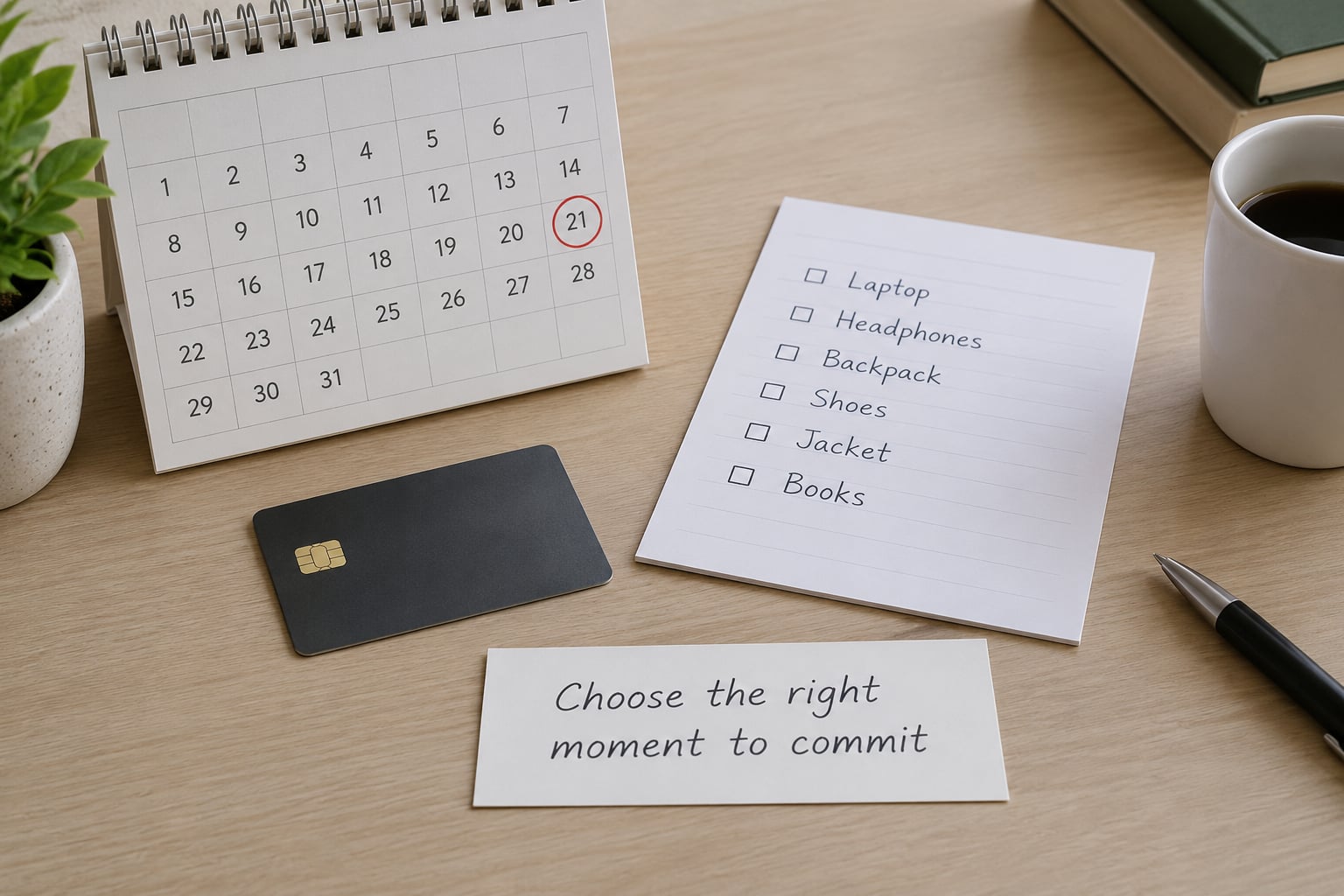
Decide, in advance and in writing, that you will not commit before a set date. Write it where you will see it. A cooling-off period works because it moves you out of the emotional moment and back into ordinary thinking.
The safeguard: the wait has to be a real interval you chose, not pressure manufactured to hurry you. Fake countdowns, expiring holds and invented scarcity are the opposite of this step. A delay you did not set is manipulation wearing a friendly coat.
The success signal: when the date arrives, you can explain the purchase in one sentence of plain value. If your reason is that it is a good deal, that is not value. If it is that the thing solves a problem you actually have, that is.
3. Separate the buying decision from the payment
Now move from evaluating to paying by an interval that suits the size of the decision. Small everyday purchases need nothing. A large or unfamiliar purchase deserves days, sometimes a fortnight.
The mechanism is worth understanding. When payment and consumption are separated in time, the outlay enters mental accounting as a smaller, differently-categorised amount, and the moment you receive the product is no longer tinted by the memory of paying for it. Deferred payment also blunts the awareness of financial loss that fires at the till.
The safeguard: never push past a refund window, a price-protection promise or the end of a promotion. Timing should buy clarity, not forfeit a genuine deadline.
The success signal: you take delivery of the thing without a spike of regret, because the paying already happened and closed.
4. Compare immediate payment with delayed payment
Put the real options side by side. Paying in full now. Paying later at the same total. Paying in installments. Depositing part now and the balance later.
Look at four columns for each: total payable amount including all interest and fees, effect on your cash flow this month, what you are exposed to if your income changes, and whether the schedule suits the lifespan of the product.
The safeguard: a plan that is lower per payment but higher in total is not a discount. It is a different product with a different price, and it should be described that way to yourself. In several economies, buy-now-pay-later style products carry late fees that quietly erase any apparent saving.
The success signal: you chose the structure because its total cost and schedule both make sense, not because the smallest monthly number felt easiest.
5. Use commitment devices, not payment avoidance
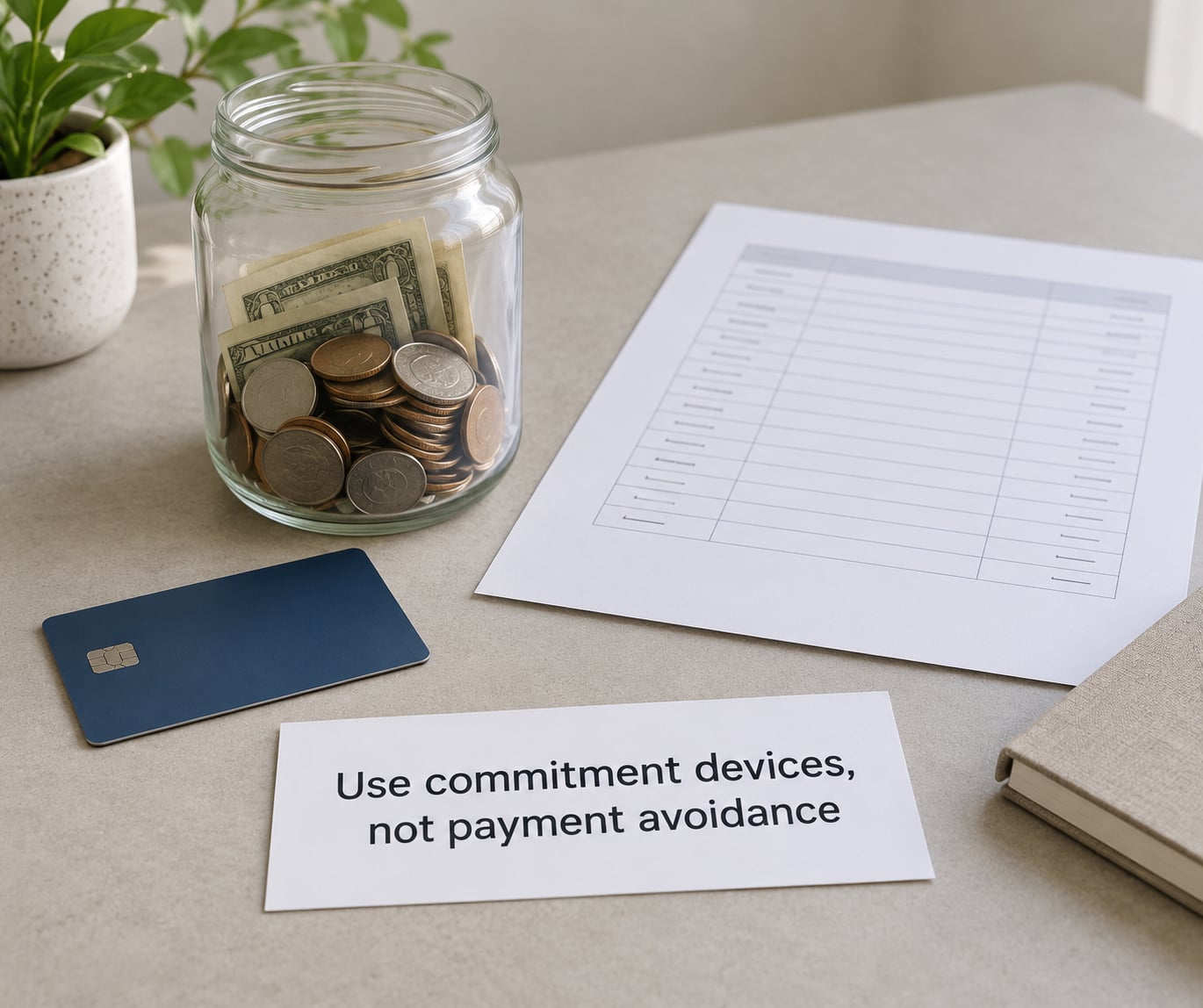
A commitment device makes a considered decision easier to carry out. Earmark the money today in a separate savings pot and schedule the transfer for the day you said you would pay. Put the date in your calendar with a reminder a few days ahead.
The safeguard: a device serves the decision you already made. It stops drift. It must never be the thing that lets you sign for something you cannot afford, and it should never carry a penalty you did not read. People describe predictability as more reassuring than speed, a clear schedule with reminders beats an instant but opaque charge every time.
The success signal: the payment happens on the date without a scramble, and no part of the arrangement surprised you when the money left.
6. Set a final review point
Pick one date, close to payment, and ask three questions in writing. Is this still useful? Is it still affordable at its full total? Is it worth that amount once bonuses, discounts, shipping and interest are all added up?
This is the step most people skip, and it is the one that catches the impulse purchase that would otherwise land. Three questions take four minutes.
The safeguard: answer from what you know today, not from what you hope will be true by payday.
The success signal: two of the three answers are clear yeses. One maybe is a no.
7. Pay on the date that matches the decision
Schedule the payment only after the review period ends. Re-read the final terms on the day, confirm the total amount, then pay.
If your circumstances have changed, decline. That is not a failed strategy, it is the strategy working. The purpose of payment timing is to let a decision settle so you can judge it accurately, not to buy you a longer runway to avoid a no.
The safeguard: if you would be uncomfortable explaining this schedule to someone you respect, it is the wrong schedule.
The success signal: the money moves, the item arrives, and nothing about the process felt like a trick. That last part matters more than the conversion.
Common Mistakes
Six failure modes, each with the fix.
Borrowing to disguise affordability. A card limit is not money you have. Fix: run every scenario against the ceiling from step one, using real balances, and treat the credit line as absent.
Ignoring the total cost. Comparing monthly amounts instead of sums owed. Fix: write the full payable figure at the top of every comparison, interest and fees included, and compare like with like.
Missing a real deadline. The delay pushes you past the end of a promotion or a return window. Fix: list the constraining dates before you choose an interval, not after.
Delaying past the point of clarity. A long pause stops being a cooling-off period and becomes rumination. Fix: cap the interval. Seven to fourteen days suits most large purchases, and after that, decide.
Manufacturing urgency. Fake countdowns and expiring holds to force a fast yes. Fix: remove the deadline from the offer entirely and see whether the purchase survives without it.
Applying this to small stuff. Running a full review process on a fifteen dollar item wastes the attention you saved for the big ones. Fix: set a threshold. Below it, decide and pay in the moment.
Two habits worth adding. Show the full cost and the schedule at the same time, every time, because shoppers trust installment offers far more when the amount and all charges are stated plainly. And give people control before the charge lands: the ability to see, pause, change or cancel matters more to most buyers than the discount itself.
Buyers are not fooled by this stuff so much as the marketing side assumes. Communities like r/Anticonsumption document checkout tactics in detail, and the reaction to anything that obscures the real price is mostly irritation. Transparency is not a legal nicety here, it is the conversion strategy.
Frequently Asked Questions
Does paying later always reduce purchase pain?
No. Delaying payment works best on large or high-consideration purchases where a cooling-off period improves judgement. On everyday items it changes nothing, and on unfamiliar sellers or first orders a deferred charge can read as risk rather than relief. The useful test for how to use payment timing to reduce purchase pain is whether the delay buys you clarity. If it does not, you are just postponing discomfort.
Is it cheaper to use an installment payment plan?
Usually not. A plan with a smaller monthly figure is cheaper per payment and often more expensive overall, because interest and fees ride on the total amount rather than the monthly one. Compare the full payable amount, not the instalment, before you choose. Rules and protections around instalments vary by country, so read the specific terms where you live.
How long should I wait before making a large purchase?
For most large purchases, seven to fourteen days is the useful range. Long enough to break the emotional momentum of the moment, short enough that you still remember why you wanted it. If a purchase is genuinely life-changing in scale, write the waiting period down before you start counting. Beyond a couple of weeks the delay stops producing clarity and starts producing doubt.
When is a deposit useful for reducing purchase pain?
A deposit helps when the full amount would strain you but the item is worth owning and the terms are clear. It lowers the immediate outlay, which reduces the pain of paying today. The safeguard is disclosure: a plainly labelled deposit reads as legitimate, while a hidden first charge reads as bait-and-switch and costs you trust in the seller.
Can payment timing help with online shopping decisions?
Yes, and online is where it matters most, because there is no physical till to mark the moment of payment. Splitting the charge, scheduling it after delivery, or spreading it over a stated schedule all reduce the spike at checkout. What to use payment timing to reduce purchase pain cannot do is disguise an unaffordable total. Keep the full amount visible and the delay will help.
Conclusion
Start with paper. Write down the full price and every payment term attached to it, including interest and fees.
Then choose a waiting or savings period you can genuinely keep, put the date in your calendar, and set one review point before any money moves.
Keep the purchase only if it is still useful, still affordable and still worth that full total after the delay. If it is not, you have just saved the cost of a regret, and that is the outcome you were after.