
Why anchoring with a premium tier lifts mid tier sales is simple to state and harder to prove: a credible premium option sets a reference point, and once that reference exists the mid tier is judged as the sensible step up rather than as the expensive one. The mid tier then attracts buyers who were previously shopping on price alone, because they are now comparing against something higher.
The catch is that the lift is a volume shift, not a free bonus. If the premium tier is implausible or hollow, it does nothing but make your whole page look expensive. What follows is the mechanism, the failure modes, and a test design you can run on a real pricing page.
Table of Contents
- What Premium-Tier Anchoring Does to Mid-Tier Sales
- How the Anchoring Effect Changes Buyer Judgement
- Why a Premium Tier Can Increase Mid-Tier Demand
- When the Effect Is Strongest—and When It Fails
- How to Design a Premium Tier That Helps
- How to Test the Effect in a Pricing Experiment
- How to Measure Whether Mid-Tier Sales Actually Lifted
- Frequently Asked Questions
- Conclusion
What Premium-Tier Anchoring Does to Mid-Tier Sales
Price anchoring is the practice of letting one number shape how another number is judged. In a price ladder, the premium tier is the number that does the shaping, and the mid tier is the number that benefits. Premium-tier anchoring is not a discount and it is not a gimmick you bolt on; it is the deliberate use of the highest price on the page to move the evaluation point for everything below it.
A premium tier performs three separate jobs at the same time, and confusing them is why pricing pages get rebuilt repeatedly:
- It reframes the mid tier. The mid tier stops being “the expensive plan” and becomes “the sensible one”, because it now sits between nothing and the most expensive option.
- It signals product depth. A real top tier, with real capability behind it, tells buyers the vendor has depth in the category. That judgement partly spills onto the mid tier.
- It catches buyers who would otherwise leave. A small share of prospects need the top option for compliance, procurement or scale reasons. Without it they price you against a competitor and negotiate from scratch.
Deliberate anchoring looks different from accidental inflation. Accidental inflation is what happens when a team sets the top tier high because it felt safe, then never explains why it costs what it costs. Deliberate anchoring means the top tier has a defensible reason to exist, is stated plainly, and is something you would be willing to sell to a named buyer.
How the Anchoring Effect Changes Buyer Judgement
The mechanism was named in the 1974 paper Judgment under Uncertainty by Amos Tversky and Daniel Kahneman. Subjects spun a wheel of fortune rigged to land on 10 or 65, then had to estimate the probability of an out-of-range outcome such as 80 or 20. Estimates clustered near whatever the wheel had shown: the 10 group answered around 25 percent, the 65 group answered around 45 percent. Numbers with no relevance to the question moved the answer anyway, and moved it in the direction of the first number seen.
That is anchoring, and the important detail is the second half: people did not simply accept the wheel. They started from it and adjusted. Adjusting is not the same as starting fresh, and no amount of adjustment fully unwinds the starting point.
Applied to a pricing page, three things follow. First, judgement is relative. A buyer with a competing quote in hand and a buyer with no comparison both reassess the mid tier by looking at the premium tier beside it. Second, the first serious number on a page tends to set the scale for the rest, which is why the order of the cards matters as much as the amounts. Third, adjustment is biased short of full independence, so a mid tier that is 80 percent cheaper than the premium reads as generous even when it costs the same as it did before the premium existed.
Prospect theory explains the second half of the story. People weigh losses against gains asymmetrically, so the mid tier is judged as what you give up by not taking the premium as well as what you get by taking it. A premium that looks genuinely richer makes that comparison land well for the mid tier.
Why a Premium Tier Can Increase Mid-Tier Demand
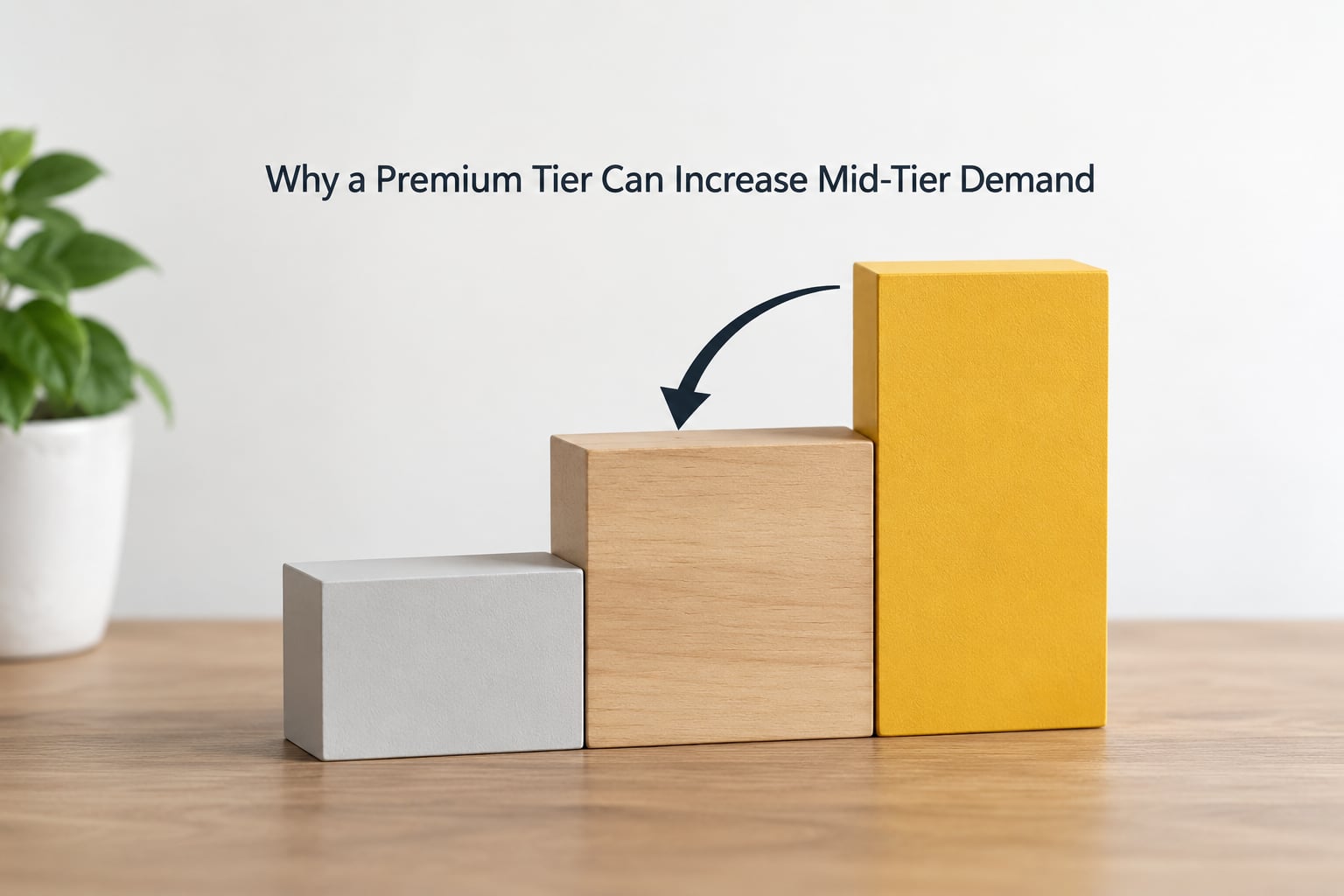
Why anchoring with a premium tier moves the middle tier and not the entry tier
The entry tier barely benefits from anchoring. Someone who arrived determined to spend the least was never anchored on the mid tier anyway, so a higher number changes nothing for them. The mid tier is different because it is the one option a wavering buyer is genuinely weighing, and that is exactly where a new reference point does work.
Take an illustrative ladder indexed to the entry tier, so no absolute amounts are involved. The numbers are an example of the shape, not a result measured from a live account.
| Tier | Index, entry tier = 1.00 | Role on the page |
|---|---|---|
| Entry | 1.00 | Catches price-first buyers who would otherwise leave |
| Mid | 2.50 | The intended target and usually the margin engine |
| Premium | 9.00 | The measuring stick and the enterprise catch |
Run the same offer without the premium tier and the mid tier sits alone at 2.50, where it competes directly with the entry tier on cost. Add a credible option at 9.00 and four things happen for the mid tier, which is why the lift shows up there rather than at the bottom:
- A high anchor sets the scale. The comparison the buyer runs is no longer mid against entry, it is mid against the highest number on the page.
- Comparison gets easier. Three tiers give the buyer a scale to place their own requirements on, instead of a binary decision between cheap and not cheap.
- There is a reason to trade up. Buyers who would have hesitated at the jump from entry to mid now see a further step, so the mid tier reads as the first move rather than the whole climb.
- The entry price stops being the headline. Attention shifts to relative position on the ladder, which is the question most buyers were actually trying to answer.
The compromise effect is doing much of the work here. When three options are on the table, a meaningful share of buyers pick the middle one, because middle is read as balanced and extremes are read as compromises in one direction or the other. That middle option is often labelled the Goldilocks tier.
One caution about the effect: most published material asserts it, very little of it publishes a clean before-and-after from a real page. Treat the size of the lift as something you measure on your own offer, not a figure you inherit from a blog.
When the Effect Is Strongest—and When It Fails
The effect holds when the ladder is legible. It needs a clear price ladder where the gaps are visible, real differences between tiers so the top one is not padding, some buyer uncertainty about which tier fits, and a top tier whose value is visible on the page rather than buried in a sales call. It is also stronger when the mid tier is explicitly positioned as the best-value choice, because the anchor then confirms a message you already sent.
It fails in specific, recognisable ways:
- The anchor is absurd. A top tier priced beyond the reach of almost any buyer does not read as quality. It reads as a negotiating position or a fantasy, and the mid tier inherits the distrust.
- There is no substance behind the top tier. If the premium plan differs by one line item, buyers notice, and the whole page gets re-read as pricing theatre.
- The gaps collapse. A too-small gap between tiers makes the mid tier look like the bad deal, because its extra cost buys almost nothing extra.
- Too many options. Past roughly four or five choices, buyers stop comparing on price and start guessing, and the reference point loses its grip.
- A category reference price fights you. If buyers arrive with a strong external expectation of what your product costs, your own top tier cannot move it.
- Anchoring is discount-only. Showing only a was-price teaches buyers to wait for the anchor to collapse, which makes the next genuine price harder to sell.
The failure mode experienced practitioners worry about most is cannibalization. Watch the tier mix after launch: if mid-tier units hold while average revenue per account climbs, the anchor is working. If mid-tier units drop and the buyers simply moved up, your revenue per account may be fine while your volume story is weaker than the dashboard suggests. And if the premium tier sits at a couple of percent of sales for two quarters while costing you maintenance time, it has stopped paying for itself.
How to Design a Premium Tier That Helps
Start by choosing a premium that means something. Pick the price the buyer would pay for the version of your product with the constraint removed, then round it to a number you can say out loud. If you cannot name three capabilities that only exist in the top tier, you are not building a premium, you are relabelling.
Then set the gap. A useful rule of thumb is to put the premium at roughly three to four times the mid tier, and the mid tier at roughly two to three times the entry tier. Gaps that are too tight make the mid tier pointless; gaps that stretch past about five to one start making the anchor feel invented. Treat these as starting points for testing, not rules.
Make one value advantage on the top tier unmistakable, and give the mid tier its own unmistakable advantage. If both tiers list forty features in small grey text, no ladder exists. The middle tier needs one sentence a buyer can repeat, something like best value for a growing team.
Keep the ladder short. Three tiers is the default that most pricing pages land on for a reason, and four can work when the fourth sits clearly outside the others.
Keep the comparisons honest. Presenting a fabricated was-price or a premium that exists only on the pricing page is a reference-pricing claim, not an anchor, and it falls foul of consumer-protection rules in several markets, including the EU Omnibus requirement to show the lowest price applied in the prior 30 days. A real anchor survives a sales conversation. A fake one does not.
How to Test the Effect in a Pricing Experiment
Pick the two arms before you pick the numbers
Control shows entry and mid tiers. Variation shows the same two tiers plus a credible premium. Everything else stays identical: same copy, same badge treatment, same traffic source, same sales motion. Change one variable or you learn nothing.
Guard against contamination between buyers
The classic mistake is showing the premium to some visitors and the control to others in the same week, then having sales conversations leak the new tier to control-group prospects. Assign at the account or domain level, not the session level, and keep the split running long enough to cover a full billing cycle rather than a few days.
Read profit, not just volume
Conversion rate alone will mislead you, because an anchor can raise conversion and lower revenue if the new buyers were all going to buy the entry tier anyway. Read contribution after discounts and servicing costs for each arm, per account and per month.
A worked illustration, indexed so the control mid-tier revenue equals 100, shows what a healthy result looks like. These are example figures for shape, not measurements from any real account.
| Metric | Control, two tiers | Variation, three tiers | Reading |
|---|---|---|---|
| Mid-tier units | 100 | 118 | The lift is real volume, not just perception |
| Entry-tier units | 100 | 91 | Some entry buyers stepped up, which is fine |
| Premium-tier units | n/a | 6 | Small share, as intended |
| Total revenue index | 100 | 116 | Growth came from more value, not just price |
| Contribution per account | 100 | 109 | Margin held after servicing the new tier |
If total revenue rises while contribution per account falls, you have bought volume with margin, and the honest conclusion is that the anchor changed behaviour but not profitability.
How to Measure Whether Mid-Tier Sales Actually Lifted
Two claims get confused here, and they need different evidence. The perception claim, that the mid tier feels cheaper, shows up in win-loss interviews and in survey answers to why you chose your plan. The volume claim, that more buyers picked the mid tier, shows up in the tier mix. Only the second one is a business result.
Track these together: mid-tier units per period, mid-tier revenue, total revenue across all tiers, the premium share of sales, conversion rate on the pricing page, average order value, and contribution margin per account. Read them as a set. A rise in mid-tier units with a fall in total revenue is a reshuffle, not growth.
Watch two ratios in particular. The premium mix share tells you whether the top tier is doing its enterprise-catching job or sitting unused. The mid-tier cannibalization ratio tells you the same thing from the other side: the share of mid-tier buyers who came from a cohort that would previously have bought entry. Below roughly a fifth, most of the lift looks like new demand rather than migration, though your own numbers will set the bar.
Frequently Asked Questions
Does a premium option always increase sales of the middle tier?
No. The lift depends on the premium tier being credible and close enough to be reachable. If the top price sits far beyond what most buyers could pay, or if its extra features do not justify the jump, it stops working as a reference point and can even push mid-tier buyers toward the entry plan. Treat the effect as something to test on your own ladder rather than a rule you can rely on without evidence.
How far above the mid tier should the premium price be?
A common starting range is roughly three to four times the mid-tier price, with the mid tier sitting at two to three times the entry tier. Gaps below about one and a half times make the mid tier look like poor value, and gaps stretching past five to one make the top option look invented. These are starting points for a pricing test, not fixed rules, and the right ratio depends on your cost to serve and your category.
Should the premium tier be much better than the mid tier?
It should be visibly different, not enormously better. Buyers need at least two or three capabilities that exist only at the top tier, and the mid tier needs its own clear advantage so the step up is a choice rather than an obligation. When tiers differ by a single line item, experienced buyers read the whole ladder as packaging rather than value and the anchoring effect largely disappears.
Will adding a premium tier reduce sales of the cheapest option?
Usually a little, and that is not automatically bad. Some entry-tier buyers will step up, which raises revenue per account if your margin holds. The number to watch is total contribution across all tiers, not entry-tier unit count on its own. If mid-tier and premium units grow while total contribution falls, the new tier bought volume with margin and the structure is not paying for itself.
What is the best way to test premium-tier anchoring?
Run a two-arm test at account level: one arm sees entry and mid tiers, the other sees the same offer plus a credible premium tier, with all copy and design otherwise identical. Keep the split running for a full billing cycle, then read mid-tier units, total revenue and contribution per account together. Splitting by session instead of account lets sales conversations contaminate the control group.
Conclusion
Why anchoring with a premium tier lifts mid tier sales comes down to one thing: the mid tier stops being judged on its own price and starts being judged against a higher one. Build a three-tier ladder with a premium that has real capability behind it, position the mid tier as the best-value choice in plain words, and test the whole structure against a two-tier control before you believe anything.