
To understand older consumers as a growth market, stop treating age as the segment and start treating life stage, resources, household structure and technology confidence as the segment. The demographic shift is real and well documented, but the commercially useful insight sits inside the group, not in the headline number about how many people turned 65 this year.
This guide walks through a research sequence I have watched marketing teams use successfully: define the audience properly, separate aging from cohort, map the barriers, watch the buying process, size the prize honestly, test for dignity as well as relevance, then run a small measurable pilot. Most of the work is qualitative and takes weeks, not months.
The trap most teams fall into is a single persona called “seniors.” One person, usually 78, usually pictured with a walker, used for every decision. That persona cannot tell you why two people of the same age respond to completely different offers, and it certainly cannot tell you what to change on a landing page tomorrow.
Table of Contents
- What You Need
- Audience definitions that survive contact with data
- Your own customer data
- Qualitative tools
- Secondary research as a starting hypothesis
- Decision criteria agreed in advance
- Step-by-Step
- 1. Segment older adults by life stage, not by age alone
- 2. Separate age effects from cohort and life-stage effects
- 3. Map needs, motivations and purchase barriers
- 4. Watch how older consumers search, compare and buy
- 5. Quantify the opportunity without equating age with wealth
- 6. Test concepts for relevance, dignity and accessibility
- 7. Build a learning loop and decide what to do first
- Common Mistakes
- Treating chronological age as a complete persona
- Assuming retirement means spending falls
- Assuming older adults are tech-shy
- Ignoring caregivers and other intermediaries
- Testing only with existing customers
- Using patronizing language
- Setting a budget that says the audience is niche
- Frequently Asked Questions
- What age group should brands target when older consumers are a growth market?
- Are older consumers inherently more loyal and valuable than younger consumers?
- How do generational differences affect how older consumers make purchase decisions?
- What is the best way to research what older consumers want?
- Which marketing channels work best for older consumers today?
- How can brands avoid stereotypes when marketing to an older audience?
- Conclusion
What You Need
Before any strategy work starts, you need inputs. Not a brief written from desk research, but actual material you can hold and argue with.
Audience definitions that survive contact with data
Define the boundary in writing and be honest about why you chose it. Fifty-plus, sixty-plus and sixty-five-plus are different markets with different proportions of working, retired and dependent members. Pick one, state the reasoning, and note which adjacent bands you are deliberately excluding so a colleague cannot quietly widen the audience later.
Your own customer data
Order history, average order value, purchase frequency, repeat rate, category mix, contact channel preference and the age band on file. This is the cheapest evidence you will ever gather, and it is the baseline every external report gets compared against. If you serve this market at all, the data is already sitting in your systems.
Qualitative tools
Twelve to twenty semi-structured interviews will do more than a large survey for the early work, because the useful information is in the reasoning: the workaround someone invented, the phrase they used, the moment they decided to abandon a purchase. Add a small diary study or observation sessions where you can watch the actual process rather than asking people to recall it.
Secondary research as a starting hypothesis
Published work gives you the shape of the problem before you spend money. Useful anchors include a 14-year YouGov panel study published by RSM on how shopping behavior changes with age, Ipsos work that splits older adults into four attitudinal segments, and Susan Golden’s Stage Not Age framework, which argues that what matters is what stage you are in rather than how many birthdays you have had.
Decision criteria agreed in advance
Write down what would make you invest, and what would make you stop, before you see the results. Typical criteria are segment size, accessible margin, repeat purchase potential, media cost to reach, and whether the organization can serve the customer properly. Deciding after the fact is how teams talk themselves into projects that were never viable.
One more input people skip: someone inside the organization who can say no. If nothing in your process can kill the idea, the research stage is theatre.
Step-by-Step
Seven steps, in order. Each one produces something the next one needs.
1. Segment older adults by life stage, not by age alone
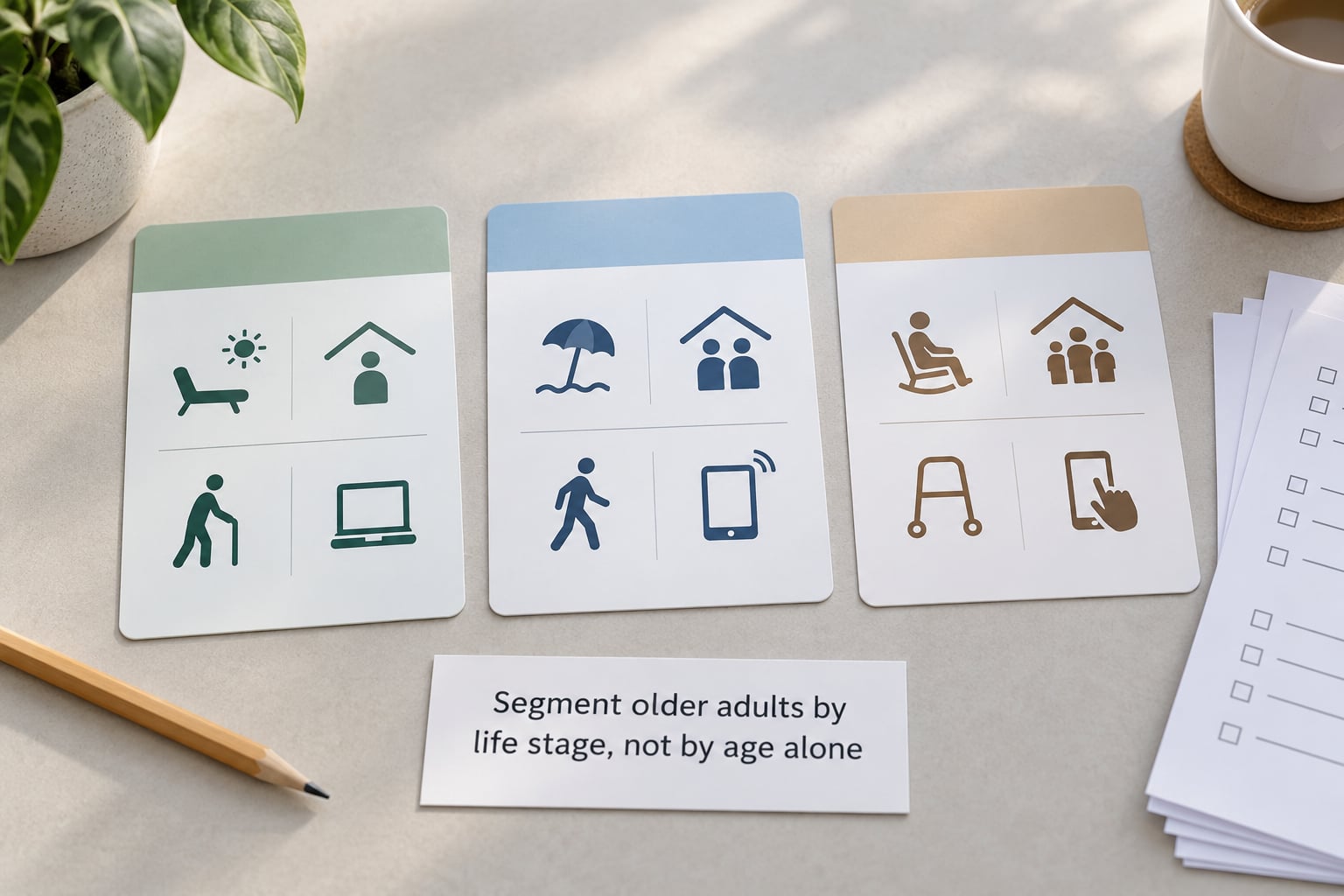
Split the audience on variables that actually change what someone buys and how they buy it. Useful ones: retirement status and whether work is still part of the week, household structure and who lives in the home, income source and asset position, health and mobility constraints, technology confidence, and purchasing role within the household.
A worked example makes the point better than any definition. Consider two people who both turned 70 last year. One is a recently widowed retired teacher who does her own shopping, uses a smartphone for most things, and buys for herself alone. The other is still working part time, lives with a spouse who handles the paperwork, and buys for a household with a grown child nearby who helps with anything technical.
Same age, different job to be done. The first needs straightforward online ordering, clear delivery information and a way to reorder something she liked. The second needs someone she trusts to confirm the choice, a service that speaks to both of them, and reassurance about the paperwork. Segment on age and you will average these two into a message that fits neither.
Two or three segments beat eight. You need enough spread to see real differences and few enough that each one can carry a distinct offer, channel and creative treatment.
2. Separate age effects from cohort and life-stage effects
This is where most analysis quietly goes wrong. A cross-sectional survey of people at different ages shows a difference, and readers assume aging caused it. Sometimes it did. Often what you found is that a generation grew up with different conditions and simply carries different preferences into old age.
Three effects get tangled together. Age effects are changes tied to the body and to life stage: slower recovery, reduced mobility, more prescription management, a shift from building to spending. Cohort effects are shared formative experiences: a childhood without cars, a working life in one industry, an era with different brand trust norms. Life-stage effects sit in between: retirement, becoming a grandparent, caring for a parent, inheriting an estate, managing a diagnosis.
To separate them, you need comparison of two kinds. Compare the same person at two points, which means longitudinal panel data or your own repeat customers over time. And compare people of the same age who grew up differently, which means asking formative experience questions directly rather than inferring from birth year.
The practical test: ask what people like you are buying that younger people at the same life stage are not. If the answer points at something physical, that is likely age or life stage. If it points at a preference for a familiar brand or a habit formed decades ago, that is cohort. Both are useful. Only one of them is fixed by waiting.
3. Map needs, motivations and purchase barriers
Build one map, in one place, covering six areas. Functional needs are the job itself, done reliably. Emotional motives are what the purchase is really about: safety, dignity, independence, not being a burden, feeling competent. Trust covers what would make them walk away: an unfamiliar brand, an unclear return policy, a company that cannot explain its prices. Accessibility covers reading, hearing, movement, memory and dexterity. Service covers what happens before and after the purchase, including whether someone will answer the phone. Financial risk covers the fear of committing to something that turns out to be wrong.
The questions that surface trade-offs are more useful than the questions that produce agreement. Ask what they gave up to buy this, what they checked before paying, what nearly stopped them, and what they would tell a friend who was hesitating. Trade-offs tell you where the market actually sits.
You know a barrier is real when it shows up unprompted, recurs across unrelated segments, and changes behaviour rather than just opinion. If people say a long form is annoying but complete it anyway, you have an irritation. If people abandon the form halfway, you have a barrier.
4. Watch how older consumers search, compare and buy

Map the actual process rather than the one in your marketing funnel. Most buying processes in this market pass through five stages: a trigger that starts the search, a period of gathering information, a comparison narrowed by some trusted filter, a purchase where someone else may be involved, and post-purchase support that determines whether they come back.
Intermediaries matter more here than in most categories. A spouse, an adult child, a professional adviser, a clinician, a paid carer, or a trusted member of a local community can each be the person who actually confirms the decision. Work out who that person is and make sure your content holds up when they read it, because in many cases they are the one who will search.
Not everyone is offline, and treating them as offline is both inaccurate and expensive. Email, search and video all reach large parts of this audience, and the qualitative evidence keeps pointing the same way: this group responds to substance over style, wants information rather than entertainment, and converts better from channels with editorial credibility than from social ads built for interruption. Test the channels against your own segments rather than against national averages.
One finding worth repeating because it is counter-intuitive: in long-running panel data, shopping frequency tends to peak around 69 and then decline, variety-seeking drops after 50, and buy-one-get-one style promotions lose their pull in the same region. Older shoppers spend more per basket while buying less often, and loyalty to a familiar retailer holds up once established but weakens when distance or store size works against it.
5. Quantify the opportunity without equating age with wealth
Older adults now hold a large share of household wealth in developed markets and a majority of discretionary spending, and the global longevity economy is frequently put in the region of 22 trillion dollars. Treat those as directional context, not as a business case.
What you actually need for a growth decision: how many people are in each segment, how often they buy, what an average basket looks like, how long they stay, how much service capacity each customer consumes, and what the accessible share is after you subtract people you cannot reach or cannot serve well.
Then check the awkward parts. Support costs, longer decision cycles, higher returns on complex items, accessibility remediation on digital properties. A segment that looks attractive on revenue and unattractive on margin is a different proposal from one that looks expensive to acquire and cheap to keep.
The comparison you should make is not older versus younger in the abstract. It is your best current segment against your best candidate older segment, on the same measures, with the same service assumptions. That is the only version of this analysis that survives a budget conversation.
6. Test concepts for relevance, dignity and accessibility
Build two or three concepts per segment and put them in front of people outside the team. Then check them against a fixed list, because taste and prejudice are hard to spot in your own work.
Readability: can someone read the headline at a normal distance in a normal room, and does the body copy survive being read aloud. Cognitive load: one idea per asset, obvious starting point, no hidden navigation. Sensory access: captions, contrast, text alternatives, no reliance on colour alone. Autonomy: does the message offer a choice or issue an instruction. Authenticity: would a real person in this segment recognise themselves, or is the casting doing the work instead. Stereotyping: does the concept assume frailty, decline, confusion or poverty.
A good signal from testing is that people describe the concept in terms of themselves rather than in terms of the category. They say this is for someone who still drives to the shops, not this is for seniors. That shift in language usually marks the difference between a concept that feels written for them and one that feels written about them.
Two things consistently separate the work that lands from the work that embarrasses a brand. Subject matter over entertainment, and creative made by people who understand the life stage rather than briefed to guess at it.
7. Build a learning loop and decide what to do first
Pick the cheapest test that could change your mind. That might be a landing page variant with a different barrier addressed, a short service pilot in one region, a revised returns message, or a different mix of channels for one segment. Give it a defined window, a named owner, and thresholds written down in advance: what result means continue, what result means pause, what result means stop.
Run qualitative feedback alongside the numbers, not after them. A conversion lift with no explanation is not a learning, and an explanation with no movement is not a result. The point is to keep the reason attached to the number, so the next iteration inherits both.
Close the loop on a fixed date. Every older consumer project I have seen drift failed on scheduling rather than on research quality, because the findings sat in a deck while the work continued without them.
Common Mistakes
Each of these is common, cheap to make and expensive to unwind.
Treating chronological age as a complete persona
Age is a weak proxy and a decent filter. Use it to define a boundary, then segment inside it on life stage, resources and behaviour. A persona built on age alone will produce the same message for everyone and a poor result for all of them.
Assuming retirement means spending falls
Retirement changes the source of income far more than the level of spending. Discretionary categories often hold up, some categories shift, and the segment that matters most commercially is frequently the one with time and disposability rather than the one with the largest assets. Check your own data instead of assuming a direction.
Assuming older adults are tech-shy
A large share are online, many use smartphones daily, and voice assistants are used by people who never opened an app. What varies is confidence, not capability. Build for the least confident person in the segment rather than designing a separate inferior experience for them.
Ignoring caregivers and other intermediaries
In categories where money, health or risk is involved, a second person often approves or advises. Excluding them creates friction and can read as disrespect. Including them transparently is different from targeting them, and the distinction is worth stating plainly in your creative.
Testing only with existing customers
Your current customers are the easy case. People who considered you and chose something else, or chose nothing, carry the information you need about barriers. Make recruitment part of the research design and budget for it.
Using patronizing language
The quickest way to lose trust is a headline that talks down. Words implying decline, confusion, second chances or being too old for something do lasting damage. Run copy past someone in the segment, not past your colleagues, and read it out loud.
Setting a budget that says the audience is niche
Allocation often does not match the spending power involved, and the reasoning is usually that older customers take too long to convert. Fix the measurement first, because a pilot that runs on a realistic conversion window usually justifies itself.
Frequently Asked Questions
What age group should brands target when older consumers are a growth market?
Most teams get further by starting at fifty-plus than at sixty-five-plus, because retirement and income-source change starts there rather than at a birthday. The right boundary depends on your category and how long customers stay with you. Define it in writing, note which bands you are excluding, and then segment inside it on life stage, household structure, health and technology confidence rather than treating everyone above the line as one audience.
Are older consumers inherently more loyal and valuable than younger consumers?
They are often more valuable once established, but not automatically at acquisition. Panel data suggests older shoppers spend more per basket while buying less often, and that loyalty to a familiar retailer holds once it exists but is harder to win. Value still depends on service cost, decision length and category. Compare your best existing segment against your best candidate older segment on the same measures before committing budget.
How do generational differences affect how older consumers make purchase decisions?
Formative experience shapes trust, risk tolerance and which brands feel familiar, and it does not fade with age. Someone who grew up without cars may read a service message very differently from someone who grew up with them. Segmenting by formative experience tends to produce sharper messages than segmenting by birth year. The practical method is to ask about formative experiences directly in interviews, then test whether the resulting groups behave differently in real purchase data.
What is the best way to research what older consumers want?
Start with twelve to twenty semi-structured interviews, because the useful detail sits in reasoning rather than in stated preference. Ask about trade-offs, near-misses and what nearly stopped a purchase. Follow with observation or a diary study, since people misremember their own process. Use your existing customer data as the baseline and be sure to include people who considered buying and chose something else, not only current buyers.
Which marketing channels work best for older consumers today?
It varies more by segment than the national averages suggest. Email and earned or editorial sources with credibility tend to convert well because this audience responds to substance over style, and search and video reach large numbers of people. Direct mail still works where the category involves repeat purchases. The mistake is assuming everyone is offline or assuming one platform covers the whole group. Pick channels using your own segment data and test two at a time against a control.
How can brands avoid stereotypes when marketing to an older audience?
Avoid assumptions about frailty, decline, confusion and poverty, and never imply that buying your product restores a younger self. Write for autonomy: offer a choice rather than an instruction, and give information rather than reassurance about your motives. Have people in the segment read the copy aloud before it ships, and check that casting reflects a range of bodies, mobility levels and household situations. If your own team is entirely under 45, that review matters more.
Conclusion
The shift is worth taking seriously, but the headline demographic number is the least useful part of it. What makes older consumers a growth market you can actually serve is the variation inside the group: different life stages, different household structures, different levels of confidence and different people involved in the decision.
So the first action is small and concrete. Take the single broad older-adult persona currently sitting in your strategy, replace it with three segments built on life stage, resources and buying role, and write the interview questions you would use to test them. That single replacement usually changes more media spend, more creative briefs and more landing page copy than a quarter of market reports.