Inflation changes shopper decision rules by making price the loudest attribute in the basket. Instead of grabbing the familiar brand on autopilot, shoppers run a stricter sequence: protect essentials, hunt promotions, compare unit prices, trade down to store brands, and finally drop or swap entire categories. That sequence is the single most useful thing to understand about how inflation changes shopper decision rules, because it tells you which lever to pull before you change price.
The mistake most retailers and brand teams make is reading inflation as a volume problem. Prices rise, units fall, everyone panics about demand. But total retail spending often holds up while the mix underneath it moves hard — different brand, different pack size, different store, different category. Spend is reallocated, not simply removed.
What follows is the behavioral model underneath that shift, the budgets that move first, and how researchers actually measure the change rather than guess at it.
Table of Contents
- What Does Inflation Change About Shopper Decisions?
- The definitions that matter
- How Inflation Changes Shopper Decision Rules
- The four-stage escalation model
- Which Shopper Budgets and Mental Accounting Rules Shift?
- How Do Reference Prices and Perceived Value Change?
- Why Do Shoppers Trade Down, Switch Brands, or Buy More?
- How Do Promotions and Store Labels Become More Important?
- What Happens to Brand Loyalty and Product Quality Perceptions?
- How Can Researchers Measure Inflation-Induced Decision Changes?
- Frequently Asked Questions
- How does inflation affect spending?
- What is retail inflation?
- Does inflation lead to lower consumer confidence?
- Why is 2% inflation a good thing?
- Is trading down to store brands a permanent habit?
- Do inflation-formed shopping habits last after prices fall?
- Conclusion: What Should Marketers Do First?
What Does Inflation Change About Shopper Decisions?
Retail inflation means the prices shoppers pay for goods move up faster than their incomes do. A basket that cost one amount last year costs more now, and the gap between what a shopper planned to spend and what the basket requires is the pressure that rewrites their rules.
Five terms do most of the work in this conversation, and it pays to define them once.
The definitions that matter
Purchasing power erosion is what happens when the same nominal budget buys fewer goods. It is arithmetic, not psychology, but shoppers only experience it psychologically: the receipt goes up, the cart looks the same.
Price elasticity describes how much quantity moves when price moves. Everyday staples tend to be inelastic, meaning shoppers absorb the increase and keep buying. Discretionary and identity goods are elastic, so a price rise pushes people out of the category instead.
Down-trading is switching to a cheaper option within the same category — usually a store brand or a smaller pack size. It is the most common response because it requires the least effort and the least visible sacrifice.
Shrinkflation is a price increase disguised as a product change: the pack is smaller, the bar is thinner, the count is lower. Skimpflation is the same trick applied to recipe or formulation. Both matter to decision rules because shoppers who detect them stop trusting the shelf tag entirely and start auditing unit price.
Reference price is the number a shopper compares the current price against, whether that number is on the shelf today or remembered from last month. Inflation changes the reference, not just the price.
How Inflation Changes Shopper Decision Rules
The core shift is from preference-led purchasing to constraint-led purchasing. Before, the rule was “buy what I like, when I like.” Under sustained inflation the rule becomes “buy the least-bad acceptable option inside a fixed envelope.” Four stages describe how households get there, and most shoppers pass through them in order rather than all at once.
The four-stage escalation model
Stage 1 — Budget control. The shopper takes control of the envelope before touching the basket. Impulse buying drops, basket size shrinks, and discretionary add-ons get cut first because they carry the least functional cost to remove.
Stage 2 — Promotional focus. Once the envelope is fixed, the shopper stops paying full price wherever a deal exists. Timing becomes a decision rule: buy when the promotion runs, not when the need arises. Coupon clipping, loyalty scanning and store-brand trial all appear at this stage.
Stage 3 — Down-trading. Promotion discipline stops being enough, so the shopper changes tier. Same category, cheaper brand, often a different size or format chosen to hit a psychological price point.
Stage 4 — Category abandonment or substitution. The final stage is exit. The item is dropped, postponed indefinitely, or replaced with a substitute category that delivers the same job — cooking at home instead of eating out, generic instead of branded, secondhand instead of new.
Not everyone reaches stage 4, and which stage a shopper sits at tells you more than their income does. A household in stage 2 is looking for a deal mechanic. A household in stage 3 is looking for permission to switch. A household in stage 4 will not respond to either.
One January 2026 survey of more than 1,000 US shoppers run by In-Store Marketplace shows how crowded the early stages are: 50% said they were buying fewer items, 41% had switched to cheaper brands, 37% were actively seeking coupons and promotions, and 33% had delayed purchases. Only the last group describes stage 4 behavior, which suggests most households are managing pressure inside a category rather than leaving it.
Which Shopper Budgets and Mental Accounting Rules Shift?
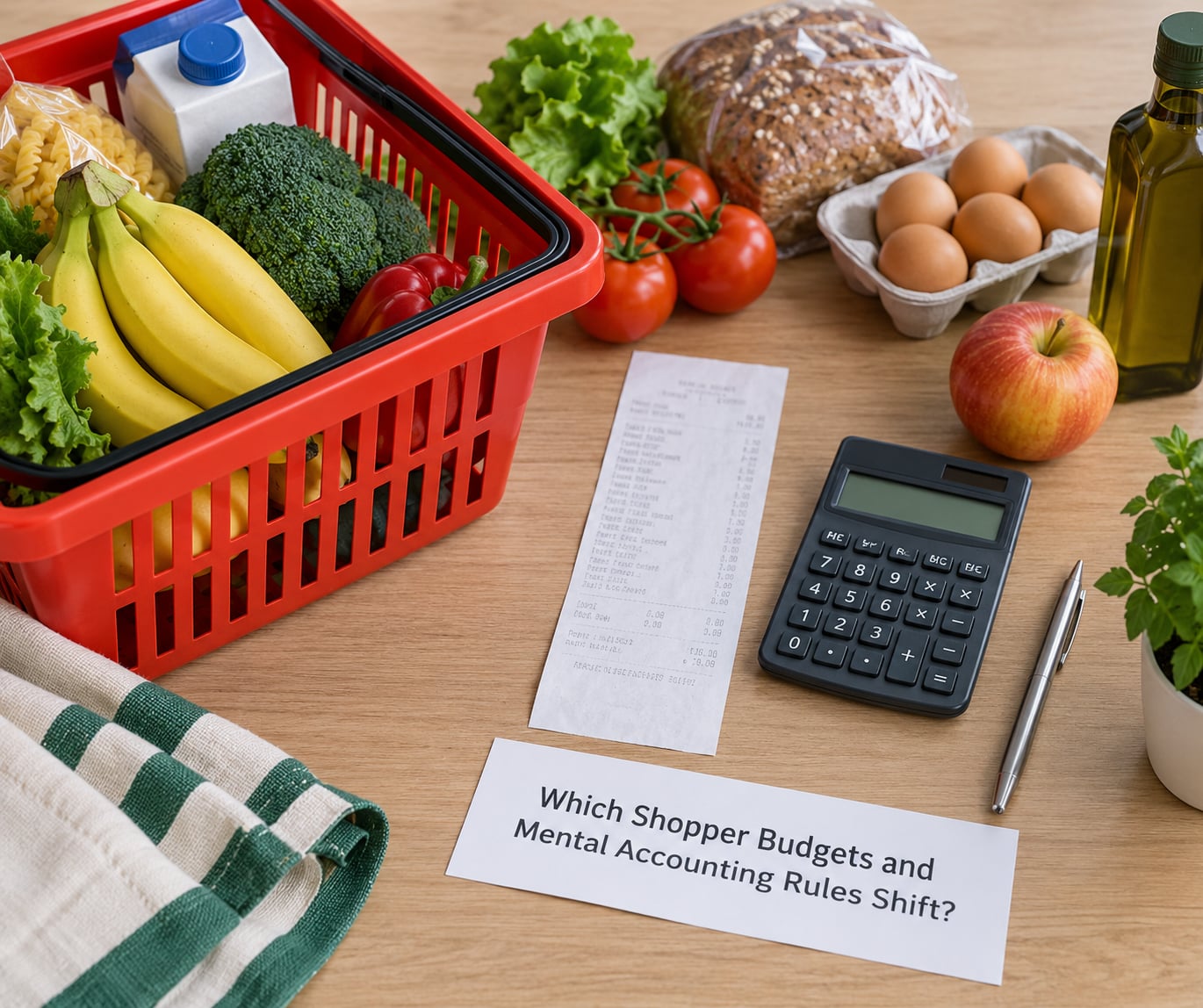
The interesting part of budgeting under inflation is that shoppers do not cut every line proportionally. They reclassify. Mental accounting treats money as belonging to labeled pots, and inflation changes which pots get defended.
Essentials pots — food, utilities, transport, basic household — get protected first, usually to the point of substitution rather than reduction. Discretionary pots get thinned, and the thinning is where the behavior change is visible. Savings pots get raided rather than replenished, which is one reason a household can feel squeezed while the spending total still looks stable.
The table below maps the pressure a household is under to the decision change it usually produces. It is a useful diagnostic: ask a shopper which row they are in and you already know what intervention will land.
| Budget pressure | Dominant decision change | What the shopper is now optimizing for |
|---|---|---|
| Monthly envelope no longer covers the usual basket | Selective omission of non-essential items | Keeping the core basket intact |
| Envelope covers the basket only with discipline | Promotion timing and coupon use | Effective price after discounts |
| Brand loyalty feels unaffordable | Down-trading to store brands and smaller pack sizes | Quality per unit spent |
| Category price exceeds the reference price by a wide margin | Substitution into another category | The job the product does |
| Large-ticket item out of reach | Permanent postponement | Timing, not whether |
| Savings buffer depleted | Borrowing or cutting non-food categories entirely | Short-term cash flow |
Decision fatigue sits underneath all of this. Every stage requires the shopper to evaluate more options than before, and the evaluation happens under stress with an incomplete mental model of what is actually on offer. That is why shoppers simplify wherever the environment lets them — a single familiar brand, a fixed basket, a store they trust — and why simplification itself becomes a decision rule.
How Do Reference Prices and Perceived Value Change?
Price is only painful relative to a reference, and inflation rewrites both halves of that comparison. A shopper who remembers paying a specific number three months ago is anchoring on an internal reference price; a shopper comparing a shelf tag to a nearby shelf tag is using an external reference price. Under inflation both references matter, and they often disagree.
Three mechanisms do most of the work.
Psychological price thresholds. A price change from 4.99 to 5.49 registers differently from 5.49 to 5.99, even though the gap is the same, because it crosses a threshold the shopper already held. Retailers who want to hold a ladder position often hold the threshold instead of the dollar gap.
Unit price versus dollar price. Shrinkflation forces unit price into the decision. The shopper who was comparing dollar prices now compares prices per ounce, per sheet, per serving, and pack size becomes a decision rule of its own rather than a detail.
Reference reset. Sustained inflation resets the internal reference upward. The absolute price stops feeling expensive once it has been paid several times, which is why a price that feels normal after a year can feel like a bargain when it is cut back to last year’s level. Perceived value is a moving baseline, and it moves for shoppers who are barely complaining.
This also explains the disconnect shoppers report between official statistics and their own grocery receipt. The headline number is an average across items and households; the shopper experiences a specific basket in a specific store. When that basket is weighted toward the items that rose most, lived experience and the average can drift apart for a long time.
Why Do Shoppers Trade Down, Switch Brands, or Buy More?
Because the response is not always “buy less.” Inflation pushes shoppers in several directions at once, and the direction depends on how commodity-like the item is and how visible the quality difference feels.
Trade down is the calculated swap within a category. It is a rational response when the quality gap between tiers is small and the saving is visible.
Switch brands is the same move with more commitment. It costs a little more effort and it carries a perceived quality risk, which is why shoppers switch once, then stay switched — brand migration under inflation tends to stick.
Reduce quantity is the response that shrinks the basket. It works for consumables and fails for anything where the unit is the point of the purchase.
Change format means a different size, concentration or container chosen to hit a price the shopper accepts. It preserves the category and sacrifices convenience, which is why it is so common in household and personal care.
Buy more is the counter-intuitive one. When the unit price on a large pack is clearly better, a smaller pack becomes irrational and shoppers buy up. This is why discount and value-oriented retailers gain share during inflationary periods even in categories where nobody needs more volume.
Delay covers large and non-urgent purchases. Deferred furniture, appliances and vehicles show up as postponed rather than canceled, which keeps demand in the category while shrinking volume.
Which direction a category takes depends mostly on how much quality difference the shopper can see. That is what the category table below captures.
| Category type | Examples | Price tolerance | Rule that fires first |
|---|---|---|---|
| Commodity staples | Rice, pasta, cleaning basics, paper goods | Low | Store-brand substitution, unit price comparison |
| Health and safety items | Baby, personal care, medication-adjacent goods | Very low | Switch only after verification; loyalty holds longest here |
| Habit and replenishment goods | Personal care, beverages, pet consumables | Low to moderate | Subscription and loyalty rewards, size change |
| Indulgence goods | Snacks, coffee, treats, casual dining | Moderate | Promotion timing, smaller treat size |
| Identity goods | Apparel, footwear, cosmetics, electronics | Low in the moment, high in aspiration | Brand switching, second-hand and refurbished substitution |
| Durable goods | Furniture, appliances, big-ticket electronics | Very low during pressure | Permanent postponement until replacement threshold |
The rational-versus-psychological distinction matters here. Trade down is a rational optimization. Buying a bigger pack because it feels like a better deal is a heuristic, and a well-aimed one. Shrinkflation is a shortcut too, except it is aimed at the retailer, not the shopper.
How Do Promotions and Store Labels Become More Important?
Promotions stop being a margin tool and become a decision rule. Once the shopper has decided to buy something, the remaining question is timing, and the shopper answers it by watching prices. A retailer that makes the saving easy to see gets to set the timing; one that makes shoppers hunt gets abandoned.
The same survey of more than 1,000 US shoppers from January 2026 quantifies the effect: 37% were seeking coupons and promotions, and 61% said clear promotional signage in store reassured them. Another 44% responded to value messaging. Just 68% said they felt familiar with the tariff-related price changes, which tells you the customer-facing explanation still lags the shelf reality.
Four mechanics are doing the work.
Coupons keep a purchase on its original brand by shrinking the price gap. They buy a brand switch at a fraction of the cost of a price cut.
Loyalty rewards convert the shopper’s own data into a reason to consolidate spend. Fifty-one percent of surveyed shoppers named loyalty programs as a source of reassurance, which is partly a price effect and partly an anxiety effect.
Shelf tags and unit price are the interface where the decision actually happens. Comparing per-unit numbers is hard work, and shoppers who are not willing to do that work need the retailer to do it for them.
Price-lock guarantees work by fixing the reference price rather than lowering it, which is useful when a retailer cannot match a competitor’s price.
There is a failure mode here. When promotions are frequent, shoppers learn that full price is fictional and the reference price resets to the promotional one. A brand that then tries to sell at full price is being judged against a number the shopper invented, and the label that looked generous last season now reads as inflated.
Channel is part of this. In a 2022 eMarketer analysis, in-store sales grew 10.0% while ecommerce fell 1.8% in the measured month, and shoppers named brick-and-mortar their preferred channel far more often than either mobile or desktop shopping. Seeing the real product, checking the pack, and catching a promotion in the same trip is a value experience that a product page struggles to reproduce.
What Happens to Brand Loyalty and Product Quality Perceptions?
Loyalty survives inflation where the shopper can still tell the difference, and collapses where they cannot. That is the whole rule, and it explains why loyalty holds in some categories and crumbles in others within the same household.
Loyalty is buffered when the purchase is infrequent and the failure is costly. Nobody re-evaluates a trusted brand of toothpaste every three weeks, because the cost of a bad outcome exceeds the saving. Loyalty breaks when the item is bought constantly, the price is visible every trip, and the quality difference is hard to articulate — which is exactly where down-trading concentrates.
Quality perception does something subtle under inflation. When a familiar product’s price rises, shoppers do not automatically conclude the quality improved. Most conclude the brand got greedy, unless the rise comes with a visible addition: more volume, a longer guarantee, better ingredients, a clearer label.
Brands also gain an unexpected buffer. Forty-seven percent of surveyed shoppers named brand familiarity itself as a confidence signal during inflationary periods. A known brand reduces the risk of a bad purchase when the shopper is short on time and attention, which is a defensible reason to recommend the familiar option at the moment of choice even when it costs more.
The practical read: brands do not lose loyalty on price alone. They lose it on price plus an absence of proof. The shelf needs to argue the value case, not just restate the higher number.
How Can Researchers Measure Inflation-Induced Decision Changes?
Attitude surveys tell you what shoppers say they will do. Scanner data tells you what they actually did. Everything in between is a judgment call, and the methods are not interchangeable.
| Method | What it captures well | Main limitation |
|---|---|---|
| Attitude survey | Stated rules, perceived pressure, reasons behind a switch | Hypothetical bias; shoppers overstate their own deal-seeking |
| POS and scanner data | Actual trade-down, private label share, volume and mix shifts | No reasons; capture only what is scanned |
| Shopping diary | Unit price attention, pack size choice, promotion timing | Expensive and slow; small samples |
| Conjoint and MaxDiff | Which attributes buyers actually trade off when price rises | Hypothetical design; needs careful attribute ranges |
| Synthetic audience simulation | Fast scenario testing of rules before a launch | Only as good as the behavior model behind it |
Three questions decide whether a dataset can answer the question you are asking. First, does it separate a temporary trade-down from a durable preference shift? The cleanest test is persistence: if the switch survives a full price cycle, it is a preference. If it reverses the moment the competitor discounts, it was a promotion response all along.
Second, does it separate inflation from income change? Both look identical in scanner data. The discriminator is relative behavior — a household trading down while income holds steady is reacting to price, and a household cutting volume across unrelated categories is reacting to income.
Third, does it control for demographics? A younger cohort reaching the same income point will behave differently from an older one, which is why a segment-weighted trend is safer than a headline percentage.
For triangulation, I would pair one stated-preference instrument with one revealed-preference source, then sanity-check the gap between them. Where the survey says shoppers will trade down and the scanner data shows them buying the same private label they bought three years ago, the market is telling you the trade-down already happened and the price cut will only reset the reference price.
Frequently Asked Questions
How does inflation affect spending?
Inflation changes spending mainly by reallocating it rather than stopping it. Households protect essential purchases first, then thin discretionary items, then switch brands within a category, and only at the final stage postpone or drop a category entirely. Because the shifts happen inside the basket, total spending can stay flat while brand mix, pack size and store mix move substantially underneath. That is why sales totals alone rarely reveal the pressure a household is under.
What is retail inflation?
Retail inflation is the rate at which the prices shoppers actually pay for goods rise, as distinct from the wider consumer price index that also covers services. It matters on its own because it changes the arithmetic of a shopping trip: the same planned basket now costs more, and the shopper closes the gap by changing what goes in the basket rather than by simply buying fewer items.
Does inflation lead to lower consumer confidence?
Usually yes, and the link runs through perceived purchasing power rather than through a single psychological switch. Shoppers who feel their money buys less report lower confidence, become more deliberate, and lean harder on promotions and familiar brands. Confidence is also slow to recover, because it is built from repeated monthly comparisons between expected and actual spending rather than from any single data release.
Why is 2% inflation a good thing?
A modest, predictable rate of inflation is generally considered healthy because it reflects an economy where prices adjust gently rather than spiking. It keeps wages and prices moving together, discourages households from hoarding cash, and gives firms room to adjust without a shock. The problem is rarely the rate itself but the surprise: inflation that arrives faster than wages is what rewrites shopping rules.
Is trading down to store brands a permanent habit?
Sometimes, and the honest test is persistence rather than intention. A trade-down that survives a full price cycle has become a preference and will not reverse easily. A trade-down that disappears the moment a national brand discounts is a promotion response, not a migration. Track the same households over several quarters and the distinction becomes clear: roughly 41% of surveyed shoppers reported switching to cheaper brands during recent price pressure, but many of those switches are reversible.
Do inflation-formed shopping habits last after prices fall?
Partly. Mechanical habits such as checking unit prices, tracking promotions and rotating store brands tend to persist, because they cost effort to unlearn and they still pay off at today prices. Price-linked habits such as stocking up during a deep discount usually fade quickly once the gap closes. The durable residue is a habit of comparing rather than a habit of buying a specific cheaper brand.
Conclusion: What Should Marketers Do First?
The behavioral shift is not that shoppers buy less. It is that the rule they use to decide has changed from preference to constraint, and the constraint propagates outward from essentials until it reaches categories you would not have predicted.
Start by finding out which stage your customers sit at, per category, rather than in aggregate. Stage 2 shoppers respond to a good promotion mechanic. Stage 3 shoppers respond to permission and proof — a credible store-brand option, a clear per-unit comparison, a guarantee that reduces the risk of switching. Stage 4 shoppers respond to a different job entirely, often a substitute category or a postponement-friendly offer.
Then test your value story against the four mechanisms shoppers actually use: unit price, reference price, pack size and promotion timing. That is where the decision is made, in the aisle and on the product page, in seconds.