
A category entry point is a specific situation, need, occasion or context that cues a buyer to bring a product category, and ideally a particular brand, to mind at the moment of choice. Understanding what category entry points mean for brand growth starts here: brands grow by being linked to more buying situations, not by winning harder arguments about features.
The idea comes from Jenni Romaniuk’s work at the Ehrenberg-Bass Institute, and the shorthand everyone uses now, CEP, does a lot of hiding. Most of the confusion I see comes from treating a CEP as a customer segment when it is closer to a memory cue. The rest comes from skipping the method and just listing situations that sound plausible.
A few things worth holding on to before the detail:
- A CEP is a situation, not a person. The same buyer enters a category differently at 8am and at 11pm.
- The point is more entry points considered, not better arguments made. Receptivity beats persuasion.
- The list is a map of demand, not a strategy. It only becomes strategy once media, distribution and creative line up behind a few of them.
- It explains why a brand comes to mind. It does not, on its own, explain why that brand wins the sale.
Table of Contents
- What are category entry points?
- Why do category entry points matter for brand growth?
- How do you identify the strongest category entry points?
- What are the main types of category entry points?
- Need states
- Occasions and moments
- Locations
- Emotional states
- Time of day
- Usage situations
- Reference points
- How do you choose which entry point to own?
- How can a brand turn an entry point into growth?
- What mistakes do brands make with category entry points?
- Frequently Asked Questions
- What is a category entry point?
- Is a category entry point just a persona or target audience in new words?
- How many category entry points does a typical category have?
- How do you measure whether a category entry point strategy is working?
- What are new category entries?
- How do category entry points work in AI search and answer engines?
- Conclusion
What are category entry points?
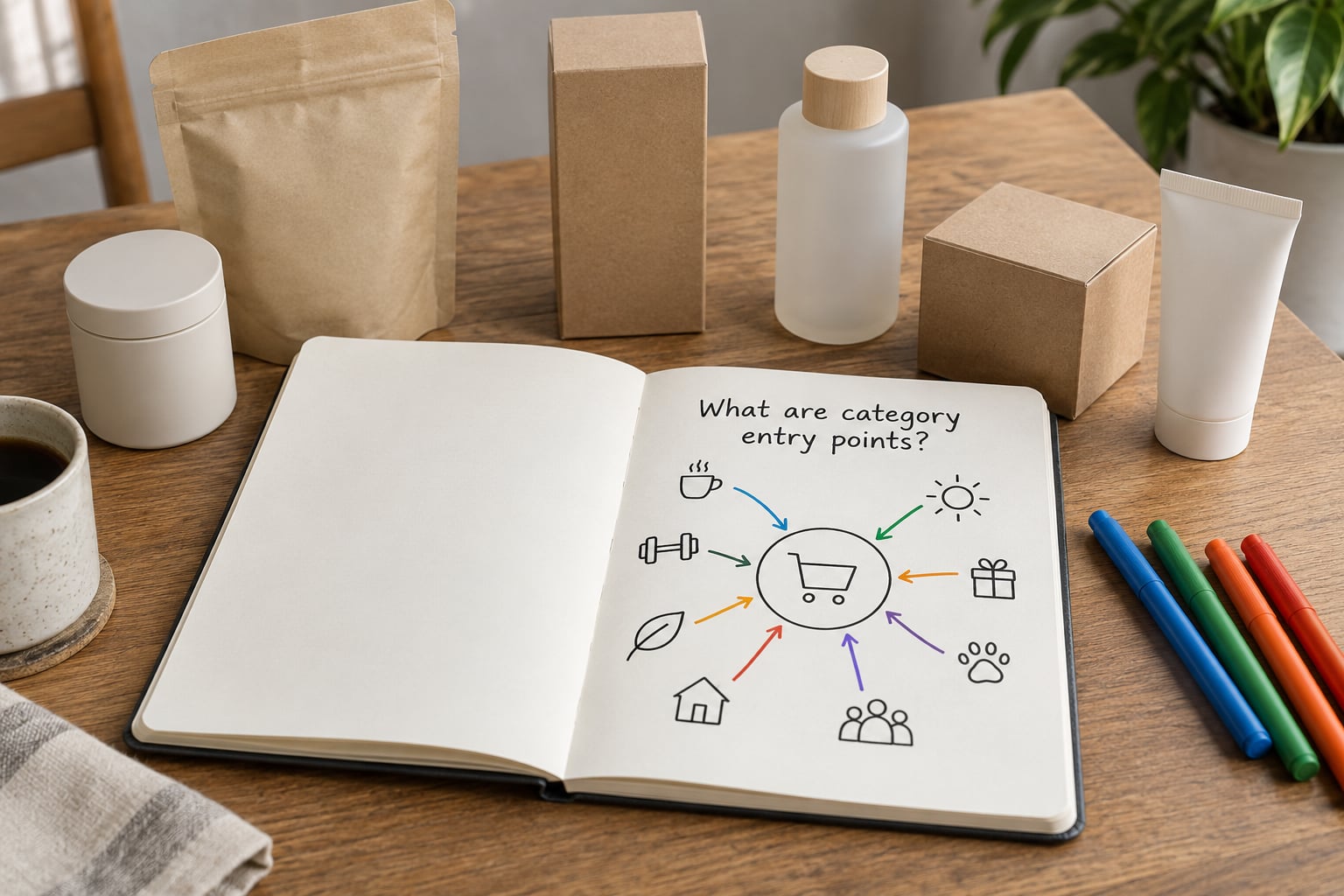
The short version is that an entry point is a moment, not a market. Hunger at 4pm, an unexpected guest on a Friday, a long drive, a quarterly planning cycle: each one pulls a different set of brands into the running, and none of them requires the buyer to be thinking about your product at all beforehand.
They are often described as buying cues or mental shortcuts, and the research lineage matters here. Romaniuk’s work at the Ehrenberg-Bass Institute, built on the Institute’s “law of the markets” finding that most buyers pick whatever is familiar and available in the situation they happen to be in, treats memory as organised by situation rather than by product attribute. The brand is retrieved, not evaluated.
That framing separates a CEP from three things it is often confused with:
- A target audience or persona. “Women 25 to 34 in urban households” describes who. “Reaching for something after a long shift” describes when. The same person is a different buyer in each situation.
- A product attribute. “Sweat-wicking fabric” is what the product has. “Getting to the gym without a bag” is the situation in which that attribute starts to matter.
- A positioning statement. Positioning decides what you claim about yourself relative to rivals. A CEP describes the circumstances in which your claim gets a chance to be considered at all.
The distinction matters because the two solve different problems. Positioning answers “why us?” after you are in the consideration set. Entry points answer “how do we get in the consideration set” more often.
Why do category entry points matter for brand growth?
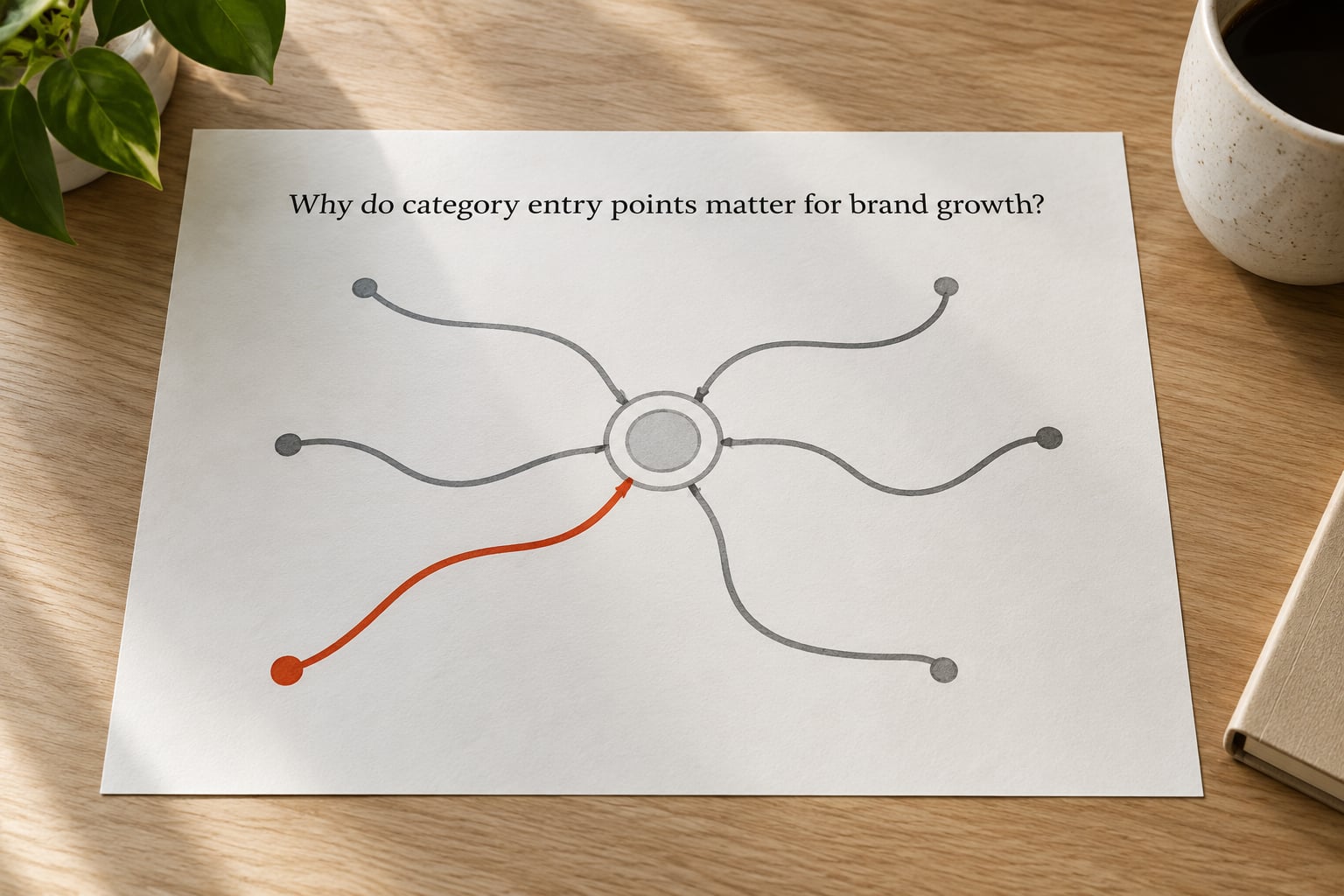
Because growth in most categories comes from buying more people at lower frequency, not from squeezing more loyalty out of the people you already have. Penetration and frequency are not evenly interchangeable, and in a crowded market the brands that grow fastest are usually the ones with the broadest set of occasions on which they are even considered.
Three ideas carry most of the argument.
Salience outranks differentiation in the memory test. If someone cannot recall your brand in the moment they need the category, a clever line about your features has nowhere to land. Familiarity is the gate, not the merit.
Reach beats frequency. Being present in twenty situations thinly is usually a better investment than hammering three situations hard. Memory in this model is built by repeated encounters with a cue, and encounters come from breadth of presence.
Availability is two things at once. Mental availability is whether the brand comes to mind in the situation. Physical availability is whether it is actually there to buy. Owning an entry point you cannot stock, display or deliver is a wasted slot.
What this does not mean is that a brand must win every route in. Owning thirty situations badly is worse than owning four properly, because each one still needs distinctive assets, distribution and creative behind it. The goal is more entries in the mental consideration set than you have today, chosen deliberately.
How do you identify the strongest category entry points?
Most of the work is in the method, not the list. A five-step process gets you a defensible shortlist instead of a brainstorm.
1. Start from situations, not from your product. Write down every moment in which someone in this category would reach for something. If you cannot describe the cue without naming your product, you have started from the wrong end.
2. Reconstruct recent real occasions. Ask about the last purchase, not the next one. Shoppers rationalise heavily after the fact, so “why do you buy” surveys tend to return tidy reasons that do not match the moment. “Tell me about the last time you bought this” recovers the actual context, including who was there and what time it was.
3. Use their words, not yours. Situations get remembered in language: “running a fever”, “before the in-laws arrive”, “when the invoice runs late”. Copy the phrasing from interviews directly into the map. Internal jargon in a cue description is a sign the situation has not been understood yet.
4. Check where you already stand. For each situation, look at whether your brand is present in the channel the shopper would use, whether your creative already evokes that cue, and whether a competitor is visibly claiming it. Most maps are mostly a list of existing presence rather than a list of gaps.
5. Score, then cut. Rank the situations and take the top few into planning. The number of things you can properly resource is far smaller than the number of situations that exist, and teams that skip the cut end up spreading across thirty entries and building none.
Budget-wise, this is a small research investment for most teams: a round of interviews, some sales and channel data, and a workshop. It is not a nine-month programme, and treating it as one is how good ideas get abandoned.
What are the main types of category entry points?
The taxonomy matters less than the coverage. Seven types cover most of the ground in consumer categories, and each behaves differently.
Need states
The underlying job the category is bought to do: nourishment, freshness, staying awake, cleaning a specific mess. These are the most stable cues and the easiest to be present for, because they recur for everyone in the category.
Occasions and moments
Social or emotional milestones: a birthday, hosting guests, a wedding, a promotion, a holiday. Occasions carry emotional load, which makes them useful for building distinctiveness even when the purchase frequency is low.
Locations
Where the purchase actually happens or the need occurs: the gym, the office kitchen, the car, a hospital corridor. Location cues are unusually reliable because they map directly onto physical availability decisions.
Emotional states
Feeling states that cue the category: stressed, overwhelmed, tired, uncertain, under pressure. These are less literal than needs and often the richest source of creative territory, though they are also the easiest to claim generically.
Time of day
The 4pm slump, the late-night top-up, the Sunday evening reset. Time cues are narrow, sharply defined and easy to buy against, and they routinely out-perform broader cues because the shopper self-identifies at exactly that moment.
Usage situations
How the product is actually deployed: shared at the table, one-handed, on a train, in a meeting. These often sit closest to the product’s real form and map well onto shelf and interface decisions.
Reference points
People, places or objects the cue is attached to: a doctor’s advice, a child’s birthday, a particular retailer, a trusted review. These act as borrowed credibility and matter more in considered purchases than in fast ones.
How do you choose which entry point to own?
Score each candidate on how often it happens, how strongly it pulls the buyer toward a purchase, and how hard it is to actually be there. Add a judgement on competitive pressure and whether your brand has any honest right to the situation.
| Entry point | Frequency | Intensity | Accessibility | Read |
|---|---|---|---|---|
| Unexpected guests, Friday evening | Low | High | Medium | Support it with occasion creative |
| Mid-afternoon slump at the desk | High | Medium | High | Lead here; easy to buy and place |
| Long drive, passenger, no time to stop | Medium | High | Low | Deprioritise unless distribution is there |
The accessibility column is the one teams skip and regret. An entry point with high frequency and high intensity that your brand cannot physically reach is a theoretical entry point, and treating it as real produces plans that never show up in sales.
On competitive intensity, be honest about who is already standing there. A cue already owned by the category leader is not automatically off limits, but it is expensive, and you should only enter it with assets and distribution to match.
How can a brand turn an entry point into growth?
Owning an entry point means the same brand shows up in the same situation, in the same physical place, with the same recognisable signals. That is four kinds of work.
Product. Does anything about the range make this situation easier? A pack size that fits in a gym bag, a format that survives a long drive, a taste that works at 11pm. If the situation does not change what you sell, you may be buying media for a cue rather than serving it.
Distinctive brand assets. Cue and brand have to be wired together, which is what distinctive assets do. A colour, a shape, a sound, a character. Generic cues are the ones a whole category can claim, and a brand with no distinctive asset in a situation rarely becomes the default answer there.
Channels and physical availability. Match where the cue occurs to where the buyer will look. Retail placement, search coverage, delivery range and shelf presence are part of entry point ownership, not a separate operational matter.
Creative. Build communications around the situation rather than around the product’s virtues. A campaign that only ever shows the pack is announcing itself in a situation nobody chose.
Test the same way you test anything else, and be patient about what you are measuring. Behaviour changes slowly, and a single campaign readout will tell you more about media efficiency than about entry point strength.
One newer context is worth a paragraph. In AI answer engines there is no shelf, so there is no moment where the shopper sees you next to a rival. The cue has to be reproduced in text, and that shifts part of the work from physical availability to being described in the situations people actually ask about. Nobody owns this angle yet, and it is a reasonable place for a small brand to have an advantage over a large one.
What mistakes do brands make with category entry points?
Treating an entry point as a demographic. “25 to 34” tells you nothing about a moment. Demographics describe a mailing list; entry points describe a memory cue.
Copying a competitor’s map. If the list came out of another company’s workshop, the situations may be real but the right to claim them is unexamined. You end up advertising against an incumbent’s strength.
Claiming a situation you cannot serve. Entry points that demand distribution, service or product changes the business has no plan for produce frustration rather than availability.
Activating the leader’s cue by accident. Creative built around a need state almost everyone uses tends to say the category’s name rather than yours. The category gets the salience.
Measuring activity, not demand. Ads run, posts published, impressions bought: none of these are entry points owned. The question is whether you come to mind more often when that situation comes up.
Expecting the list to replace a point of view. Category entry points explain salience. They say nothing about distinctiveness, and a brand that is everywhere and says nothing memorable can still lose to a brand that is present in four situations and unmistakable in all of them.
That last limit is worth restating, because it is the part the concept itself is honest about. If your problem is that people consider your brand and pass, more entry points will not fix it.
Frequently Asked Questions
What is a category entry point?
It is a specific situation, need, occasion or context that cues a buyer to bring a category, and ideally a particular brand, to mind at the moment of choice. Hunger at 4pm or an unexpected guest on a Friday are both entry points. The concept comes from Jenni Romaniuk’s work at the Ehrenberg-Bass Institute, where memory is treated as organised by situation rather than by product attribute.
Is a category entry point just a persona or target audience in new words?
No. A persona describes who someone is; an entry point describes when a category comes up for them. The same person is a different buyer in different situations, which is why entry points map better onto media and creative than demographics do. The overlap happens because people usually describe their lives with demographic labels, then stop there.
How many category entry points does a typical category have?
More than you can resource. A figure of roughly 35 per category circulates widely in practitioner material, but it appears without a credible published source, so treat it as a prompt rather than a finding. Most teams that run this exercise end up with somewhere between ten and twenty serious candidates and can properly own only a handful at a time.
How do you measure whether a category entry point strategy is working?
There is no standard metric, which is where most disagreement comes from. In practice teams track how often the brand is named when people describe recent purchases in that situation, and they correlate that with sales in the matching period, allowing for the lag. Support metrics such as branded search volume and share of entry point are directional, not definitive.
What are new category entries?
A new entry point is a buying situation that has recently become common enough to shape behaviour, usually because something in the consumer’s world changed. Subscription models, regulation, a shift toward repair over replacement, or a routine reshuffle after a life event can all create one. They show up first in interviews and search behaviour, then in sales data.
How do category entry points work in AI search and answer engines?
There is no shelf, so part of the job shifts from being stocked to being described. Answer engines draw on text, so a brand that is written about in the situations people actually ask about has a better chance of being surfaced in the answer. The cues still come from human situations, but distribution happens through language rather than placement, and this area has almost no settled practice yet.
Conclusion
Category entry points matter because they explain the mechanism behind most brand growth: brands are retrieved from memory by situation, and brands linked to more situations get considered more often. The map tells you where the demand lives and where you currently do not show up.
Start with one session. Ask people about the last time they bought, write the situations in their own words, and score them on frequency, intensity and whether you can actually be there. Pick the two you can credibly serve, align product, distribution and creative behind them, and check back after a few buying cycles whether you are being named more often when that situation comes up.