To communicate a price premium credibly, pair every claim about higher value with evidence the buyer can independently check, then frame the difference as a consequence they care about rather than a number on a page. That is the whole mechanism, and most premium messaging breaks at the second part because the proof is missing or unverifiable.
This guide walks through the six steps that turn a defensible price gap into a message a skeptical buyer accepts, what to gather before you write a word, and the failure modes that make an honest premium look like a rip-off. It takes about an hour to work through the first draft and another to test it on real buyers.
Table of Contents
- What You Need Before You Draft a Premium Message
- Step-by-Step: How to Communicate a Price Premium Credibly
- 1. Identify the specific value buyers receive
- 2. Connect the premium to the most credible cost driver
- 3. Use proof that answers buyer skepticism
- 4. Frame the price in the buyer’s terms
- 5. Make the comparison fair and specific
- 6. Test the message before scaling it
- Common Mistakes That Make a Premium Look Arbitrary
- Frequently Asked Questions
- How do you justify charging a premium price without sounding arrogant?
- What proof is most credible when explaining a higher price?
- Should a brand compare its price with a competitor?
- How can a brand explain a price increase to existing customers?
- What is the difference between premium pricing and simply being expensive?
- How do we communicate value when customers focus only on price?
- A note on the evidence behind this guide
- Conclusion
What You Need Before You Draft a Premium Message

A price premium is the gap between your price and the reference price a buyer measures you against: the category average, the nearest comparable offer, or the cheapest thing that looks similar. A premium becomes credible at the moment a buyer accepts that the reference price is the wrong comparison, or that your price is higher for a reason they can verify.
Four things have to be settled before you draft anything. The first is the customer problem in the buyer’s own words, because a premium justified against a problem you invented never lands. The second is your actual cost drivers, which is usually where teams are vague. The third is a proof inventory: what you have that a competitor could not put on their page tomorrow. The fourth is the claims you can substantiate, which is a shorter list than most people assume.
On cost drivers, be honest about which of these you are actually funding: superior materials or components, specialist labour or expertise, durability that extends service life, measurable performance, service and support, deliberate scarcity, or the elimination of risk for the buyer. Value-based pricing is defensible when it rests on the buyer’s outcome. Cost-plus pricing is not a justification, because your costs are invisible to the buyer and say nothing about what they receive.
On proof, count what exists today: test data, certifications, published standards, warranty terms, named customers who will take a reference call, third-party reviews, documented delivery records. In a r/AskMarketing thread about premium ice cream, users testing the same product with brand cues stripped found perception tracked price, packaging and expectation rather than taste. The signal has to be actively communicated, because buyers will not decode it themselves.
If your proof inventory is empty, that is the finding. You are not short of messaging, you are short of evidence, and no amount of copywriting repairs it.
Step-by-Step: How to Communicate a Price Premium Credibly
1. Identify the specific value buyers receive
Write down what the buyer gets, in one sentence, that they would not get from the cheaper option. If the sentence contains a word like quality, craftsmanship, experience or care, it is not finished yet.
Split the value into the categories that actually motivate spending. Functional value is a measurable difference in outcome. Risk reduction is the removal of a bad outcome the buyer is afraid of. Emotional value is how the purchase makes them feel about themselves. Social value is what their peers or customers infer from the choice. Time value is hours or weeks returned.
Most premium brands lead with the emotional layer and can prove nothing there. Flip it: put the functional or risk-reduction layer first, because that is the layer a buyer can verify and the layer that survives a price comparison. Several r/indiehackers operators report that raising prices deliberately shifted who bought from them, with lead quality improving once the cheap tier was gone.
How do you know it worked? Read the sentence back to a buyer in their words. If they restate it more concretely than you did, the value is specific. If they nod and say “sure, but why is that worth more”, you have named a benefit but not a difference.
2. Connect the premium to the most credible cost driver
Pick the one cost driver you can defend hardest, not the one that sounds most luxurious. Credibility comes from specificity and from repeatability: a buyer should be able to picture the thing that costs money and see why it is worth it.
“We use better materials” fails because it is universally claimed, unverifiable at the point of decision, and identical to what the competitor’s page says. Swap the adjective for the specification: a named alloy with a published tolerance, a stitch count, a measured hour of labour, a documented load rating, a stated number of service visits avoided. Now the claim is checkable and the competitor would have to publish the same number to match it.
Risk is often the strongest available driver because buyers feel it before they can measure it. A ten-year warranty, a fixed-scope implementation, a named implementation lead, or a money-back commitment each move downside onto you, which is a much more concrete statement about price than any adjective.
How do you know it works? Ask three existing customers why they think you cost more. If their answers cluster around your stated driver, you are transmitting it. If they say “the brand seems expensive” with no reason attached, your driver is not reaching them.
3. Use proof that answers buyer skepticism
Match the proof to the specific doubt it disarms. Buyers doubt durability, doubt the results, doubt the seller will still exist in three years, and doubt that the comparison is fair. One piece of evidence rarely answers all four.
Third-party validation carries more weight than self-report because it costs you nothing to say. Certifications, published test results from a named lab, an award with the awarding body named, analyst coverage, and press write-ups that include the specifics all transfer credibility. Guarantees and warranties function the same way: the obligation is visible, so the claim is checkable.
Customer evidence works when it is specific enough to be useful and named enough to be traceable. “Great service” proves nothing. A named customer, a stated starting condition, a number, a timeframe and a quote they agreed to gives you proof a buyer can imagine themselves inside.
Two forum patterns are worth planning around. In an r/askcarsales thread on the due-diligence objection, salespeople described the price objection as a mask for a different unstated concern, which means proof aimed at the wrong doubt still fails. And in trade forums like Fine Homebuilding, buyers ask “can you come down on the price” as a negotiation step rather than a verdict on value, so a rehearsed answer beats an improvised one.
How do you know it works? Show a buyer the proof without the price, then ask what it would be worth if they expected it to be the expensive option. If they can estimate a price range, the proof is doing the work.
4. Frame the price in the buyer’s terms
Translate the gap into the buyer’s outcome, their cost, or their risk. Sticker price is the seller’s unit of account. Total cost of ownership, which includes replacement, downtime, rework, internal time and switching, is the buyer’s.
Make the buyer’s number computable. Per-use cost, cost per year over a realistic service life, cost including the cost of the failure you are preventing. When you can hand a buyer a sheet where they do the arithmetic themselves, the premium stops being your assertion and becomes their conclusion.
Be honest about the limitation here. Premium-pricing advice leans more on reasoning than on controlled experiments, and most of the strong effects in this area rest on a small number of studies rather than a large replicated literature. If your audience is analytical, say so rather than borrowing authority you do not have.
How do you know it works? If you state the yearly figure and the buyer asks a follow-up question about their own operation, the framing reached them. If they repeat the sticker price back at you, they are still anchored on it.
5. Make the comparison fair and specific
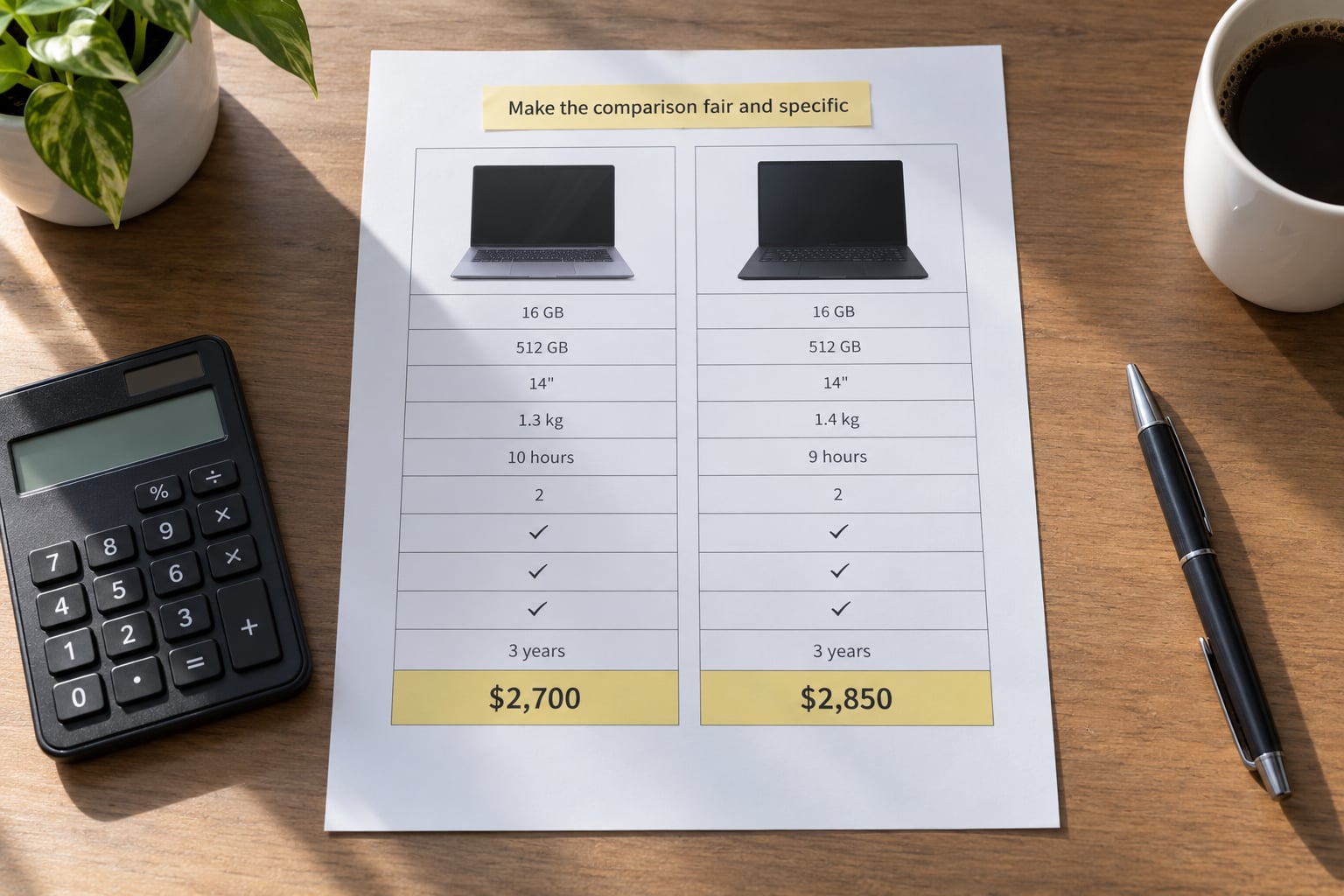
Anchoring means your price is judged against a reference point, so choosing a misleading reference produces a number you won for now and a refund later. The defensible move is to name the comparison, list what is included on both sides, and disclose the differences that do not favour you.
Compare like with like. Put the tier a buyer would actually consider next to yours, not a stripped-down budget version. Then show what they give up at the lower price, using their terms rather than yours: fewer included services, shorter support, higher maintenance, no named contact, slower turnaround.
Show the reference price at the point of decision rather than burying it. A pricing page with three tiers anchors differently from a single-tier page, and in r/shopify discussions about pricing pressure, tiered pricing was the common relief for small merchants serving both price-sensitive and value buyers.
How do you know it works? Give the comparison to someone who is not on your team and ask what the honest reason for the gap is. If their answer is a reason you did not write, you have left an ambiguity a competitor will use.
6. Test the message before scaling it
Run the message past real buyers before it goes on a page or into a pitch. The goal is to find the sentence they cannot repeat, not to collect opinions about whether they like it.
Three cheap tests work. Ask five to ten qualified buyers to restate your value claim after reading the page, and log the words they use; where your language and theirs diverge, that is your rewrite. Run a landing page variant and watch the specific drop-off step, since a page that reads well and loses people at the price line has a proof problem, not a copy problem. Finally, ask your sales team to state the justification cold, unprompted, and compare their answers, because inconsistent stories between salespeople show up immediately as lost deals.
Track discount frequency and win rate by segment. Rising discounts mean the premium is not being communicated credibly somewhere in the process, and the fix is upstream of the negotiation.
How do you know it works? Non-sales buyers volunteer the price justification without being asked, and the sales team says the same thing every time.
Common Mistakes That Make a Premium Look Arbitrary
Unsupported superiority claims. “The best in the industry” invites the buyer to supply the counterexample. Replace the superlative with a specification and a source.
The feature dump. Listing materials, components and process steps without a consequence reads as a spec sheet, not a reason. Every feature needs one line on what it changes for the buyer, and one line is often enough.
Vague luxury language. Words like exclusive, artisan and meticulously crafted are so widely used that they carry no information. The r/AskMarketing result above is the same point made experimentally: expectations and cues drove perception, not an intrinsic property.
Hidden comparisons and hidden fees. Trade buyers consistently treat “can you come down on the price” as a ritual step, but a fee that appears later reads as deception rather than as price, and it undoes every proof point you built earlier.
Habitual discounting. Once a product has been discounted regularly, the original price stops functioning as a reference, so buyers treat it as invented. Rebuilding that reference takes sustained discipline, and no premium copy fixes a damaged price history.
Segment mismatch. A premium communicated to buyers who structurally cannot absorb it teaches the market that your price is arbitrary. In the r/indiehackers discussions, moving away from the low end changed perceived quality and lead quality at the same time. Where the buyer cannot absorb the premium, declining the fit clearly is the credible option.
One more habit is worth naming because the evidence supports it: being willing to walk away. On the r/Contractor bidding threads the consensus advice was to hold firm and treat price pushback as noise. A seller with no alternatives and a seller defending a defensible price sound different, and buyers hear the difference.
Frequently Asked Questions
How do you justify charging a premium price without sounding arrogant?
Drop the tone and answer the question the buyer is actually asking. Every premium buyer is comparing you with a cheaper alternative, so treat the price as a difference to be explained rather than a favour to be granted. Name the specific differentiator, attach one piece of proof they can check, and state what it changes for them. A claim with evidence does not need to be loud.
What proof is most credible when explaining a higher price?
Third-party proof and visible obligations. Certifications, published test results from a named lab, a named award body and a warranty with clear terms all cost you nothing to state and cannot be dismissed as advertising. Customer evidence with a name, a number and a timeframe comes next. Self-reported quality claims carry the least weight, whatever the adjectives.
Should a brand compare its price with a competitor?
Sometimes, and honestly. A specific like-for-like comparison helps a buyer resolve the question they are already asking, especially when you disclose what the cheaper option gives up. Avoid naming a rival you have not studied, avoid comparing against a stripped-down tier nobody would buy, and never leave out a difference that counts against you. Misleading anchors win one deal and cost the relationship.
How can a brand explain a price increase to existing customers?
Give notice early, state the new price and the effective date plainly, and give one real reason rather than a list. Cost pressure, a change in what is included and a deliberate repositioning are all acceptable reasons when they are true and singular. Skip the apology language, which reads as deference to a charge you intend to defend, and offer existing customers something concrete in return.
What is the difference between premium pricing and simply being expensive?
Premium pricing is a defensible gap tied to a cost driver you can name and evidence the buyer can check. Being expensive means the gap exists but the reasoning does not survive comparison. The test is whether a buyer can explain why you cost more after reading your material and talking to someone in sales. If they cannot, you are charging more, not running a premium.
How do we communicate value when customers focus only on price?
Do not fight the price focus head on. Give them the arithmetic instead: cost per use, cost per year over a realistic life, or cost including the failure you are preventing, and let them run it on their own numbers. If the buyer still cannot build a case internally, that is segment information worth acting on rather than a pitch to sharpen. Price-only buyers rarely convert at the premium tier.
A note on the evidence behind this guide
Two effects from the pricing literature carry most of the weight here. The price-quality inference effect describes how buyers use price as a signal of quality when quality cannot be observed directly, which is why the signal has to be actively sent rather than assumed. Anchoring and reference-price effects describe how buyers judge your number against a comparison point, which is why the choice of comparison matters as much as the evidence.
Beyond those two, the practical advice here is largely reasoning from operator behaviour rather than controlled evidence. Forum material on pricing pushback, discount discipline and segment fit is qualitative and self-selected, and it is used here to illustrate failure modes rather than to establish rates. Anyone citing a percentage in this space should show the sample.
Conclusion
Start narrow. Name one cost driver you can defend, attach one piece of proof a buyer can verify, and translate the gap into one consequence in the buyer’s own numbers. Write that down in a single sentence, then test whether three people who have never met you can repeat it back. Everything else on the page, the packaging and the sales script comes after that sentence holds up.