
Validating demand with a landing page test means putting one promise, one price and one audience on a single page, sending qualified traffic to it, and watching for a costly action instead of a polite one. An email address is weak evidence. A pre-order or a card payment is strong evidence. The method below covers the setup, the seven steps, and the threshold that turns a page view into a build decision.
Most ideas die from a quiet failure: nobody was ever asked to pay. Building first and validating later produces months of work resting on an assumption you never checked. A landing page test costs a few hundred dollars of traffic and about a week, and it puts a real choice in front of strangers who have no reason to be polite about it.
I have watched founders treat a waitlist of 900 email addresses as proof, then discover that four people would pay anything and the rest wanted a free tool. The gap between those two groups is exactly what the test is designed to expose.
Table of Contents
- What You Need
- A specific audience
- A falsifiable value proposition
- A focused page
- One conversion action
- A traffic source
- A tracking plan
- A decision threshold
- Step-by-Step: How to Validate Demand With a Landing Page Test
- 1. Define the demand hypothesis
- 2. Choose one conversion action: how to validate demand, not curiosity
- 3. Write the minimum viable landing page
- 4. Set the success threshold before publishing
- 5. Send qualified traffic to the test page
- 6. Measure behaviour beyond the conversion
- 7. Review results and decide what to do next
- Common Mistakes
- Frequently Asked Questions
- How much traffic do I need to validate demand on a landing page?
- What is a good conversion rate for a landing page test?
- How long should I run a landing page test before deciding?
- Does a waitlist prove demand, or do I need pre-orders?
- Can ChatGPT build a landing page for a validation test?
- When should I skip a landing page test entirely?
- Conclusion
What You Need
A landing page test can be run by one person with a page builder and an ad account. The hard part is not the tooling, it is deciding in advance what counts as a pass. Seven things need to be defined before anything is published.
A specific audience
Write down who the page speaks to, down to the situation they are in. “For small businesses” is not an audience. “For the operations manager at a 30-person logistics firm who currently reconciles carrier invoices in a spreadsheet” is. Broad targeting is the most common reason a test returns a weak result that gets blamed on the page.
A falsifiable value proposition
One sentence that a buyer could agree or disagree with. If no reasonable person could say “that would not help me”, the promise is too vague to test. Specificity here does more work than any design choice.
A focused page
One page, not a site. A headline, the problem, the outcome, a short explanation of how it works, the price or price range, and one call to action. Everything that competes for attention dilutes the signal you are trying to measure.
One conversion action
Choose the single action that best represents buying intent for your product. Too many calls to action and you learn nothing about what people actually wanted.
A traffic source
Ads aimed at the specific audience are the cleanest option. Communities, cold outreach to a relevant list, or your own audience work too, as long as the people arriving resemble the people you meant to reach.
A tracking plan
Decide before launch what you will record: sessions by source, conversions, cost per conversion, and where each lead came from. Simple link parameters and a free analytics property are enough. Decide too how you will judge lead quality, because volume alone is not evidence.
A decision threshold
Write the number that means go, the number that means stop, and the range between them that means the test was too small to tell. Committing to this before the data arrives is the single most useful habit in the whole process.
Step-by-Step: How to Validate Demand With a Landing Page Test
1. Define the demand hypothesis
Turn the idea into a sentence that can be proved wrong. The template: “Because struggles with , they will when offered .”
A founder of a scheduling tool for therapists might write: “Because solo therapists lose billable hours to no-shows, they will book a paid 15-minute setup call for a reminder and deposit system at a monthly price, once they see a cancellation policy tied to their own no-show rate.” That sentence names the buyer, the pain, the offer and the evidence that would support it. Everything downstream gets easier once it exists in writing.
Include the price inside the hypothesis. Willingness to pay is one of the things you are testing, so a hypothesis that avoids pricing tests very little.
2. Choose one conversion action: how to validate demand, not curiosity
Signals stack in strength, and the rung you pick determines what the whole test is worth.
- Email signup on a free page. Cheap and easy, and easily inflated by curiosity. Treat it as a message test, not a demand test.
- Email signup with the price on the page. Much better. People who give an email after seeing a number have at least read the offer.
- Account creation or a form that asks qualifying questions. Filters out browsers and keeps only people willing to invest a minute.
- Pre-order, refundable deposit, or card payment. The strongest signal you can get from a page. Money moved is intent you can bank.
Move down the ladder as far as your risk tolerance allows. A founder who charges even ten dollars during validation usually sees the quality of the response change completely, because the population of replies shifts from people who are curious to people who are willing to act.
3. Write the minimum viable landing page

Build the page in the order a sceptical buyer reads it: what is this, is it for me, what does it cost, why should I believe it, and what do I do now.
A workable wireframe runs from the top down. Headline naming the audience and the outcome. Two or three sentences on the problem in the reader’s own words. A short list of what they get. The price, displayed plainly rather than behind a contact form. Proof, which early on means credentials, pilot results, a named partner, or a concrete number you can defend. A short block answering the two objections you hear most. One button, repeated once at the bottom. Nothing else competes with it.
Use plain customer language from your discovery conversations. Marketing phrasing reads as a pitch; the sentence a customer used to describe the problem reads as recognition.
One page builder and one form tool cover the whole job. Founders often pair a simple page builder with a form-first tool, which keeps the page light and puts the qualifying questions before the email field. A day is enough to build this, and a day is the right amount of effort.
4. Set the success threshold before publishing
Decide the pass mark now, while you are still capable of being objective. Three numbers usually cover it.
Traffic volume. Below a few hundred qualified visits, a conversion rate tells you very little, because the confidence interval is wide. Above roughly a thousand visits you will usually see a directional answer even at modest rates.
Conversion rate. Set a floor based on what the action costs you and what a customer is worth. A page that turns two percent of visitors into paid deposits is a different proposition from one that turns eight percent into email signups.
Cost per conversion. Compare it against what you can afford to spend to acquire a customer over its lifetime. A ratio in the region of three to one between lifetime value and acquisition cost is a common sanity check, and a test that lands far outside that range is telling you something worth listening to.
Also write down the lead-quality bar in advance. Ten deposits from people who fit your ideal customer profile mean something different from ten from anyone who clicked.
5. Send qualified traffic to the test page
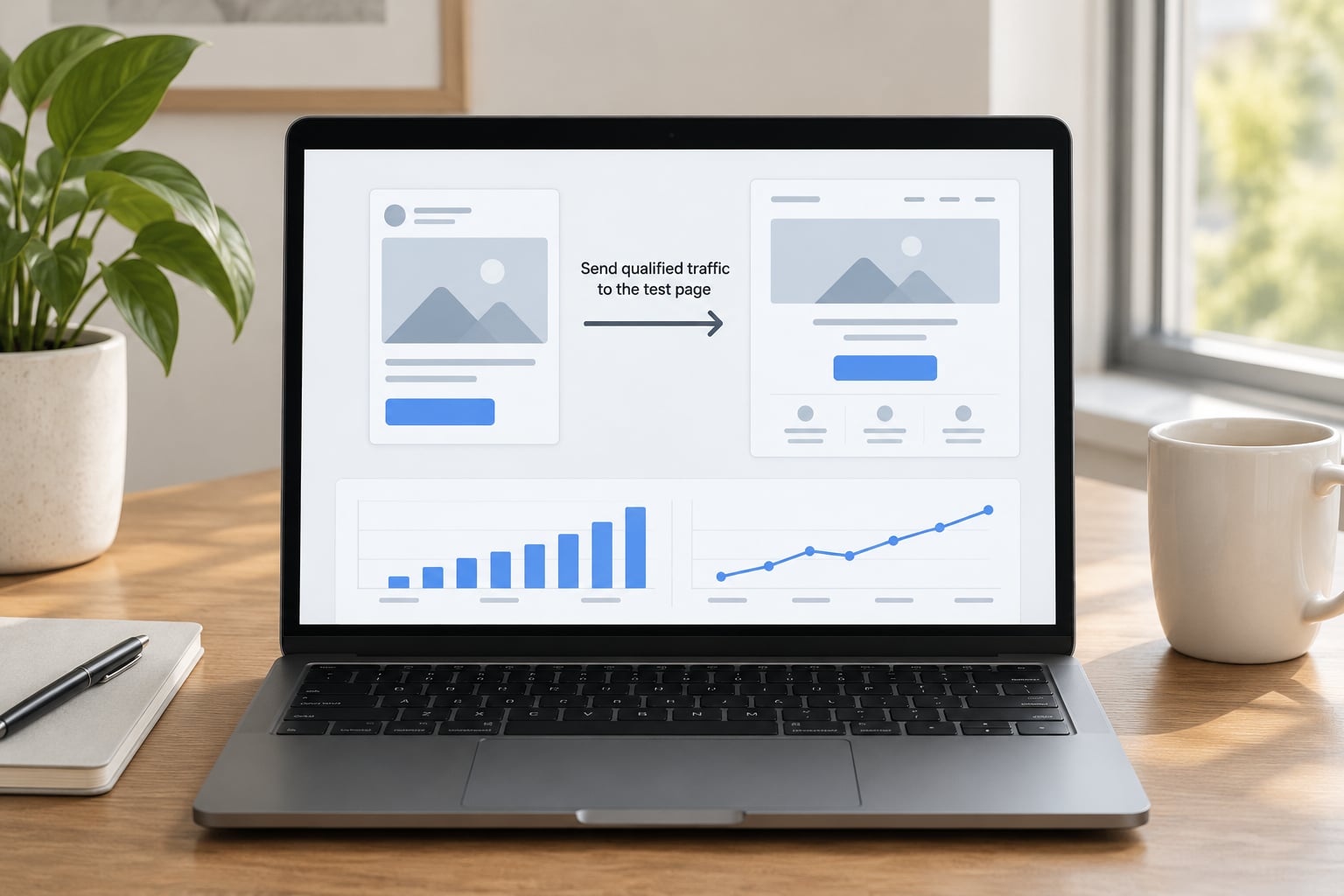
Match the traffic to the audience. Search ads on the exact problem language, a small prospecting campaign on a social platform, or a message posted in a community where that audience already gathers all work, provided the post comes from you rather than looking like an advertisement.
Free traffic is useful but noisier. A community reply tells you the idea is interesting to people who read it. It does not tell you how many will pay. Founders who rely on polite, free feedback regularly read enthusiasm as demand, and the gap between the two is where most wasted quarters begin.
Keep the page frozen while the test runs. Changing the headline halfway through means neither version has enough traffic to judge, and you end up with an anecdote instead of a result. If you want to compare messages, run them as separate pages with separate links from the start, so each one collects its own data.
Budget in small increments. A few hundred dollars spread across a week usually produces more readable data than the same amount spent in a day, because the budget survives long enough to see the tail of the traffic distribution.
6. Measure behaviour beyond the conversion
The conversion count is the headline, but the behaviour around it tells you why. Record where visitors came from, how far down the page they went, how long they stayed, how often the button was engaged, and how many people completed the action rather than abandoning the form halfway.
These numbers separate two very different failures. Low scroll depth with a normal click-through rate points at the headline and the audience fit. Deep reading with no clicks points at the price, the proof, or a missing reassurance. Very short dwell time across the board usually means the traffic was never yours to begin with.
Read the leads too. Which role wrote in, which company size, which exact objection appeared in the replies. Ten usable replies beat a hundred empty signups, and the replies are where you find the language for the next version of the page.
7. Review results and decide what to do next
Compare the numbers with the threshold you wrote down in step 4, not with a benchmark you found this morning. Landing page conversion rates vary enormously by audience and offer, and your own economics are the only fair comparison.
Then sort the result into one of three buckets.
Clear yes. The threshold was met, the leads fit your customer profile, and the cost per conversion sits inside your economics. Move to a concierge version delivered by hand for the first handful of customers, then build.
Clear no. Enough qualified traffic, far below the floor, with good engagement on the page. The problem is either not painful enough at the price offered or not painful enough for this audience. Either way, do not build.
Murky. Results land between the two. This is the most common outcome and the one most often talked up as a success. The honest response is a second test with a changed variable, usually the message or the price, not a bigger build.
Write down the decision, the evidence behind it, and what you would need to see to reverse it. Founders who skip this step tend to re-litigate the same evidence a month later.
Common Mistakes
Most failed tests fail for reasons that have nothing to do with design.
Vague audience. “Small business owners” produces a mixed crowd where some people need the product and most do not. Fix: name the role, the situation and the trigger that would make them look for a solution this week.
Competing calls to action. A subscribe button, a contact form and a social link give every visitor an easy exit. Fix: one action, repeated, with everything else turned into plain text.
Claims nobody tested. If the promise has never been put in front of a stranger, the page is testing your imagination as much as the market. Fix: test the promise in the smallest possible unit, including through cold outreach, before you pay for traffic.
Traffic that was never a fit. Broad interest targeting fills the page with people who will never buy anything at any price. Fix: check the traffic report before judging the page, and judge each source separately.
Editing the page mid-test. You end up with a blend of two versions and no clean result. Fix: freeze the page, or build distinct variants with distinct links from day one.
Quitting on the first bad day. Daily numbers bounce, especially at small volumes. Fix: set the test length in advance, a minimum of a week, and judge only at the end.
Judging by clicks alone. Traffic to a page proves almost nothing about demand. Fix: score the test on a costly action, then on the quality of the people who took it.
Frequently Asked Questions
How much traffic do I need to validate demand on a landing page?
A few hundred qualified visits is the practical floor. Below that, the conversion rate swings too widely to support a decision, because one extra signup can double your percentage. If you need paid traffic to reach that volume, budget in small daily increments across a week rather than in one burst, and count only sessions from the audience you defined.
What is a good conversion rate for a landing page test?
There is no universal number, and anyone quoting one without knowing your audience and offer is guessing. Judge the rate against your own economics: what a customer is worth to you, what you can afford to spend acquiring one, and how much friction your chosen conversion action creates. Compare each result against the threshold you set before launch, not against someone else’s site.
How long should I run a landing page test before deciding?
One week is the shortest sensible window, because weekday and weekend traffic behave differently and daily numbers bounce heavily at low volume. Two weeks is better if the budget allows, since it covers two full cycles. Set the duration in advance and judge only at the end, or you will stop on whichever day happens to look worst.
Does a waitlist prove demand, or do I need pre-orders?
A waitlist measures interest, not intent. It becomes meaningful when the price is on the page, when the form asks qualifying questions, and when the people who sign up match your ideal customer. Pre-orders and refundable deposits are stronger because money moved. Move as far down that ladder as the risk of your idea allows you to go.
Can ChatGPT build a landing page for a validation test?
Yes, and it is well suited to the job. Ask it for a first draft with your headline, problem statement, pricing and objection handling, then edit the language using real sentences from your customer interviews. What it will not do is choose the promise, the audience or the decision threshold. Those three decisions carry the entire weight of the test.
When should I skip a landing page test entirely?
Skip it when you can sell the outcome by hand faster than you can build a page, which is the case for concierge or service businesses. Skip it when your audience is unreachable by any channel you can buy. Also skip it when the result would not change what you do next, since a test you are not willing to act on is theatre rather than evidence.
Conclusion
The decision rule is short: a landing page test validates demand when qualified people take a costly action, at a cost you can afford, and they resemble the customers you meant to reach. Everything else is curiosity with a nice headline.
So start with three things today, before you open a page builder. Write one falsifiable hypothesis naming the audience, the problem, the promise and the price. Choose one conversion action as high on the commitment ladder as you can manage. Then write the number that means go and the number that means stop. Build the page, freeze it, run the traffic, and let the threshold decide.