
There is no universally correct answer to how to decide between house of brands and branded house. The choice follows from four measurable inputs: how much your audiences overlap, how strong your parent brand equity already is, how much reputational risk you can absorb, and what you can fund for the long haul.
That is the honest starting point, and it is also why most articles on this topic frustrate readers. They describe both structures beautifully, list six pros and six cons, and then leave the decision to intuition.
Below is a framework you can actually run. It takes about twenty minutes with a spreadsheet and a pen, and it produces a written recommendation you can hand to a board, an investor or a team that wants its own name on the box.
One more thing before we start. If you find yourself torn halfway through, the answer is often not a compromise between the two. It is a third structure — an endorsed brand or a hybrid — and that option solves most of the cases where people argue about the binary.
Table of Contents
- How to Decide Between House of Brands and Branded House at a Glance
- What Is the Difference Between the Two Brand Architectures?
- House of brands vs branded house: what each looks like at scale
- Is Apple a branded house or a house of brands?
- How Customer Perceptions Change
- Which Architecture Fits Your Growth Strategy?
- How to Compare Cost, Risk, and Operational Control
- A Decision Framework for Choosing the Right Structure
- 1. Write down the objective in one sentence
- 2. Audit the portfolio honestly
- 3. Measure audience overlap
- 4. Score the parent brand’s equity
- 5. Map the next three years, then match
- 6. Model the downside before you commit
- A self-scoring matrix you can run in twenty minutes
- How to Test the Decision Before Committing
- Which Should You Choose?
- Frequently Asked Questions
- Which is better for a new business, a house of brands or a branded house?
- Can a company use both house of brands and branded house?
- How do customers choose between a house of brands and a branded house?
- Which option is less expensive to launch?
- How can a business switch to a branded-house strategy?
- What is the main risk of using a house of brands?
- Conclusion
How to Decide Between House of Brands and Branded House at a Glance
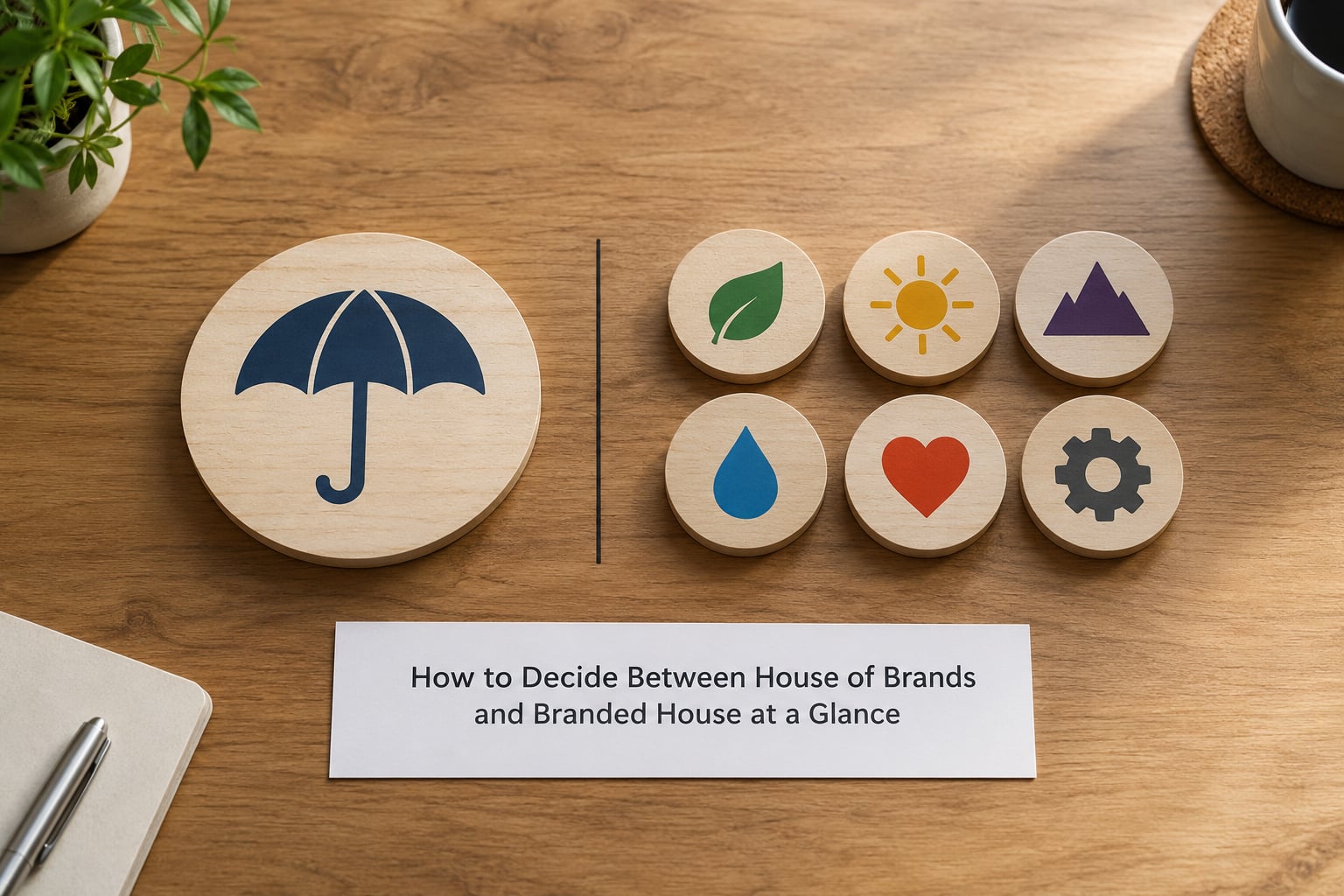
House of brands vs branded house comes down to one question: does the customer buy the product, or the name on the product? Everything else — cost, risk, speed, governance — follows from how you answer that.
| Dimension | Branded house | House of brands |
|---|---|---|
| Naming approach | Master brand plus a descriptive product name, such as a category word or model name | Every product carries its own invented name with no parent attached |
| Parent visibility | The parent name appears on the pack, in the logo and in the advertising | Customers may never learn who owns the brand |
| Where brand equity sits | Concentrated in the master brand and shared by everything in the portfolio | Held separately by each brand, so it cannot be lent to the next launch |
| Trust transfer | Strong. Recognition earned on one product carries straight to the next | None. Every new name starts at zero awareness |
| Risk exposure | Contagious. A problem with one product attaches to the parent and to its siblings | Contained. A failing brand takes damage alone and can be sold or dropped |
| Cost to launch the next product | Low. Packaging, photography and media reuse an existing system | High. Naming, identity design, trademark work and launch media all start fresh |
| Time to first sale | Short. Customers already know the name and need no re-education | Long. You have to build awareness and justify a switch from whatever they use now |
| Strategic flexibility | Lower. New products inherit the parent’s positioning, including its limits | Higher. Each brand can target a different audience, price point or category |
| Usually wins when | Audiences overlap heavily, the parent is well known, and the products are close substitutes | Audiences barely overlap, categories are unrelated, or acquisitions arrive with stronger names than yours |
The 20-second version: high audience overlap and a strong parent name push you toward a branded house. Low overlap and no established parent equity push you toward a house of brands. That is not the whole answer, but it clears out most of the confusion.
What Is the Difference Between the Two Brand Architectures?
A branded house puts every product under one master brand name that carries the identity and the accumulated trust. The customer knows the parent, and that knowledge helps sell the next thing you launch.
A house of brands gives each product a standalone identity and keeps the parent hidden or absent. The customer forms an opinion about the product alone, with no reference point and no inherited goodwill.
House of brands vs branded house: what each looks like at scale
Once you see the four standard models together, the choice stops feeling abstract. Most real portfolios are not pure — they borrow from the endorsed and hybrid patterns as their range widens.
| Model | How the customer meets it | Sub-brand independence | Best fit |
|---|---|---|---|
| Branded house | Parent name first, product second, one shared identity | Low; sub-brands cannot stray far from the parent promise | Tightly related products, one audience, efficient launches |
| House of brands | Product name only, no visible parent | High; each brand can be sold, replaced or repositioned alone | Unrelated categories, separate audiences, acquisitions |
| Endorsed brand | Distinct product name with a visible parent signature or badge | Medium; the product leads and the parent reassures | A product with its own character that still needs parent credibility |
| Hybrid | Some lines under the parent, others standalone, sometimes endorsed in between | Varies by line | Portfolios that grew by acquisition or run several categories |
The endorsed pattern is worth pausing on, because it solves more cases than people give it credit for. The product leads in the advertising and carries its own name and look; the parent appears as a quiet signature. The customer gets distinctiveness plus reassurance, and the parent still gets an equity contribution.
Hybrid is the honest label for most large portfolios. A company that grew through acquisition, then built its own category, then expanded into an adjacent one, rarely has a single coherent architecture — and pretending otherwise wastes a lot of meeting time.
Is Apple a branded house or a house of brands?
Apple is the textbook branded house, and it is worth studying precisely because the result looks so different from a typical portfolio. Apple puts its own name on almost everything it sells — iPhone, iPad, Mac, AirPods, Watch — and the customer buys into a single promise about how the thing works and what it feels like to own it.
The product names are not competing brands. They are category or model labels attached to one identity, and that is why an Apple customer already trusts a device they have never held. The same structure appears at Samsung with its Galaxy lines and at Virgin, where the parent name did a lot of the persuading.
Contrast that with Unilever or Procter & Gamble, where a shopper buying a personal care product is unlikely to connect it to the parent at all. Both work. They solve different problems.
How Customer Perceptions Change
Architecture shapes perception before it shapes any internal process. A customer who already recognises the name evaluates the product differently from one meeting an unfamiliar label, and that difference shows up in what they believe before they read a single feature.
Awareness is the first shift. In a branded house, your marketing budget compounds: money spent making people trust the parent reduces the cost of every future launch. In a house of brands, each launch starts the compounding again from nothing, which is why the model suits companies with the budget to sustain several separate engines.
Perceived quality follows a similar line. A parent name acts as a quality signal, so a new product inherits a reasonable assumption of quality before the customer has evidence. Without that signal, the brand has to earn credibility through product experience, reviews and word of mouth, which is slower and harder to control.
Trust transfer is where the models diverge most sharply. Trust earned by one product follows the parent name, so a failure in one place undermines everything else. Without a shared name, that contagion cannot happen — but neither can any of the goodwill, because it never had anywhere to go.
Differentiation works against the parent promise in a house of brands. If your positioning is precise, every sub-brand has to fit inside it or work hard to justify why it does not. That constraint costs flexibility and buys coherence.
Price sensitivity is worth mentioning because it surprises people. A weak or unknown brand competes on price, because the customer has no other reason to pay more. A master brand with genuine equity competes on value, and it can hold a higher price without losing the comparison shopper.
The commercial consequence: in a house of brands, performance and marketing carry the load. In a branded house, reputation carries part of it. If your products are genuinely differentiated and you can charge for that, a house of brands is defensible. If they are similar and the parent name does the persuading, a branded house protects you.
Which Architecture Fits Your Growth Strategy?
Architecture should follow the plan, not the other way round. Decide where the portfolio is going over three to five years, then pick the model that gets you there with the least friction.
| Your growth plan | Model that fits | Why |
|---|---|---|
| Extending an existing category with a new variant or line | Branded house | The audience is already yours; reuse of equity is the cheapest growth available |
| Entering a new category for the same customer | Endorsed brand or branded house | The audience overlaps but the promise differs, so the product needs some independent character |
| Selling to a different audience entirely | House of brands | Overlapping the names would transfer the wrong associations |
| Acquiring a company with a strong name | House of brands or endorsed brand | Rebranding it immediately destroys the equity that made it worth buying |
| Expanding into new geographies under local conditions | Hybrid | Some lines travel, others need local naming and local endorsement |
| Building a platform others will use | Branded house | The parent name becomes the asset, so it should be visible everywhere |
| Preparing to sell, franchise or spin off the business | Depends on what a buyer values | Sellable subsidiaries come from separated brands; a single strong parent sells as one whole |
A house of brands supports choice, experimentation and category diversification. It lets you test a radical proposition in one brand without staking the parent name on it, and it lets you kill or sell that brand if the test fails.
A branded house supports cross-selling, consistent positioning and accumulated equity. It suits businesses where customers buy several products over time, because each purchase makes the next one easier.
Watch the trap practitioners describe most often: defaulting to a branded house because it is easier, then discovering eighteen months later that the new line needs an audience the parent actively repels. The sub-brand feels constrained, the team wants to escape, and the naming argument turns into a political one.
How to Compare Cost, Risk, and Operational Control
Cost is where the two models differ most and are discussed least. A branded house spreads fixed costs — identity work, photography, packaging structure, media templates — across every product. A house of brands pays that fixed cost again for each new name, then pays a recurring price to keep that name alive.
For a small team, that recurring price is the binding constraint. Naming work, trademark searches, identity design and the ongoing media needed to make a second name known are all fixed costs, and a three-person marketing team cannot absorb many of them without something else degrading. One house, run properly, beats five names maintained badly.
Risk runs the other way and deserves equal weight. In a branded house, reputation is a shared asset and a shared liability. The classic cautionary case is GE Capital, which operated under a single powerful corporate brand and took serious reputational damage from one division’s problems, damage that reached far beyond that division’s business.
The same mechanism shows up at smaller scale. A recall on one product line, a pricing dispute on another, a service complaint on a third: all three conversations now happen under one name, and customers carry impressions between them whether you want them to or not.
House of brands contains that damage. It also gives you real operational options: a weak brand can be repositioned, licensed, sold or discontinued without touching anything else in the portfolio. Practitioners who frame this as “which popular brand will lose all its trust” are describing the branded house risk accurately.
Governance is the quiet cost nobody budgets for. A branded house needs rules about which names may sit under the parent, how new sub-brands are approved, and what happens when a product drifts from the parent promise. A house of brands needs a brand portfolio owner, a naming standard and a retirement process. Both need someone accountable, and that role usually does not exist yet.
Reversibility is the question people skip. Moving from a house of brands to a branded house later means redesigning identities, renaming products, replacing packaging, re-running trademarks and re-educating customers who have built a mental map. Moving the other way is cheaper but sacrifices the independence you built. Decide how much exit optionality you need before you commit, because you cannot buy it back cheaply later.
A Decision Framework for Choosing the Right Structure
Run these six steps in order. Skipping to step five is how teams end up with a preference they cannot defend.
1. Write down the objective in one sentence
Not “be more premium”. Something testable, like entering the contract catering market within eighteen months, or protecting a strong parent while testing a lower-cost line. The architecture you choose should serve that sentence, and if it does not, the sentence is wrong.
2. Audit the portfolio honestly
List every brand you own with awareness, revenue, sentiment and category. Mark the ones doing the heavy lifting and the ones nobody remembers. Accidental brand sprawl looks identical to a deliberate house of brands until you check whether the low performers were ever given a positioning and a budget.
3. Measure audience overlap
Compare the buyer profiles, not the demographics alone. A useful threshold: above roughly 60% overlap between two products’ buyers, a shared master brand will usually help. Below about 30%, it will usually hurt, because you are attaching a name to a promise it cannot make. Between the two, an endorsed brand is the safer route.
4. Score the parent brand’s equity
Check unaided awareness, how customers describe the brand unprompted, and whether sentiment is positive. Above roughly 70% awareness with clean sentiment, the parent is an asset worth building on. Under 30% awareness, there is nothing to transfer, and a branded house buys you overhead without the benefit.
5. Map the next three years, then match
Use the growth table above. If the plan is organic extension and cross-selling, that is a branded house. If it is acquisitions and new audiences, that is a house of brands. Mixed plans produce endorsed or hybrid structures.
6. Model the downside before you commit
Write the worst plausible outcome for each option: a recall, a failed launch, an acquisition. Then ask which one you could survive. Risk tolerance is a business fact, not a preference, and it should appear in the recommendation.
A self-scoring matrix you can run in twenty minutes
Score each line from 1 to 5, where 1 is firmly against you and 5 is firmly in favour, then multiply by the weight.
| Criterion | Weight | What a high score means |
|---|---|---|
| Buyer overlap across the portfolio | 3 | The same people buy most of your products |
| Strength of the parent brand today | 3 | The parent is already widely known and well regarded |
| Ability to absorb reputational contagion | 2 | A single product failure would not seriously hurt the business |
| Marketing resourcing per new launch | 2 | You can fund the awareness a brand-new name needs |
| Freedom to reposition products independently | 1 | You want the option to sell or retire single brands |
Scoring key: 60 or above points toward a branded house. 35 to 59 points toward an endorsed or hybrid structure. Under 35 points toward a house of brands. Anyone scoring in the middle band is usually reacting to an audience overlap problem that has not been measured properly, so measure it before choosing.
How to Test the Decision Before Committing

Every framework above is a hypothesis. These are the tests that turn it into a decision you can defend.
Customer interviews work better when you show names rather than describe them. Put two unbranded concepts side by side and ask which one they would try, then ask who they picture owning it. If the same picture comes up every time, that is your audience overlap data.
Concept testing on the packaging catches the reaction that surveys miss. Test the parent-led design against the standalone design with the target buyer, not with your team, because internal enthusiasm for a master brand is close to worthless.
Search and demand analysis gives you a read on which name already has a floor of awareness. A term with no existing demand means you are funding awareness from nothing; a term people already use for something else means you are fighting an association.
Look at the evidence that supports each architecture. Consistent naming and repeat purchase rates support a branded house. Separate buyer profiles, low cross-category association and independent category positions support a house of brands.
A pilot launch settles what research cannot. Run one product under the parent and one standalone, in the same period, with comparable spend. Watch conversion, repeat purchase and cross-interest — whether buyers of one try the other.
Which Should You Choose?
Match the structure to the situation rather than to a general preference.
- Established premium portfolio with closely related products: branded house. The parent is the reason people choose, and coherence protects the price.
- Rapidly expanding company buying other businesses: house of brands, with a clear endorsement rule. Keep the acquired names alive and separate the trust.
- Products for genuinely different audiences: house of brands or endorsed. Overlapping names transfer the wrong associations and waste the media spend.
- Limited launch budget and a small team: branded house. One identity, one system, shared assets. Depth beats count.
- Products that are substitutes for each other: branded house. Separate names in the same category compete for the same customer and cannibalise each other.
- A repositioning or a move upmarket: hybrid, so you keep the equity of the familiar name while giving the new tier its own character.
- An acquisition whose brand is stronger than yours: keep the acquired name, endorse rather than absorb. Absorbing it throws away the asset you paid for.
- A business being prepared for sale or spin-off: work backwards from what a buyer wants. Separate brands create separable assets; one parent sells as a whole.
If you are diagnosing an existing portfolio rather than choosing fresh, look for the symptoms. Customers cannot tell which brand belongs to whom, sub-brands fight over the same shelf, and nobody owns the naming decision. That is brand sprawl, and no architecture fixes it until someone is given the authority to retire a name.
Once you have decided, write it down. A one-page architecture charter covering naming rules, endorsement rules, who approves a new brand, and the conditions that trigger a review prevents most of the drift that turns a deliberate structure into sprawl.
Frequently Asked Questions
Which is better for a new business, a house of brands or a branded house?
For most new businesses, a branded house is the better starting point. You cannot afford the ongoing cost of building awareness for several standalone names, and one identity lets every piece of marketing work for the next launch. Choose a house of brands only when your products serve clearly different audiences or when you already have an acquired name worth protecting.
Can a company use both house of brands and branded house?
Yes, and most large companies do. This is called a hybrid architecture: some lines launch under the parent name while others run standalone, sometimes with a visible endorsement between the two. The important part is that the split is a deliberate rule, not an accident that grew out of whatever the marketing team shipped last quarter.
How do customers choose between a house of brands and a branded house?
Customers rarely think about architecture at all. They respond to familiarity, trust and performance. A recognised parent name shortens the decision because recognition acts as a quality signal, while an unfamiliar name has to earn attention through the product itself and a reason to switch. Price matters more when the brand has no recognition to lean on.
Which option is less expensive to launch?
A branded house is cheaper for every launch after the first. Packaging structure, photography, media templates and design work are shared across the portfolio. A house of brands pays naming, trademark, identity and launch awareness costs again for each new brand, plus a recurring budget to keep that name known. For small teams, that fixed cost is usually the deciding factor.
How can a business switch to a branded-house strategy?
Switching is possible but expensive and slow. You need to redesign identities, rename or re-badge products, replace packaging, re-register trademarks and re-educate customers who have learned a different map. Phase it: bring the strongest performers under the parent first, keep marginal brands standalone, and do it category by category rather than in one rebrand.
What is the main risk of using a house of brands?
The main risk is fragmentation. Each brand accumulates separate costs for awareness, design and management, and none of them inherits the equity of the others, so the portfolio grows more expensive per unit of revenue every year. The secondary risk is that customers never connect the businesses, which hurts cross-selling and weakens your negotiating position with retailers and platforms.
Conclusion
Choose the architecture that transfers the right source of trust while matching the portfolio you are actually building. Heavy audience overlap and real parent brand equity point to a branded house. Weak parent equity, unrelated categories and an acquisition-led plan point to a house of brands. Everything in between is an endorsed or hybrid structure, and forcing it into one of the two poles usually makes the problem worse.
Start with the first decision only: write your objective in one sentence and score your portfolio against the matrix above. Once that page exists, the architecture choice gets much easier, and the arguments that follow are about evidence instead of preference.