To frame shipping costs so they feel smaller, present the same charge in a different unit, against a different reference, or at a different moment in the buying flow. Breaking a delivery fee into a per-day rate, spreading it across the items in a cart, or showing it beside the order total changes how large the number feels without changing what the buyer pays.
That distinction is the whole subject. Framing never lowers your carrier bill and never alters the invoice. It changes perceived magnitude, which is where most of the recoverable damage sits.
Shipping is the fee shoppers complain about most and abandon over most often. Multi-study averages compiled by the Baymard Institute put the overall cart abandonment rate close to 70%, and extra costs such as delivery, tax and fees account for roughly 48% of those abandonments. Merchant discussion boards fill with the same unanswered question: is our abandonment rate actually driven by postage? Most sellers cannot say, because nobody has ever tested the framing.
The four steps below work in order. Change them in a different sequence and you will usually end up testing wording before you have decided what the fee buys.
Table of Contents
How to Frame Shipping Costs So They Feel Smaller: Step-by-Step
Start with the service, not the sentence. A delivery charge that buyers accept is usually one they understand, because something arrived alongside it: tracking, a shorter wait, insured handling, a return that does not require a shop counter. Decide which of those you actually provide, put the fee where the buyer sees it early, give them an honest comparison, then check whether any of it moved a number.
Use a value frame: how to frame shipping costs so they feel smaller
A fee feels large when it is attached to nothing. Attach it to a service the buyer would otherwise buy, and the same number reads as the price of a thing rather than a penalty.
- Speed, expressed per day. A charge of eight dollars on a five-day wait is one dollar and sixty cents a day. The unit change is free and often the quickest win, provided the delivery window you name is the one you actually hit.
- Handling that is described. Buyers on seller forums repeatedly say they cannot tell whether a fee covers postage, pick and pack, or insurance. “Picking, packing and tracked delivery” tells them more in four words than “Postage” ever does.
- The trip they are not making. For anyone who would have driven to a shop or a collection point, the fee replaces fuel, parking and time. Say so plainly and skip the romance language.
- Choice of speed at different rates. A standard option at a lower rate, shown next to a faster one, gives the buyer a real decision. That reframes the fee as a choice they are making instead of a charge happening to them.
Keep the wording factual. “Insured delivery with tracking, arriving Tuesday to Thursday” is a claim you can stand behind. “Free delivery” next to a line item that is not zero is not framing, it is a false statement, and it is the fastest way to lose a chargeback dispute.
Show the fee in the right place and format
Placement beats phrasing almost every time. A well-phrased fee that appears at the payment step still loses buyers, because the problem is no longer the number, it is the surprise.
- Show a live estimate on the product page and cart. Cost transparency is the most consistent recommendation in the checkout research I read, and the reason is behavioural rather than moral. Buyers who learn the cost after they have committed are deciding whether to keep their word, not whether the deal is good.
- Label the estimate as an estimate until a postcode or region confirms it. Once confirmed, do not move it. A charge that shifts after the buyer types their address recreates sticker shock in miniature.
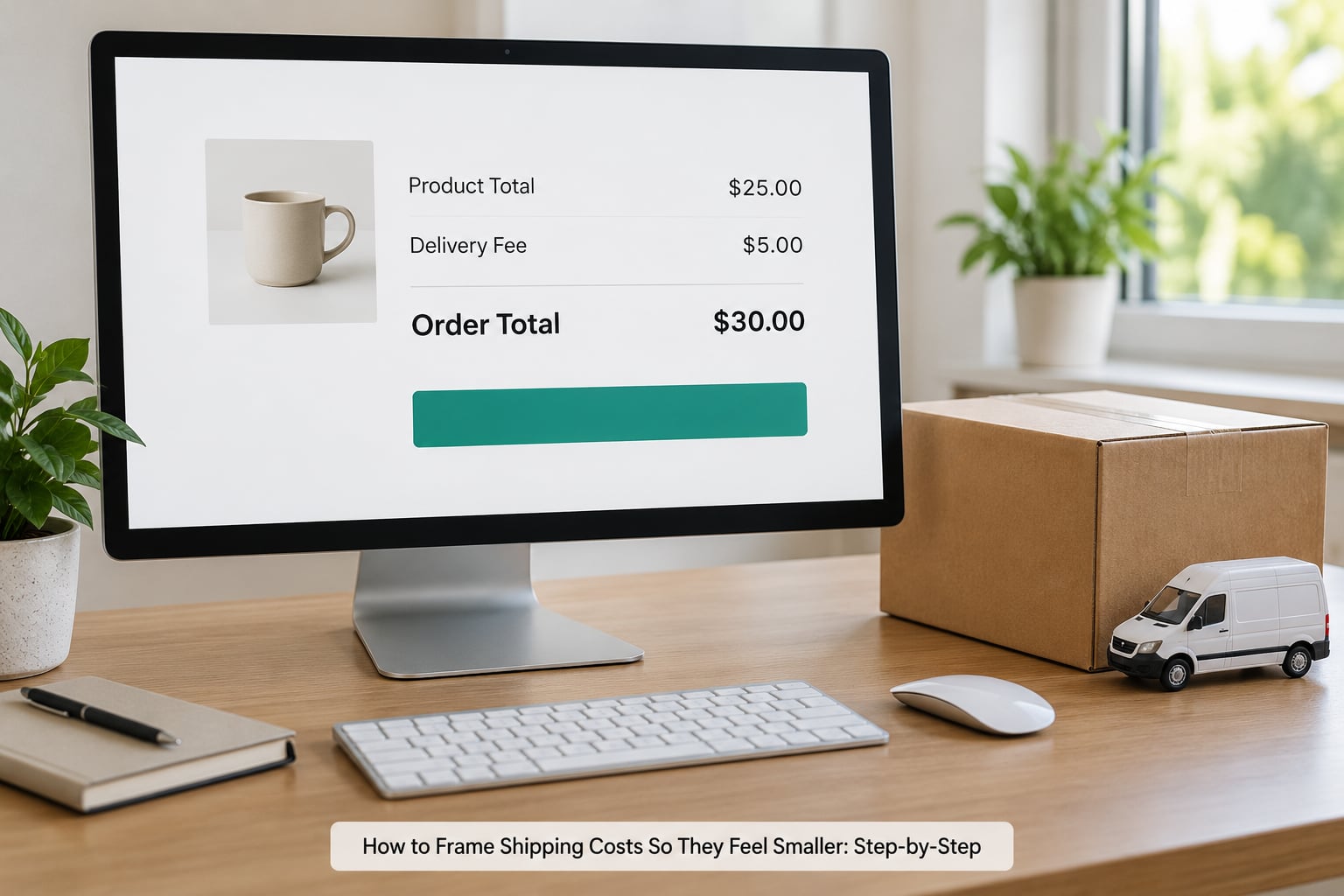
- Keep the order total visible at every step and let the delivery line sit inside the summary, above the total. Folding the fee into a tooltip or a link is the same trick as hiding it late, only sneakier.
- Name the line item for what it covers. “Delivery” reads as a service. “Postage” reads as somebody else’s cost being passed along, which invites the suspicion you were trying to prevent. Add a handling charge only if you actually handle it, and label it separately.
- Mind the phone. Abandonment in the multi-study data runs higher on mobile, around 75% against roughly 68% on desktop, and small type or a collapsed summary hides the one line the buyer needs. Give the total the largest type on the screen.
How to frame shipping costs so they feel smaller starts here: the same charge in the same words moves a long way simply by appearing earlier, on a screen the buyer is already reading.
Use a fair comparison or threshold
Once the fee is visible and understood, you can give the buyer something to measure it against. Two tools do most of the work, and both work best when the comparison is real.
Per-order versus per-item: pick a side and say why
This is the most argued-over question in seller communities, usually as a fairness issue rather than a perception one. Charging per order produces one number, which is easy to defend and easy to budget for. Charging per item divides the same total into smaller figures, so each line looks smaller while the cart total can jump when someone adds a second piece.
The practical rule depends on basket shape. If most carts hold one or two items, per-order is simpler and the buyer sees one number they can reason about. If your average cart holds several small items, per-item keeps each entry affordable-looking and makes a threshold easier to climb. Sellers on r/Etsy argue this as an ethics question; treat it as a basket-shape question instead and the argument ends quickly.
Thresholds, progress messages and absorbed pricing
- Set the threshold slightly above your current average order value and show the gap. “You are 6 dollars from free delivery” turns a charge into a progress bar and gives the buyer a concrete next action. The add-on suggestions sitting beside that message usually outperform the message itself.
- Express the fee as a share of the order when your baskets are large. On a high-value cart, a delivery charge under a few percent of the total reads as a rounding error rather than a decision. Keep the dollar amount visible too; the percentage supports it, it does not replace it.
- Absorb the cost into the listed price when the delivery quote is the objection itself. Nothing appears in the summary, so nothing is evaluated. You lose the free-delivery message you could have used as a marketing asset, discounting the delivery line becomes awkward, and sales tax and duty treatment gets more complicated depending on the market. It suits brands where nobody is comparing you on delivery anyway.
- Compare against a genuine alternative, never an invented one. A slower, cheaper option presented honestly beside the standard rate turns the standard rate into a default rather than a penalty.
Test the frame with real customers
Framing moves are cheap to change and easy to fool yourself about. One change, one surface, one hypothesis, and price held constant so you are measuring the frame rather than a discount.
- Choose a single change and write down what you expect to move, before you run anything. “Per-day framing raises checkout completion” is a hypothesis. “New copy might help” is not.
- Hold everything else steady: the rate, the delivery promise, the page layout, the promotion running that fortnight.
- Watch four numbers. Cart-to-checkout and checkout completion for the conversion effect, average order value for the basket effect, contribution margin per order for whether it was worth it, and the volume of postage questions in support tickets as a qualitative read.
- Set a margin guardrail before you start. A threshold usually lifts conversion and can cut margin per order when the added items do not cover the delivery you now absorb. Write down the break-even order value and check against it, rather than celebrating the conversion line.
- Give it enough traffic to mean something. Single-digit-point differences in conversion need thousands of sessions per variant. Declaring a winner on a few hundred sessions is how teams ship noise. If traffic is thin, alternate weeks rather than splitting a small audience in half.
- Watch real sessions. Replay the order-summary step. You will see people hesitate at the delivery line, and that hesitation is more informative than any engagement metric.
Sellers asking whether shipping is driving their abandonment are usually guessing, because the shipping question and the framing question share the same drop-off. One focused test answers both.
Common Mistakes
Most of these are not framing at all. They are disclosure problems wearing framing’s clothes, and they cost more trust than any phrasing gains.
- Saving the charge for the payment step. Surprise extra costs are the single most cited reason for abandonment in the widely cited data. Fix: put a live estimate on the product page and in the cart, and keep the all-in total unchanged afterwards.
- Vague estimates with no label. A number that might change and gives no reason invites doubt. Fix: label it as an estimate, say what it is based on, and confirm it once.
- Manufacturing urgency around delivery. “Last chance for free shipping” on a fee you always charge is pressure rather than framing, and it reads as a trick. Fix: state the deadline factually, once, and move on.
- Labels the buyer cannot decode. “Postage” and “Service fee 3” tell the customer nothing about what they are paying for. Fix: name the service in the label.
- Calling a charged delivery free. Fix: free means zero. Otherwise use “included”, or name the service you are providing.
- Hiding the total behind a link. A summary that only reveals the cost on click is the same as a late surprise. Fix: keep the total visible at every step.
- Absorbing postage and quietly raising list prices. The fee disappears, the prices drift up, and the comparison shoppers make between your old and new total is not one you control. Fix: keep the all-in price honest over a long period, not just on the day you relaunch.
- Writing about the charge instead of the service. “Shipping fee applies” names a cost and invites resistance. “Tracked delivery included as standard” names a benefit. Fix: describe what arrives, and let the amount sit on its own line.
Three habits keep the rest honest: show the all-in total before the buyer commits, keep it identical from cart to payment, and describe delivery estimates accurately even when the delivery is running late. Trust erodes fastest on the estimate that slips, and it takes longer to rebuild than any conversion gain returns.
Frequently Asked Questions
What is the best way to word shipping costs?
Name what the fee covers rather than what it is called. Delivery plus tracking reads as a service, while postage reads as someone else’s cost passed on to you. Keep the amount on its own line, describe the delivery window honestly, and never describe a charged delivery as free. Buyers cannot judge a fee they cannot decode.
Does free shipping make customers buy more?
Sometimes, and the effect is concentrated in shoppers already close to your average order value. A threshold just above it gives them a reason to add one item. The trade-off is real though: you absorb the delivery cost on every qualifying order, so a conversion lift can still mean less contribution per order. Run it for a set period and compare margin, not just checkout completion.
Should shipping costs be shown before checkout?
Yes, on the product page and in the cart, labelled as an estimate until the address confirms it. Once confirmed, keep the figure identical through to payment. Surprise extra costs are the most cited abandonment trigger in the multi-study data, and a fee that appears late is judged as unfair regardless of how reasonably it was priced.
How do I explain a higher delivery fee?
Say what drives it in one line: weight, distance, delivery zone, dimensional weight or the service level chosen. Then offer a real alternative, such as a slower standard rate, so the buyer has a choice rather than a complaint. Do not apologise for the carrier, and do not imply the fee is a markup when it is a pass-through.
Should I offer free shipping over a minimum order?
Set the threshold slightly above your current average order value, show the remaining gap, and sit an add-on suggestion beside it. Exclude bulky items clearly, because a surprise exclusion reads the same as a surprise fee. Before you launch, work out the order value at which the absorbed delivery cost is covered, then watch margin per order rather than conversion alone.
How can I test whether shipping-cost framing works?
Change one element at a time on one surface, keep the rate and delivery promise constant, and decide in advance which number you expect to move. Track checkout completion, average order value, contribution margin per order and support questions about postage. Single-digit differences need thousands of sessions per variant, so run the test long enough or alternate weeks instead of splitting thin traffic.
If your fee is genuinely out of line with what comparable stores charge, no framing trick substitutes for fixing it. The moves above matter most in the range where your cost is defensible and your presentation is not.
Conclusion
Start with one step: find out what your buyers actually object to about delivery. Read ten support tickets and watch ten session replays at the order summary. In most stores it is not the amount, it is the surprise or the ambiguity.
Then pick a single truthful value frame that matches the service you really provide, show the fee on the product page and in the cart, and leave the order total identical all the way to payment. Run it as one test against your current checkout and read margin, not just conversion. Repeat the cycle for the next frame.
How to frame shipping costs so they feel smaller is a presentation problem, not a pricing one, and it is solvable this week without touching your carrier rates.