
The next step after brainstorming is prioritization: ranking the captured ideas against agreed criteria so the team knows what to pursue, defer, and drop. If you want to know how to prioritize ideas after a brainstorm without the room splitting into a vote for whatever got said last, use the five-step method below. It takes one working session, or about an hour, and it works for a team of twelve or a solo creator with a notebook.
Most brainstorms don’t fail in the room. Generating thirty ideas in forty minutes feels productive, everybody leaves energised, and then nothing moves for a month. The list was never a decision. Prioritization is the step that turns generation into progress, and it is the step most teams skip because it involves saying no to people they like.
There’s also a psychology problem underneath. An idea you had at 2:15pm feels more vivid than the one somebody else said at 10:00, and vividness gets mistaken for value. Scoring ideas against fixed criteria before anyone argues about them removes a surprising amount of that noise.
Table of Contents
What You Need

Four things. If you assemble them before the session, prioritizing takes an hour. Skip one and you’ll spend that hour arguing about the setup instead.
The complete idea pool. Every idea from the brainstorm, in the words people actually used, before anyone edits them. A shared board, a spreadsheet with one row per idea, or a photo of the paper wall all work. What matters is that nothing is missing, because a short list quietly biases the result toward whoever contributed most recently.
Your decision criteria. Three to five questions that any idea can be answered against, written down before you look at the ideas. If you build these while reading the list, you’ll pick criteria that flatter the ideas you already like.
Relevant evidence. Whatever you actually know: search data, support tickets, customer interviews, sales figures, past performance of a similar project. You don’t need proof for every idea, only a way to separate the informed guess from the pure guess.
A shared definition of the goal. One sentence describing what this brainstorm is actually for, written in words everyone accepts. When this is missing, arguments about priorities are usually arguments about goals wearing a disguise.
How to Prioritize Ideas After a Brainstorm: Step-by-Step
Prioritization compares ideas against shared criteria, not against each other’s arrival time, volume, or the confidence of whoever suggested them. The five steps below put the criteria first and the opinions second. Skip nothing, and don’t start at step four.
1. Clarify the decision and define success
A brainstorm generates possibilities. A decision requires a question, so write the decision down in one sentence: which of these ideas, if we ran one this quarter, would move the number we care about most?
Then fill in the surrounding specifics. Who is the audience or user? What problem does the idea solve, and what happens if we do nothing? What constraints are non-negotiable, such as compliance, budget ceiling, or a launch date already promised to someone? What capacity do you actually have, in person-hours per month?
Finish by defining what has to be true for an idea to advance. “It needs a 4.5 rating and 400 reviews” is a usable bar. “It needs to feel aligned” is not, because nobody can score it honestly.
You know this step worked when the room can describe the winning idea in one sentence without hedging. If two people would describe it differently, the goal is still fuzzy and the scoring that follows will be noise.
2. Remove duplicates and obvious non-starters
Now normalize the pool. Merge overlapping ideas into a single entry with a clear name, rewrite vague suggestions as something specific, and set aside anything that fails a constraint you wrote in step one.
Clustering is the useful part here. A pile of thirty ideas usually contains six to ten distinct themes wearing thirty costumes, and the theme is what you should be scoring. Grouping related sticky notes on a board, or sorting spreadsheet rows into labelled columns, takes fifteen minutes and shrinks the decision to something a group can hold in mind.
Set aside rather than delete. An idea that violates a hard constraint is out for this cycle, not dead forever, and it belongs in a parking lot with a reason attached. People accept a deferral far more easily than a rejection, and a reason is what stops the same idea from reappearing in the next brainstorm.
Vague ideas can’t be scored at all, so clarify them. “Improve onboarding” is not an idea yet; “cut the six-step signup to three fields” is. Ask the person who wrote it what they meant before you score it on their behalf.
3. Choose criteria that reflect the decision
Pick a small set of criteria, three to five at most, that map to the decision you framed in step one. The test is simple: could two people score the same idea very differently on this criterion? If not, it isn’t doing work.
Impact asks how much the idea would change the outcome for real users, not how interesting it sounds. Effort covers the person-months and coordination overhead, including the parts nobody wants to count. Confidence records how sure you are of the impact estimate, which is a different question from impact itself. Strategic fit asks whether the idea serves the goal stated in step one. Speed to learn matters when the real risk is being wrong rather than being slow.
Which set you pick depends on the situation. Use MoSCoW (Must have, Should have, Could have, Won’t have) when the decision is a scope cut and you need categories rather than a ranking. Use ICE (Impact multiplied by Confidence multiplied by Ease) for quick sorting of a large list, though it multiplies guesses together and rewards optimism. Use RICE, which adds reach and divides by effort, when you can count how many people each idea touches. Use an impact versus effort matrix when you want a visual split into quick wins, big bets, fill-ins, and money pits. Use Kano when the real question is whether an idea delights or merely satisfies. Use WSJF when work is queued against a flow and cost of delay is the deciding factor.
You know this step worked when every idea can get a score for every criterion in a few minutes. If scoring one idea takes an argument, the criterion is too vague.
4. Score ideas independently before discussing them
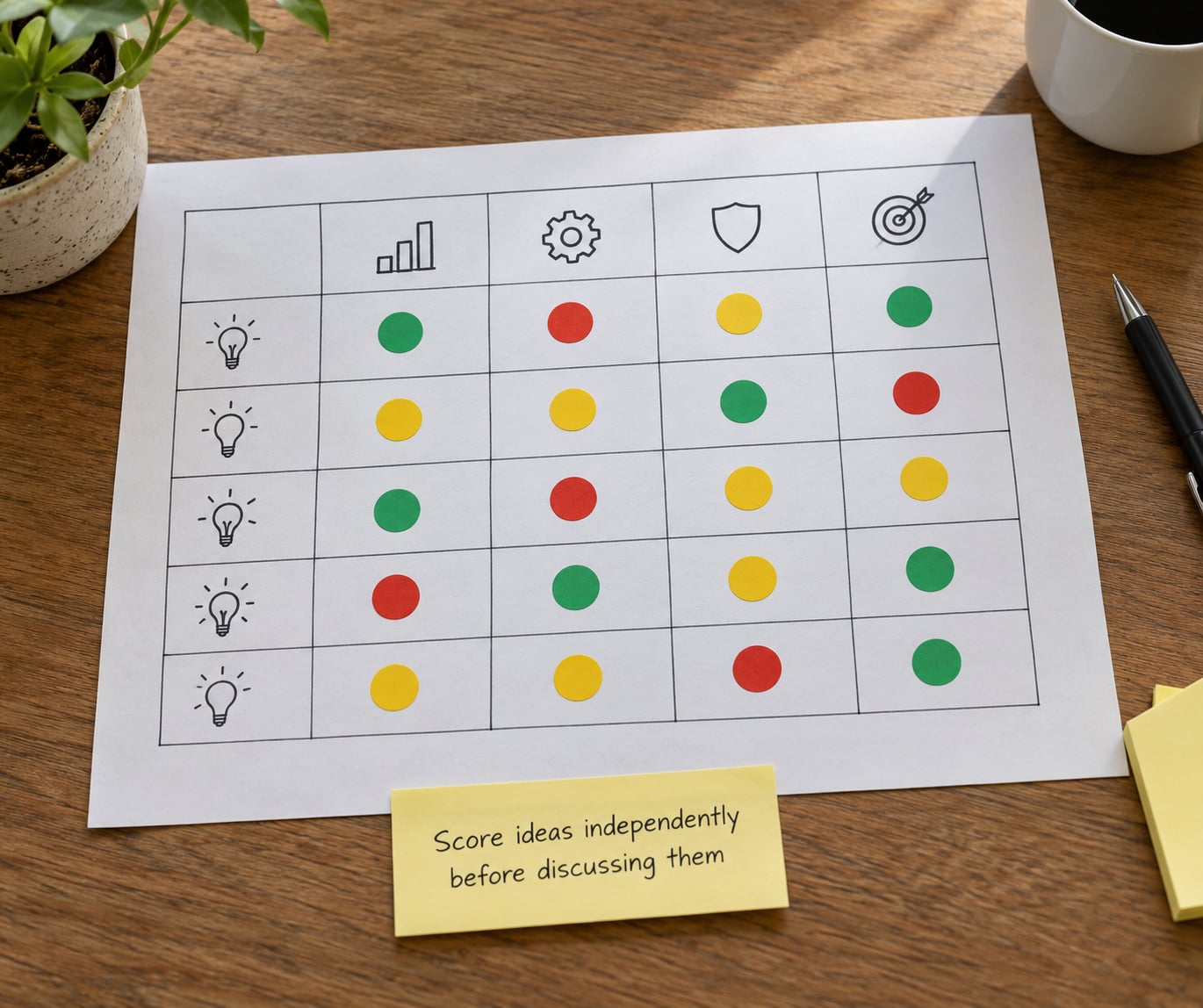
Score every idea on a fixed scale, one to five, before anyone compares notes. Silent individual scoring is the cheapest bias control there is, and for a solo creator it is the entire process, because nobody else exists to argue with.
Ask two extra things of each score. First, attach a confidence rating, because an impact of five with low confidence is a different proposition from an impact of five you’d bet on. Second, write one line of reasoning and list the assumptions behind it. The point isn’t the paragraph, it’s that a judgment you can explain turns a preference into something the group can argue with.
Anchor scores to definitions rather than instinct. For impact, five might mean “changes the outcome for most users” and two might mean “noticeable to a few”. Write those anchors next to the scale and the scores tighten up immediately.
Dot voting is a decent companion here when you need signal on relative preference rather than absolute judgement, but treat it as a tiebreaker, not a verdict. Three dots per person works better than five, and have people vote before the discussion starts so the first argument doesn’t set the anchor. Vote counts also measure how loudly an idea was proposed, which is exactly the signal you were trying to remove, so read them carefully.
You know this step worked when two people who scored independently land on a similar top group for different reasons. Large gaps between people are information: they point to a criterion that means different things to different people.
5. Compare the portfolio and choose next actions
The sorted list is a starting point, not an answer. Look at the whole set of ideas rather than the top row, because the portfolio tells you things a single ranking hides.
High impact with low effort is your quick wins: start these now, because they’re cheap progress and they build the credibility you’ll need for the harder work. High impact with high effort is the strategic bets: these usually need a sponsor, a scoped first version, or a cheap test before anyone commits a quarter to them. Low impact with low effort are fill-ins that can absorb spare capacity. Low impact with high effort is the money pit, and this is the quadrant where a written decision saves the most money later.
Then choose. How many ideas advance depends on capacity, not enthusiasm: count the slots you can genuinely staff this cycle, usually fewer than half of what everyone wants. Give each advancing idea an owner, a next concrete action, and a date. An idea without an owner and a date is a wish.
For the ideas that didn’t advance, write the “why not” in one line each. Not to win an argument, but so the person who proposed it can see the reasoning and so the decision doesn’t get relitigated from memory next quarter.
You know this step worked when the room leaves knowing exactly what happens next, who does it, and what was deliberately left out. If you’re still debating after an hour, the goal in step one was too loose.
Common Mistakes
Voting before defining criteria
Dot voting and fist-to-five feel productive and produce arbitrary results. The fix is simple: write the criteria and the definitions first, then vote. If you must vote, have people score criteria separately before combining.
Treating activity as impact
Busy ideas get scored high because they involve a launch, a redesign, a webinar. Ask what measurable change follows, and score zero where nothing measurable follows. A quiet fix to a defect that costs support hours beats a flagship launch that nobody measures.
Rewarding novelty and the loudest voice
Newest ideas and confident voices pull attention, and both are irrelevant to whether an idea should happen. Score before discussing, and let the person who proposed an idea score it last. The golden rule of brainstorming applies to the follow-through too: evaluate ideas, not people.
Scoring bundles instead of ideas
“Improve the whole onboarding flow” can’t be compared with anything. Split bundles into separately scoreable pieces, score them, then score the dependencies between them. Sequencing matters as much as ranking, since one item can be worthless until another exists.
Treating a first ranking as permanent
Priorities drift as evidence arrives. Set a review date now, and define re-prioritization triggers in advance: a competitor shipping the idea, a customer segment changing, a cost estimate doubling, or a key assumption being proven wrong. Deciding when to re-rank before you need to prevents the whole exercise from being quietly reopened by whoever is most annoyed.
When everything feels equally important, that is a signal about your criteria, not about your ideas. Either no criterion is discriminating, in which case you haven’t decided what success means, or the goal is a list of equal-ranked wishes, in which case you need to pick a ranking method that forces order, such as an impact and effort matrix, and accept that the last few slots will be thin.
A few habits help. Keep one row per idea in a single place so the pool is shared rather than remembered. Give the loudest person in the room the job of writing down objections while everyone else scores. And timebox the session: fifty minutes of scoring, ten to assign owners, and stop even if the list isn’t perfectly settled. A prioritization session that ends at 60 minutes beats one that ends next Tuesday.
Frequently Asked Questions
What is the next step after brainstorming?
The next step is prioritization: ranking the captured ideas against agreed criteria such as impact, effort, confidence, and strategic fit, so the team knows what to pursue, defer, and drop. A brainstorm without it produces a list, not a decision. Assign an owner and a next action to each idea that advances, and write a one-line reason for each idea that does not.
What is the golden rule of brainstorming?
Judge ideas, not people. Criticism during a brainstorm is deferred so that people keep generating, and the same rule has to hold during prioritization. Score the idea against criteria, never the person who suggested it, and ask people to record assumptions so disagreement targets the reasoning rather than the proposer.
What is the 6-3-5 brainwriting method?
Six people write ideas for six minutes, then pass their paper to the next person, who adds more and may build on what is there. After five rounds, everyone, including the writer, has a list. Because generation is silent, quieter contributors and less senior ideas survive to the prioritization stage, which makes the later ranking less distorted by who spoke first.
How do you prioritize ideas when everything seems important?
If every idea scores the same, the criteria are not discriminating, so go back to the goal and write what success actually means. Then choose a method that forces order, such as an impact versus effort matrix, and rank the whole set rather than assigning a flat tier. Advance only as many ideas as you can staff, usually fewer than half the room expects.
Should you prioritize ideas individually or as a group?
Score individually first, then discuss. Silent scoring keeps the first argument from anchoring everyone, and it surfaces where people genuinely disagree instead of where the most senior person set the tone. Compare scores afterwards and dig into the gaps, which usually reveal a criterion two people interpreted differently.
What should I do with ideas you decided not to pursue?
Park them with a reason and a review date instead of deleting them. A one-line why not keeps the decision from being relitigated and makes the idea recoverable if evidence changes. Without a review trigger, a parking lot quietly becomes a graveyard, and the same ideas resurface in the next brainstorm with no history attached.
Conclusion
Prioritizing ideas after a brainstorm takes about an hour and produces something a brainstorm alone never will: a decision. Frame the decision, clean the pool, pick three to five criteria, score silently, then look at the whole set as a portfolio before assigning owners and parking the rest with a reason.
Start with the least glamorous part. Agree on the decision you’re actually making, write down the constraints that cannot move, and define the criteria before anyone sees the list again. Everything after that is faster, calmer, and much harder to argue with.