A leading question is any survey question whose wording, assumptions, or answer options nudges respondents toward a particular response instead of measuring what it claims to measure. To learn how to write survey questions that avoid leading the respondent, you strip loaded adjectives, surface hidden assumptions, split double-barreled items, balance every scale, add a genuine escape option, and pilot the draft with eight to twelve real people before launch.
The bad news first: a leading question does not ruin a study quietly. It corrupts the exact number you built the study to move, and no sample size fixes it. A 2,000-response survey with a loaded stem produces 2,000 copies of the same bias.
The good news is that most leading questions are visible once you know what to look for, and most of the repair work takes about an hour per ten questions. Researchers on research-methods forums describe the same fix again and again: treat any AI rewrite as an editor pass, not an author, then hand the draft to real respondents.
Table of Contents
- What You Need
- Step-by-Step: How to Write Survey Questions That Avoid Leading the Respondent
- Common Mistakes
- Frequently Asked Questions
- How can I tell whether a survey question is leading?
- What is the difference between a leading question and a confusing question?
- Are Likert scales leading when their wording is positive?
- How do I rewrite a double-barrelled survey question?
- Does the order of survey questions affect how people respond?
- How many people should pre-test a survey questionnaire?
- Conclusion
What You Need
You need six things before you write a single stem, and most of them are decisions rather than purchases.
The research objective, in one sentence. If you cannot say what decision the survey informs, you cannot tell whether a question is neutral or merely neutral-sounding. “Understand why churn increased” beats “check customer satisfaction.”
Who is answering. Recent customers, lapsed customers, prospective buyers, and non-users all answer the same stem very differently. Know which group each question is for, because a fair question about your product to a user can be unfair to someone who has never used it.
The decision the data will feed. Write down what you will do differently for a low score versus a high score. If nothing changes, cut the question.
A draft answer set for every item. You cannot judge a stem without the options under it. Options are half the bias, and they are where most careful researchers forget to look.
Enough context to keep the question honest. Terms like “churn,” “onboarding,” or “SLA” mean nothing to a general respondent. That context belongs in the instructions, not in the stem where it can tilt the answer.
Eight to twelve real people for a pilot. Colleagues are acceptable if they sit outside the project. Friends and family are fine for a pilot, never for a result you will present.
Step-by-Step: How to Write Survey Questions That Avoid Leading the Respondent
1. Define what each question must measure
Write the construct beside each question before you draft it: not “satisfaction” but “how satisfied the respondent feels with the resolution speed of their last support ticket.” A named construct is your defence against later drift.
Then apply three rejections. Reject double-barreled items that ask two things at once. Reject vague items whose answer would look the same under two different real-world situations. Reject questions nobody will act on.
A practical test: read the construct aloud. If a respondent could satisfy it in two genuinely different ways, you have a double-barreled question, not a measure.
2. Use neutral, plain, and specific wording
Neutral wording means the stem could be asked by someone who benefits from any answer. Start there and cut four categories: assumptions, loaded adjectives, jargon, and vague timeframes.
Assumptions. “How satisfied are you with the speed of our support?” assumes the support was slow. “How satisfied are you with the speed of your last support contact?” assumes only that a contact happened.
Loaded adjectives and adverbs. Excellent, best, only, frustrating, innovative, effortless, and obviously all point. So do intensifiers like incredibly and surprisingly, which carry an implicit comparison the respondent never agreed to.
Double negatives. “Would you not agree that the app is slow?” makes respondents reverse two steps, and research on satisficing shows the extra work pushes people toward the easiest read rather than the truest one.
Vague timeframes. “How often do you use the reporting dashboard?” invites a guess. “In the past 30 days, on how many separate days did you open the reporting dashboard?” invites a count.
Keep stems under about 15 words where you can. Long stems carry more hidden material, and every extra clause is another thing to read past.
3. Balance the response options
Balanced options matter as much as balanced wording, because a neutral stem with a lopsided answer set still pushes. Four rules cover most cases.
Make the scale symmetric. A five-point agreement scale runs strongly disagree, disagree, neither agree nor disagree, agree, strongly agree. A five-point scale that runs poor, fair, good, very good, excellent is not symmetric, and it biases upward before anyone reads it.
Label every point. Numbers invite people to hunt for meaning. “1 to 5” with only the endpoints labelled produces noise that lands on the middle box.
Make the list mutually exclusive and exhaustive. Ask whether two options could both be true. If so, either split them or accept a multi-select, which is a different question and needs its own wording.
Offer a real escape option. “Don’t know,” “prefer not to say,” “not applicable,” and “have not used this” are different options serving different respondents. Pick the one that matches your construct, not all four in a row. Practitioners treat a near-zero escape rate as evidence that people are being forced rather than a sign of a clean survey; somewhere in the low single digits to low teens is normal.
Match the scale to the question. An agreement scale asked about frequency produces skewed results that look like a finding but are an artefact of the mismatch.
4. Control context, order, and instructions
Even a perfectly worded stem inherits bias from where it sits. Questions about benefits asked before satisfaction questions tend to raise satisfaction scores, which is why non-demographic blocks get randomised while screeners stay at the front.
Section headings prime too. A block called “What we did well” makes the following items read as praise. Name sections after the topic: “Your last support contact.”
Randomise answer-option order where order is arbitrary, such as a list of brands or features nobody has heard of. Do not randomise the scale itself, because people read the whole scale as a single object and reversing it mid-list is confusing rather than neutral.
Watch length as a bias source. Past a certain point, respondents start satisficing: choosing the first plausible answer, the midpoint, or a straight line down the page. Trim anything you would not defend in a methods review.
5. Check every question for leading cues
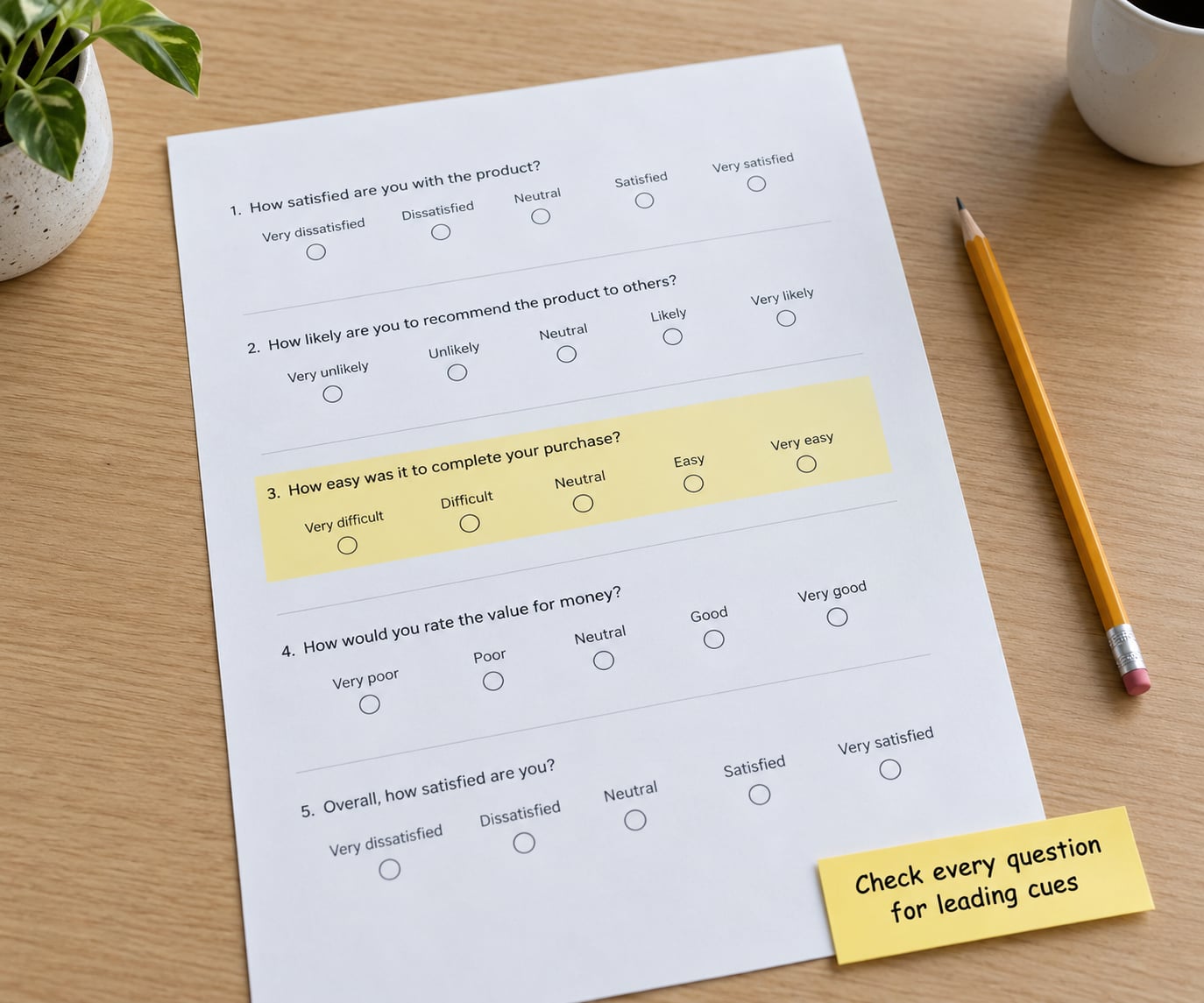
This is the review pass, and the imaginary-neutral respondent test is the fastest tool I know of. Imagine a respondent who has never heard of your product, holds no opinion about your competitor, and wants nothing from you. Read the stem aloud to that person. If their honest answer would be “I don’t know what you’re asking,” the stem leads.
Run six specific checks on each question.
Hidden assumption. Does the stem treat something as true? “Why did you leave the trial?” assumes they left. “What most influenced your decision after the trial?” does not.
Absolute term. All, always, never, only, and completely force a respondent into a corner they may not be in.
Embedded claim. A question containing an assertion invites agreement with the assertion rather than a judgement about it.
Implied answer. If the options already answer the stem, the stem is decorative and you have learned nothing.
Forced choice. If a respondent has a real answer outside the option list, the list is wrong, not the respondent.
Social desirability pressure. Questions about honesty, health, income, or ethics need an anonymity cue and sometimes an indirect format, or the answers drift toward what is respectable.
Then run the inversion test: draft the opposite-leaning version. If “How much did the process frustrate you?” sounds reasonable, the original was probably pushing and the symmetric version deserves a look. If the inversion reads as absurd, your original wording was probably fine.
6. Pre-test and revise with real respondents

Pilot testing is where the last layer of bias gets caught, because reading your own draft hides more than it reveals. Recruit eight to twelve people from your target population, watch them attempt the questionnaire without helping, and ask what they thought each question meant.
Cognitive pre-tests use think-aloud and verbal probing. You are not testing the answer, you are testing the interpretation. Useful probes: what does this word mean to you, why did you pick that option, what else did you consider, and what would you have said if you had not seen these options?
Track three numbers during the pilot. Completion rate should sit at or above roughly 60 percent, item nonresponse should stay under 5 percent, and midpoint use on opinion scales usually falls somewhere between 15 and 35 percent, with a very low midpoint share often signalling pushy wording.
Also watch completion time. Five to eight minutes for a typical short survey is a reasonable target; a much faster run suggests speeders who never read the stems.
Before you go live, run the two-variant test practitioners use: put both a plain neutral wording and a slightly warmer wording in front of 30 to 60 respondents. Where a top-two-box figure differs by more than about 10 percentage points between variants, the wording is doing work, and the neutral one is usually the honest one.
If you use a chatbot to draft or tidy wording, hand it the objective, the construct list, and an instruction to preserve your domain terms by name. The common failure is over-sanitizing: the rewrite strips every specialist term and leaves something vague and technically neutral but useless. Then treat the output as a draft you edit, not a questionnaire you send.
Common Mistakes
These are the failure modes that show up repeatedly, with the rewrite that fixes each one.
| Type | Biased version | Why it leads | Neutral rewrite |
|---|---|---|---|
| Double-barreled | How satisfied are you with the price and the quality? | One score cannot cover two ideas | Ask price satisfaction and quality satisfaction as separate items |
| Presupposition | Why did you stop using our product? | Assumes the respondent left | What most influenced your decision in the past 30 days? |
| Loaded adjective | How helpful was our friendly support team? | Two evaluative words before the answer | How satisfied were you with the response to your last request? |
| Implied consensus | Most customers agree the app is easy to use. Do you? | Tells respondents what the norm is | How easy or difficult was it to complete your task? |
| Absolute term | Did you always receive an answer within a day? | Forces a yes or no over a varied experience | How often did you receive an answer within one business day? |
| Negative framing | Would you not agree that the price is too high? | Double negative plus a loaded judgement | How satisfied are you with the price you pay? |
| Unbalanced scale | Poor, fair, good, very good, excellent | No negative anchor above the midpoint | Very dissatisfied to very satisfied with a labelled midpoint |
| Forced choice | Which do you prefer: the free plan or the paid plan? | Excludes non-users and neutrals | Screen for current usage, then ask only among users |
| Vague timeframe | How often do you export reports? | No recall window | In the past 30 days, how many reports did you export? |
| Leading examples | Was the checkout fast, like the one-step flow? | The example pre-anchors the comparison | How many steps did checkout take for you last time? |
| Social desirability | Do you always follow the security policy? | Asks for the socially correct answer | State anonymity plainly, then ask about the last four weeks |
| Anchoring list | Rate us against the leading competitors | Positions you second | Rate each provider independently without naming an order |
| Double negative | Would you not recommend us to a colleague? | Two reversals for one judgement | How likely are you to recommend us, 0 to 10? |
| Hidden claim | Because our onboarding is short, how did you find setup? | Embedded claim becomes the finding | How long did setup take, and how did you find it? |
| Order effect | Benefit questions placed above satisfaction questions | Primes favorable recall | Randomise non-demographic blocks |
| Section framing | Section headed “What we did well” | Labels the items before they are read | Section headed “Your last support contact” |
| Missing base logic | Non-users asked to rate the feature | They cannot answer from experience | Add a usage screen, then skip logic for non-users |
| Scale mismatch | Agreement scale used for a frequency item | Produces a skewed, meaningless spread | Use a frequency scale from never to daily |
| No escape option | Forced yes or no on an unfamiliar feature | Invents opinions to fill the box | Add have not used this or not applicable |
One last mistake deserves its own note: over-correcting. Once you know about presupposition, some people strip every domain term out of every stem, and the question becomes so abstract that nobody can answer it. Neutral is not the same as bland. Keep the words a respondent needs in the instructions, where they inform without tilting.
Quick Tips for Neutral Survey Questions
Read each stem without its options. If it reads oddly on its own, the options were probably doing the work.
Ask what a sceptical respondent would infer from your wording. That inference is your bias, whatever you intended.
Get a second reviewer who did not write the draft. Bias is invisible to the person who wrote it, and a second pair of eyes catches more in ten minutes than another hour of solo editing.
Move necessary context into the instructions rather than the stem, and keep the stem to the measurement.
Write down every question you could not make fully neutral, along with the reason. Documenting a known limitation is what lets you interpret the result honestly later.
If a leading question already went out, three options exist: report it as a limitation with the affected items excluded, re-field a corrected version, or run a sensitivity check comparing the affected items with related unbiased ones. What you should not do is present the affected number as if it were clean.
Frequently Asked Questions
How can I tell whether a survey question is leading?
Read the stem aloud to an imaginary respondent who has no opinion about your product and nothing to gain from you. If their honest reply would be I do not know what you are asking, the stem leads. Practically, check for hidden assumptions, evaluative words such as excellent or frustrating, absolute terms like always, and an implied answer. Then invert the question. If the reversed version also reads sensibly, the original was pushing.
What is the difference between a leading question and a confusing question?
A leading question is understood perfectly and still nudges the answer. A confusing question is not understood, so the response reflects the respondent’s guess about your intent. Leading questions usually come from loaded words, presupposition, or unbalanced options. Confusing questions come from double-barreled wording, jargon, or missing timeframes. The fix differs: leading questions need neutral rewrites, confusing questions need splitting, simplification, and a concrete recall window.
Are Likert scales leading when their wording is positive?
Yes, in one specific way. An agreement scale asks whether a statement is true, so a positively worded statement invites agreement regardless of experience, which produces acquiescence bias. Two things protect you. Alternate the direction of positively and negatively worded items across a block, and make sure each item is about a distinct attribute rather than a restatement of the same idea. Reverse wording has its own risk: a negatively framed item can be harder to read and gets skipped more often.
How do I rewrite a double-barrelled survey question?
Split it into one question per idea, then give each its own answer set. How satisfied are you with the price and the quality? becomes two items: how satisfied are you with the price you pay, and how satisfied are you with the quality you receive. Keeping them in one item forces respondents to average two unrelated judgements, and the resulting score cannot tell you which half to act on. Check your whole questionnaire for the same pattern while you are in there.
Does the order of survey questions affect how people respond?
It does, and the effect is measurable. Benefit and feature questions asked before satisfaction questions tend to raise satisfaction scores, because respondents recall what went well. Keep screening and eligibility questions at the front, keep demographics together near the end, and randomise the order of other non-demographic blocks. Randomise option order inside a list only when the list is arbitrary, and never randomise the direction of a scale, which adds confusion rather than neutrality.
How many people should pre-test a survey questionnaire?
Eight to twelve is enough for a working pilot. You are looking for interpretation failures, not statistics, and a small group surfaces confusing wording, double-barreled items, and missing options quickly. Watch completion rate, item nonresponse, and how often people choose the midpoint or an escape option. If you want to compare two neutral wordings rather than just find broken questions, raise the group to 30 to 60 and compare top-two-box figures between the variants.
Conclusion
Start with the smallest possible job: pick one question, write down the single thing it must measure, and draft it in words a stranger would use. Then read it aloud to someone with no stake in your project.
If you take the full sequence from this guide, the order matters. Define the measure, neutralise the stem, inspect the options and the context around it, then pilot with eight to twelve people and revise what they misunderstood. That loop takes an afternoon and it is the difference between data that describes your respondents and data that describes your questionnaire.
Keep the self-audit next to your screen when you build the next one. Bias is not a one-time mistake you fix and forget; it creeps back in every time a deadline compresses and a stem gets written in a hurry.