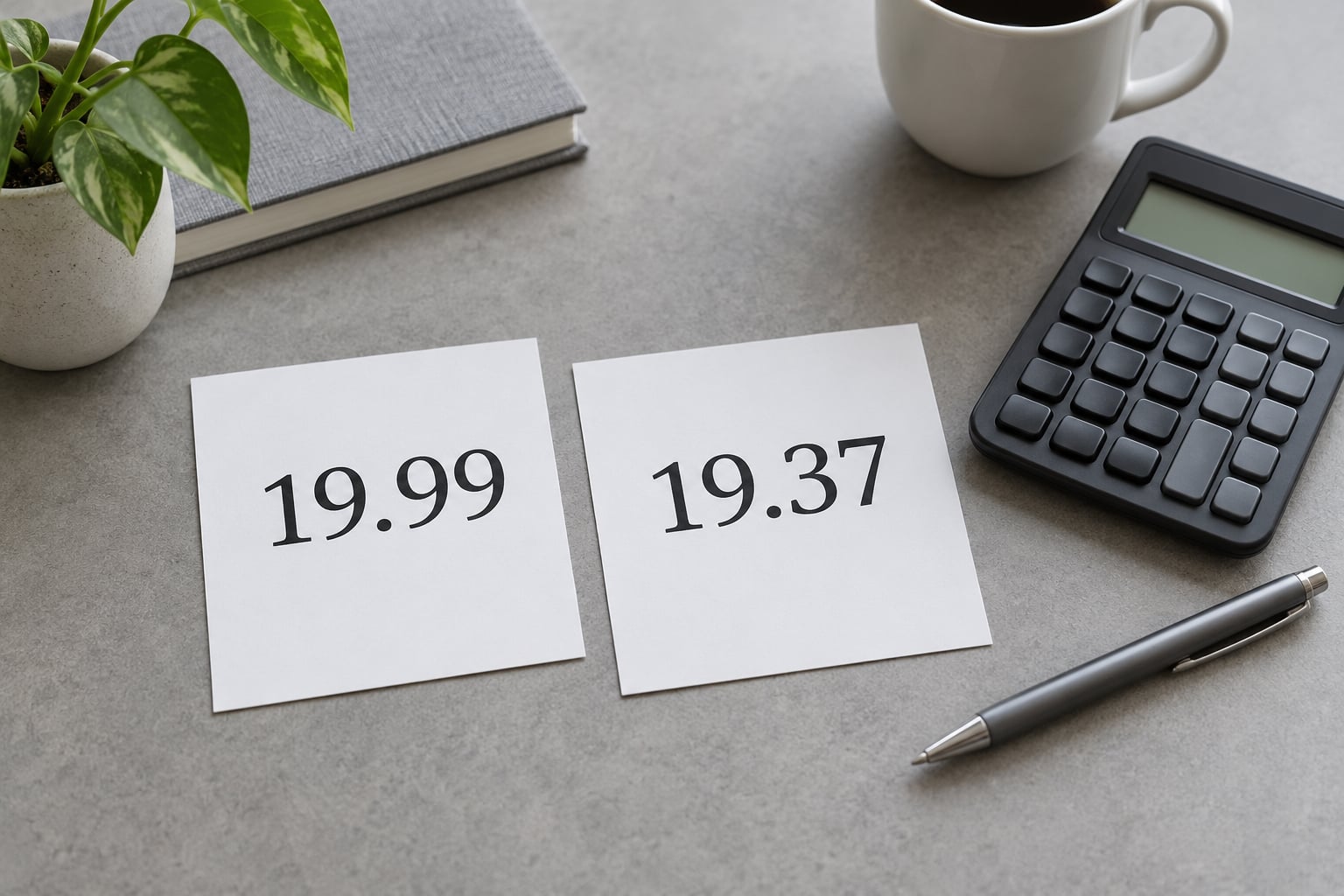
Why rounded prices feel more emotional than precise prices comes down to mental effort. A round number like 20.00 is read faster and with less strain than 19.37, and people treat that ease as a good feeling, then transfer it to the product. A precise number does the opposite: it signals that someone counted carefully, which reads as competence or suspicion depending on who is selling it.
That is the short version, and it is incomplete in ways that matter commercially. The emotional read is not automatic, it reverses at low price points, and it can lose to a competing signal: precision looks like someone who did their homework. Marketers who only hear the fluency story end up putting 20.00 on things that sell better at 19.99, or worse, applying a laboratory effect to a category where nobody was ever thinking about the digits.
What follows separates the mechanism from the folklore. I have gone through the primary studies behind round-number and price-ending effects, including the ones that came back null, and translated them into plain terms for marketers, pricing analysts and anyone quoting a fixed fee.
Table of Contents
- Why Do Rounded Prices Feel More Emotional?
- What Rounded and Precise Prices Signal to the Brain
- How Charm Pricing Changes the Feeling of a Purchase
- The Role of Anchoring, Effort, and Perceived Value
- What the Research Does Not Prove
- When to Use Rounded or Precise Prices
- How to Test Which Price Feels Best
- Frequently Asked Questions
- Conclusion
Why Do Rounded Prices Feel More Emotional?
Rounded prices can sound warmer, less calculated and easier to process, and their apparent flexibility leaves room for the buyer to imagine a deal. Three separate things are usually collapsed into one reaction, and keeping them apart makes the advice much more useful.
The first is emotional reaction: a feeling of ease, approachability or generosity attached to the price itself. The second is numerical ease: how quickly the brain handles the digits, which is measurable in response time and has nothing to do with warmth by itself. The third is an assumption about value: the buyer concludes that a clean figure means the seller chose it deliberately, or that an awkward figure means something was calculated.
Only the third one is really about the seller. Numerical ease is a property of the digits themselves, which is why the same number feels flat in a spreadsheet and warm on a shelf.
The foundational evidence is Wadhwa and Zhang (2015, Journal of Consumer Research), whose paper is titled more or less the same sentence as this article: “This number just feels right.” They found that participants evaluated products more favourably when prices were numerically rounded, and that the effect was stronger when the decision was framed as affective rather than analytic. King and Janiszewski (2011, Journal of Marketing Research) supplied the mechanism: round numbers are processed faster, and faster processing produces greater liking.
Kettle and Haubl (2010, Advances in Consumer Research) traced that speed to something mundane and powerful: frequency in language. We say “twenty dollars” and “thirty seconds” constantly, and almost never say “nineteen dollars and thirty-seven cents.” Whatever we hear most often, we process most easily.
There is also a semiotic layer worth naming, because it explains why roundness reads as deliberate in a way that extends past dollars. A round figure looks chosen, settled, non-negotiable. An awkward one looks calculated, adjustable, still being negotiated. Practitioners notice this immediately: LinkedIn discussions about price endings keep producing the same observation, that round prices feel official while 9-endings feel worked out and discounted. You can see the same logic in hourly billing, where a rate of 250 an hour signals a fixed standard and 247.50 signals a spreadsheet that nobody bothered to round.
Emotion enters through interpretation rather than arithmetic. Two people can read the identical price and land in different places, and the research says the deciding factor is usually the kind of decision being made rather than the kind of person making it.
What Rounded and Precise Prices Signal to the Brain
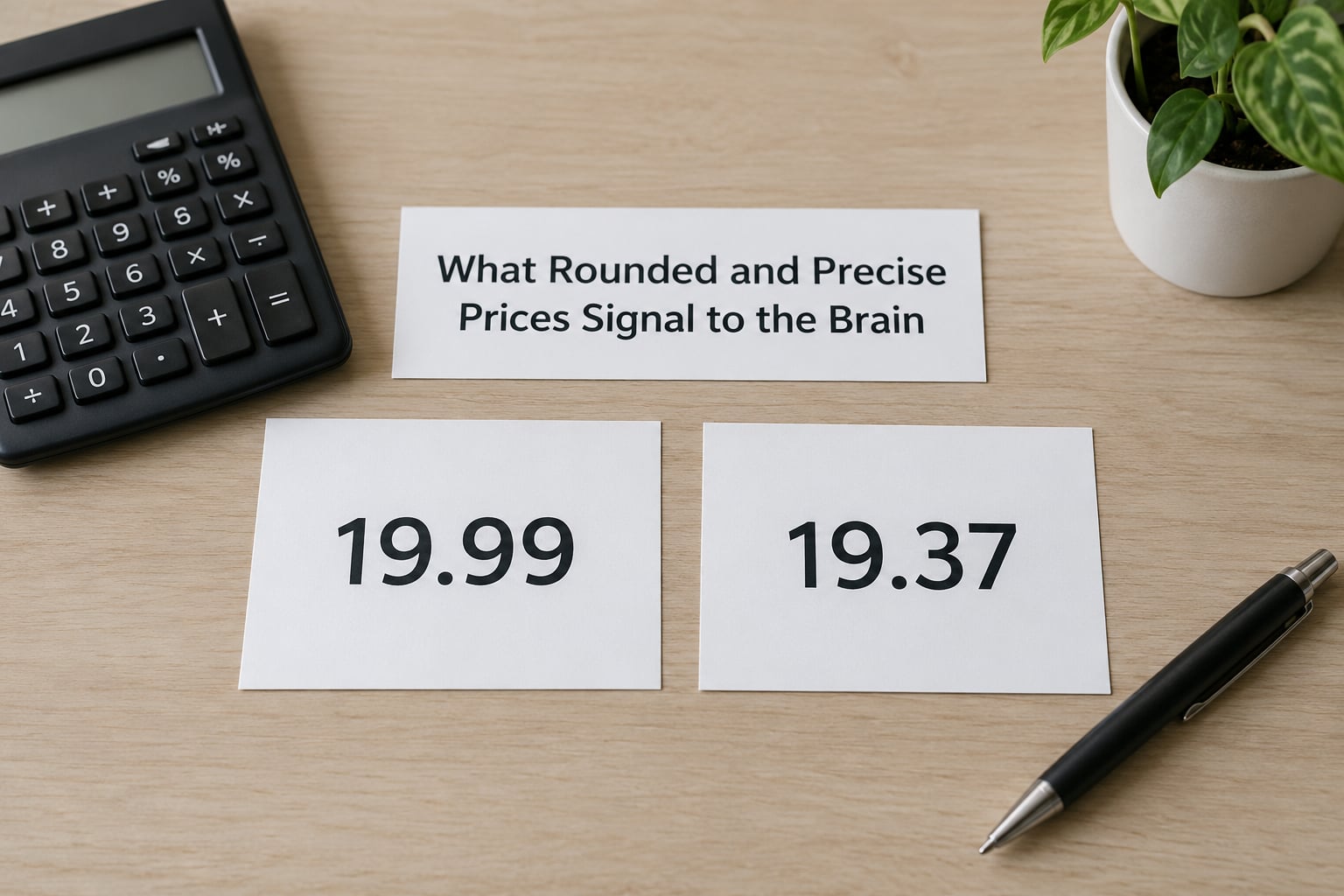
Rounded prices carry a signal of deliberation and ease; precise prices carry a signal of effort and accuracy. Neither signal is emotional or cold by itself. The table below compares the three formats that get constantly confused, because a true round number and a just-below ending are psychologically opposite tactics, not variants of one trick.
| Dimension | Round (20.00) | Just-below (19.99) | Precise (19.37) |
|---|---|---|---|
| Processing speed | Fastest, high numeric fluency | Slow to read, but the left-side read is fast | Slowest, requires mental arithmetic |
| Tone | Calm, settled, official | Deal-framed, promotional | Analytical, technical |
| Implied flexibility | Feels fixed, little room to haggle | Feels already discounted, room to feel clever | Feels negotiable or even calculated |
| Perceived deliberation | High: someone chose this number | Medium: the digits were adjusted at the end | High: someone measured something |
| Likely buyer interpretation | Intentional, possibly premium, possibly expensive | Bargain, on sale, a small win | Grounded in data, or false precision |
| Where it works best | Premium goods, services, high tickets | Value retail, grocery, promotions | B2B, technical, evidence-led claims |
| Main risk | Reads as expensive or rigid | Earns a penny of margin and signals discount | Reads as cluttered or fabricated |
Two clarifications matter here. First, precision is not inherently cold. Thomas, Simon and Kadiyali (2010, Marketing Science) documented a price precision effect in both laboratory and market data, where precise price points were associated with higher quality inferences and higher willingness to pay in certain categories. Second, rounding is not always emotional. A round price on a low-ticket item can read as indifference, which is the boundary condition covered later in this article.
The trick most blogs get wrong is treating 19.99 as a rounded price. It is not. It is a precise price with one digit adjusted downward, and it works through the leading-digit effect, not through fluency. Roundness and charm pricing run in opposite directions: one smooths the number, the other deliberately makes it awkward so the first digit dominates.
Zhang and Schwarz (2012, Journal of Consumer Research) explain part of why precision sometimes backfires, using the everyday contrast between 1 year and 365 days. Both can be true, but the rounded version is the one we treat as a summary, and it carries an inference: 1 year suggests the underlying number was close to some obvious standard. Precision carries the same implication in reverse. If a health statistic arrives as a round number, listeners often infer the underlying estimate was rough.
How Charm Pricing Changes the Feeling of a Purchase
Charm pricing is the practice of ending a price just below a round threshold, usually at .99, so that a large digit sits at the front of the number. The emotional change is not softness. It is the feeling of having gotten a small win at the moment of reading, and it depends on a specific parsing habit rather than on the whole number being easy.
The mechanism is the leading-digit effect: readers tend to encode a number from the left, so 19.99 gets filed as roughly nineteen-something, and 20.00 gets filed as exactly twenty. That is why shoppers routinely underestimate or round down prices ending in 9, and it is the reason the tactic produces an emotional response at the moment of scanning rather than at the moment of comparison.
Three things follow from this, and each one changes how you should use the tactic.
First, the left-of-threshold framing only helps when there is a threshold. A 19.99 price for a product whose mental reference is 25 does less work than one whose reference is 20, because nothing about the number crosses anything.
Second, a final-digit adjustment is not rounding. Taking 20.00 and turning it into 19.99 adds a penny of friction to the number and then uses the leading digit to hide it. Turning 400 into 400.00 does something different: it smooths a number that was already round. The first is a pricing tactic; the second is a typographic choice.
Third, the effect weakens as reference points become precise. If the buyer already knows the product competes at 19.50, then 19.99 loses its threshold and stops feeling like a bargain.
Why Rounded Prices Feel More Emotional Than Precise Prices
Here is the core mechanism in plain terms. Precise figures demand numerical attention: the reader has to hold 19 and 37 apart, compare the cents to something, and decide whether the extra detail matters. That work is small but real, and it puts the buyer in an analytic frame. Round figures remove the work. Nothing is left to reconcile, so the number can be felt rather than solved.
Emotion follows ease because of a long line of research on processing fluency. Work that feels easier is reported as feeling better, and that borrowing transfers to whatever the number is attached to. King and Janiszewski measured the speed part directly, and Kettle and Haubl explained it with language frequency. Wadhwa and Zhang tied the speed to product evaluation, and specifically found the effect amplified when participants were deciding on feeling rather than on facts.
Consider three concrete cases. A tailor quoting 800 for a jacket and one quoting 823.50 for the same jacket are not communicating the same thing, even though the second number is the more accurate reflection of labour and materials. The round figure says the price was settled; the precise one says the price was measured. A wine list with 60, 75 and 120 reads as a set of judgements. The same list at 62, 76.50 and 118.50 reads as an audit. And a monthly subscription at 20.00 lands differently from one at 21.40, because 20.00 fits inside an existing mental budget line while 21.40 requires someone to go back and recompute the budget.
A concrete case worth keeping in mind comes from shoes. In the experiment practitioners quote most often, the same shoe evaluated as a higher-quality product when priced at 75.00 than at 79.95, even though 79.95 is the higher number. The precise ending did not read as more accurate value; it read as an attempt to look calculated. Note the magnitude: this sits in a range where buyers are already deliberating, which is exactly the band where the effect shows up.
There is also a granular-language explanation to keep in mind. Zhang and Schwarz’s argument is that speakers use more precise numbers when precision carries meaning, so a precise number inherits an inference of care and effort. That is helpful, because it predicts the moment the effect flips: as soon as your audience has reason to believe the precision is real, the same digits stop feeling clinical and start feeling responsible.
The warmth is contextual, not automatic. Ask someone to choose between 20.00 and 20.75 for a product they already distrust, and the clean number will not rescue it. Fluency changes the tone of an evaluation. It does not manufacture one.
The Role of Anchoring, Effort, and Perceived Value
The emotional reading of a number depends on what surrounds it. The same 75.00 can read as restrained, generous or expensive depending on the reference price in view, the effort the number implies, and how it sits against what the buyer earns or spends in a month.
| Context | Likely response | Appropriate use |
|---|---|---|
| A visible anchor at 120 | 75.00 reads as restrained and considered | Was-pricing, renewal quotes, tiered menus |
| Reference class is vague | Precise figures look researched, round figures look lazy | Consulting scopes, B2B proposals, clinical or financial detail |
| Budget fit is tight | Just-below endings feel like a win; rounding pushes past the limit | Grocery, low-ticket retail, subscription entry tiers |
| Purchase is emotional and low-stakes | Round numbers feel warmer and raise evaluation scores | Beauty, gifts, food, apparel, impulse baskets |
| Purchase is high-stakes and analytic | Precision reads as competence, rounding reads as vagueness | B2B, insurance, technical products, medical contexts |
| Audience knows the market | Any visible tuning of the number is read as manipulation | Expert buyers, procurement, experienced negotiators |
| Price is quoted, not shelved | Roundness signals professionalism and a standard rate | Hourly professional services, fixed-fee work |
| A discount is being advertised | Clean subtraction is what makes the saving legible | Sale framing, markdown decisions, renewal offers |
Effort is the mechanism hiding in most of these rows. Buyers infer effort from detail, and they read effort as quality. That is the price precision effect, and it is why Thomas, Simon and Kadiyali found precise price points lifting quality inferences in market data. It also explains the reverse case: a round number on an item that obviously required careful measurement looks careless, because the item’s own effort level sets an expectation the price does not meet.
Anchoring changes what “round” means. A round number relative to a high anchor reads as restraint; the same number relative to a low anchor reads as a step up. Nothing about the digits changed, only the comparison point in view, which is why the same 75.00 can be described as generous in one catalogue and steep in another.
Budget fit is the most underrated of the three. A 20.00 subscription gets approved by someone with a 20.00 mental line in their budget. A 21.40 subscription asks that person to reopen a budget they had already closed, and reopening a budget feels worse than spending more within one. This is the practical reason a penny matters more in subscriptions than in a supermarket basket.
Markdowns are their own case, and practitioners call the phenomenon the lazy subtractor. A shopper who reads a drop from 400 to 299 does not do the subtraction carefully; the eyes slide and register a fall of about a quarter. The same shopper reading 399 to 299 registers a fall of exactly 100 and a clean 25 percent. Real savings are identical. The second one is legible, which is what a discount announcement is actually for.
Semiotic reading helps here too. Round numbers in a price list function as punctuation: they mark the boundaries of a category and imply that someone sorted the goods on purpose. Odd numbers fill the space between them. A list built entirely of odd numbers looks like an inventory; a list built from round numbers looks like a decision.
What the Research Does Not Prove
The evidence for round numbers is real but narrower than the marketing consensus suggests. Several attempts to replicate the fluency effect have produced mixed or null results, and those attempts are where the practical guidance actually lives.
| Study | Year | Context | Finding | Replication status |
|---|---|---|---|---|
| Thomas, Simon and Kadiyali | 2010 | Laboratory and market data | Price precision effect: precise points lifted quality inferences and willingness to pay in some categories | Established |
| Wadhwa and Zhang | 2015 | Product evaluation experiments | Rounded prices raised evaluation ratings; effect stronger for affective decisions | Widely cited |
| King and Janiszewski | 2011 | Response-time experiments | Round numbers processed faster; faster processing predicted greater liking | Widely cited |
| Kettle and Haubl | 2010 | Word frequency and preference | Frequency in everyday language explains much of the fluency advantage | Supporting work |
| Jerez-Fernandez, Angulo and Oppenheimer | 2014 | Message evaluation | Precision in numbers read as a cue to the speaker’s confidence and competence | Established |
| Zhang and Schwarz | 2012 | Conversational inference | Granularity of a number shapes what listeners infer about the underlying value | Established |
| Loschelder, Friese, Schaerer and Galinsky | 2016 | Anchor precision with experts | Too-much-precision effect: over-precise anchors backfire with knowledgeable audiences | Established |
| Harmsa | 2018 | Replication attempt | Mixed and qualified support; the fluency effect is not automatic | Preprint, qualified |
| Krull, Boecker and Loschelder | 2021 | Two pre-registered field experiments, tens of thousands of observed elevator and stair choices | Both experiments returned null effects of round versus precise health messages | Pre-registered nulls |
| Scheibehenne, Greifeneder and Todd | 2010 | Meta-analysis of choice overload | More options rarely hurts much on average; context decides | Established |
The Krull, Boecker and Loschelder (2021) result in Frontiers in Psychology deserves more attention than it gets outside academia. Two pre-registered field experiments, one tracking roughly 23,766 elevator rides and another observing 1,497 stair walks, both found that numerically round messages did not shift behaviour relative to precise ones. The authors argued that ceiling effects, established habits, architectural cues and a low baseline rate of the target behaviour could all absorb the effect. The same team reported that academic nudge effects run at 8.7 percent while real-world nudge effects measured at the level of individual units land nearer 1.4 percent, citing DellaVigna and Linos (2020).
Three boundary conditions explain most of the disappointing results.
Price magnitude. The round-number premium signal shows up at higher price points and largely disappears at low ones. At a ticket of 20.00 against 19.99 there is nothing to signal, because nobody has an emotional investment in a small purchase. The strongest version of the claim involves goods where the buyer is already deliberating, and it weakens as the decision gets cheaper and more reflexive.
Audience expertise. Loschelder and colleagues’ too-much-precision effect shows that over-precise numbers can backfire with knowledgeable audiences, who read them as an attempt to look rigorous rather than as genuine measurement. Expertise also removes fluency: a buyer who knows the market does not find 400 easier to process, because they are already thinking in terms of price bands.
Habit and ceiling. When a price is seen every week, the digits stop being processed at all. And when behaviour is already high, there is little room for a message to move it, which is exactly what Krull and colleagues found in a building where most people already took the stairs some of the time.
There is also a habit effect that cuts against the fluency story entirely. People use round numbers because they are convenient, and using them reduces accuracy. A microwave set for 30 seconds instead of 42 is the standard illustration, and the point generalises: roundness is a compression that saves effort by discarding information. A marketing explanation that ignores this will eventually recommend a price that is round because the seller did not want to do the arithmetic.
And the emotional explanation should never replace a test. A feeling reported in a survey is a weak proxy for a change in conversion, and the null results above are a standing reminder that the two can diverge completely.
When to Use Rounded or Precise Prices
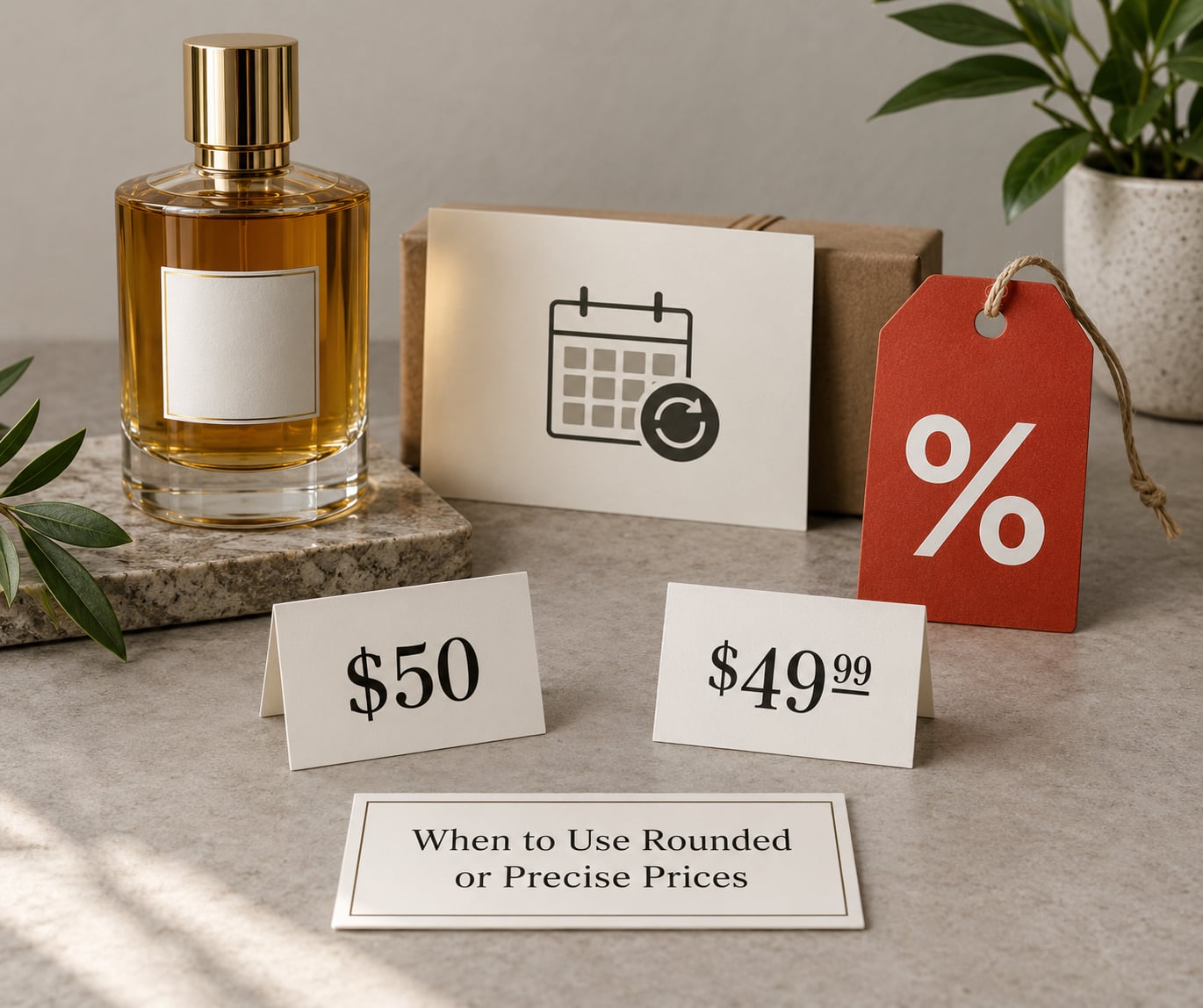
Match the price format to the positioning you want, then test if the category is unusual enough to deserve its own data. Round prices suit premium and high-involvement goods; precise prices suit evidence-led and negotiated sales; just-below endings suit value positioning and promotions.
| Category or situation | Recommended format | Reason | When a test is required |
|---|---|---|---|
| Value retail and grocery | Just-below ending | Matches a deal frame and keeps a legible comparison against the shelf | If your basket mix is heavily premium |
| Premium and luxury goods | Round number | Signals that the price was settled rather than computed | If buyers are highly price-driven or comparison-shopping |
| Subscriptions | Round entry tier, precise add-ons | Round fits an existing budget line; precision signals metered value | Whenever churn matters more than sign-ups |
| Sales and promotions | Round anchor, clean ending | Legible subtraction makes the saving readable, the lazy subtractor effect | If you advertise a percentage saving, since rounding can break it |
| Professional services | Round rate | Reads as a standard rate rather than a negotiation | If you bill time and materials in mixed currencies or units |
| B2B and technical products | Precise | Precision reads as measurement and competence to informed buyers | If buyers compare you to competitors using precise quotes |
| Multi-item and bundle pricing | Precise | Arbitrary totals invite arithmetic checks that single clean prices do not | If items are priced individually elsewhere in the catalogue |
| Quotes and estimates | Precise, with a rounded summary line | The detail signals real measurement; the summary signals a decision | If the quote is presented without an itemised breakdown |
A few rules of thumb hold across categories. Keep the format consistent within a catalogue, because mixing endings makes one item look discounted by comparison and quietly reprices the rest. Match the ending to the emotional temperature of the decision: browsing baskets take just-below, considered purchases take round. And if your audience is expert or procurement-facing, default to precision, because a tuned number reads as tuning to a person who knows what the untuned number would be.
How to Test Which Price Feels Best
A small split test answers more than any framework, provided you measure more than clicks. The question is not which ending people prefer in the abstract, but which one produces more completed purchases at a similar margin.
Keep the comparison clean. Change only the price ending, and change nothing else in the same period, because a promotion running alongside a price test will swamp the result. Give each version long enough to collect a few hundred sessions rather than a few dozen, and check the outcome at purchase rather than at click.
Measure five things, in this order of usefulness:
Comprehension. Can people recall the price correctly a minute later? A format that gets misremembered is not doing useful work, whatever it does to clicks.
Emotional response. Ask for a short association, warmth or trustworthiness rating on the price itself, keeping it separate from the product. This is the measure that most closely tracks why rounded prices feel more emotional than precise prices, and it is also the easiest to over-interpret, so treat it as diagnostic rather than decisive.
Perceived value. Ask what the product is worth to them. If a round number raises value ratings but not purchase rates, you have found a feeling without a behaviour.
Purchase intent and objection rate. Intent often moves before behaviour does. A rise in intent with no rise in completion usually means something else in the funnel absorbed the difference.
Actual conversion. The only number that pays the bills, and the one most likely to disagree with the others.
Then read the pattern rather than the single result. Feeling up and conversion flat means the effect is real but immaterial. Feeling flat and conversion up means you found a framing artefact worth knowing about. Both up means ship it, and consider whether the effect survives a change in traffic source.
One last discipline: test the ending, not the strategy. Running a round-versus-precise test inside a category that is simultaneously changing channel, promotion or positioning will produce a result you cannot use.
Frequently Asked Questions
Are rounded prices always more emotional than precise prices?
No. Rounded prices tend to be processed faster, and that ease can transfer as a positive feeling to the product, but the response depends on context. At low price points the effect largely disappears, when a buyer is highly price-driven precision can read as better value, and when habits are strong the digits are barely processed at all. The feeling is a tendency, not a rule.
Why do prices usually end in 9?
Because of the leading-digit effect. Readers tend to encode a number from the left, so 19.99 is filed as roughly nineteen-something while 20.00 is filed as exactly twenty. Putting a price just below a threshold keeps the big digit in front and makes the purchase feel like a small win at the moment of reading. The trick needs a threshold to work against, which is why it is weaker against a reference point of 25 than one of 20.
Is 19.99 a rounded price?
No, and the distinction matters more than it sounds. A rounded price such as 20.00 is numerically smooth and reads as deliberate. A price of 19.99 is a precise number with one digit adjusted downward, and it works through a different mechanism, the leading-digit effect, rather than through processing fluency. Roundness smooths the number while charm pricing makes it deliberately awkward, so they are opposite tactics rather than two versions of one.
What is the difference between rounded prices and charm pricing?
Rounded prices end in zero or five and are easier to read, which can make them feel warmer and more settled. Charm pricing ends just below a threshold, usually at .99, and works by making the number awkward so the first digit dominates attention. One relies on cognitive ease, the other on a perception of getting a bargain. They can even appear in the same catalogue, though consistency usually matters more than the individual choice.
When is a precise price better than a rounded price?
When the buyer is judging effort, evidence or expertise. Precise prices read as measured rather than guessed, which raises perceived quality in categories where measurement is the point, such as technical products, clinical detail and business proposals. Precision also holds up better with knowledgeable buyers, who can read a tuned number as manipulation. And for expert audiences it is the safer default, since over-precision is more defensible than under-precision.
Conclusion
Rounded prices feel more emotional than precise prices because they cost the brain less, and people read ease as a good feeling before they have judged anything else. That is a genuine mechanism with a research trail behind it, from the fluency speed-ups in King and Janiszewski’s response times to Wadhwa and Zhang’s product evaluations. It is also a tendency with clear edges: it fades at low prices, reverses for expert and evidence-led buyers, and has produced null results in pre-registered field experiments.
So do not ask whether rounding works. Ask what message the price is meant to carry, match the format to your positioning, and then test emotional response and conversion together rather than letting one stand in for the other. If the category is unusual, crowded or high-involvement, run the split test before you commit, because the only study that counted the rides found nothing at all.