
Decoy pricing is adding a third option to a pricing page so one real option looks like the obvious winner by comparison. The trust condition is simple: if that middle option vanished tomorrow, would most of your buyers still be glad they bought what they bought? If the answer is no, you have not built a decoy, you have built a trick, and tricks get noticed.
That single test filters out most of the bad advice floating around about this tactic. It also means the useful version of how to use decoy pricing without losing customer trust is mostly about research and restraint, not about squeezing another conversion point out of a tier table.
The behaviour is real and well documented. It is also weaker and more fragile than most pricing blogs suggest, and a decade of replication work has made the fine print considerably less flattering. This guide covers the mechanism first, then the five-step protocol that keeps it defensible, the mistakes that cost more than they earn, and the trust metrics worth watching after launch.
Table of Contents
What You Need
Before you add an option, gather five inputs. Missing any one of them is how decoy pricing turns into a dark pattern.
A real value proposition for each existing option. If you cannot write one honest sentence per tier describing who it is for, a third option will not fix the confusion. The decoy amplifies a clear picture; it does not create one.
Evidence of the alternatives customers actually weigh. Sales call recordings, support tickets, search terms, abandoned-cart data. The decoy has to match a choice people are genuinely making, not one you invented.
Comparable attributes across the tiers. This is the on-off switch for the whole effect. Frederick, Lee and Baskin (2014) showed attraction depends on options being comparable; when dimensions are hard to compare, the shift largely disappears.
Reliable unit economics. You must know your cost to serve per tier before adding a deliberately unattractive one, because a higher share of buyers on the target tier changes your mix and your support load.
A trust safeguard. Decide in advance which signal tells you to roll the decoy back. Refund rate, downgrade rate, complaint language, or support contacts per account. Pick the threshold before launch, not after the numbers worry you.
Step-by-Step: How to Use Decoy Pricing Without Losing Customer Trust
Define the customer’s real choice
Start with what buyers tell you, not with what you wish they were choosing. Pull ten to twenty recorded sales conversations or support threads and mark every moment a customer weighed two options against something outside your pricing page, usually a competitor or a do-it-yourself alternative.
That external alternative matters because it is often the real competitor. Decoy pricing can only redirect choice inside your own choice set. If most of the deliberation happens against a rival, you have a positioning problem, and a middle tier will not touch it.
You know this step worked when you can name the segment your new tier serves and quote at least one customer describing that need in their own words.
Choose a genuinely comparable decoy
A decoy is an option the target beats on every visible attribute, while the cheaper option does not beat it on every attribute. That asymmetry is what makes the target easy to choose. It is also exactly where the manipulation lives.
The honest version puts a real feature between the cheap and target tiers: a higher allowance, an added integration, a longer commitment, one more included seat. The dishonest version gives the decoy a feature nobody would pay for while removing the one thing the target is known for. Experienced buyers read the second version instantly.
Huber, Payne and Puto (1982) established the effect with beer price and taste combinations, and Simonson and Tversky (1992) later tied it to tradeoff contrast. What both sets of experiments share is comparability, which is why the same layouts perform well on one pricing page and flat on the next.
Apply the disappearance test before you ship: remove the middle tier in your head. If the target tier stops making sense to buyers who bought it, the decoy was carrying weight it should not have been carrying. Ship only if the target still stands on its own merits.
Make the value differences easy to understand
The middle tier exists to be understood, and most failed decoys fail because nobody can articulate why. Use plain language and one shared unit system across tiers, so allowances, limits, and prices compare directly instead of forcing the reader to convert between formats.
Show the full picture of what each tier costs over time rather than a headline number that flatters the target. Hide nothing in the comparison table that appears somewhere else on the page. If a feature only exists to widen the gap between two tiers, write it as plainly as everything else and say who it is for.
Label the middle tier for the segment it serves. Transparency about why a tier exists tends to read as helpful, while hiding the reasoning reads as manipulation. Cheap honesty here costs nothing.
Test the offer with real customer behavior
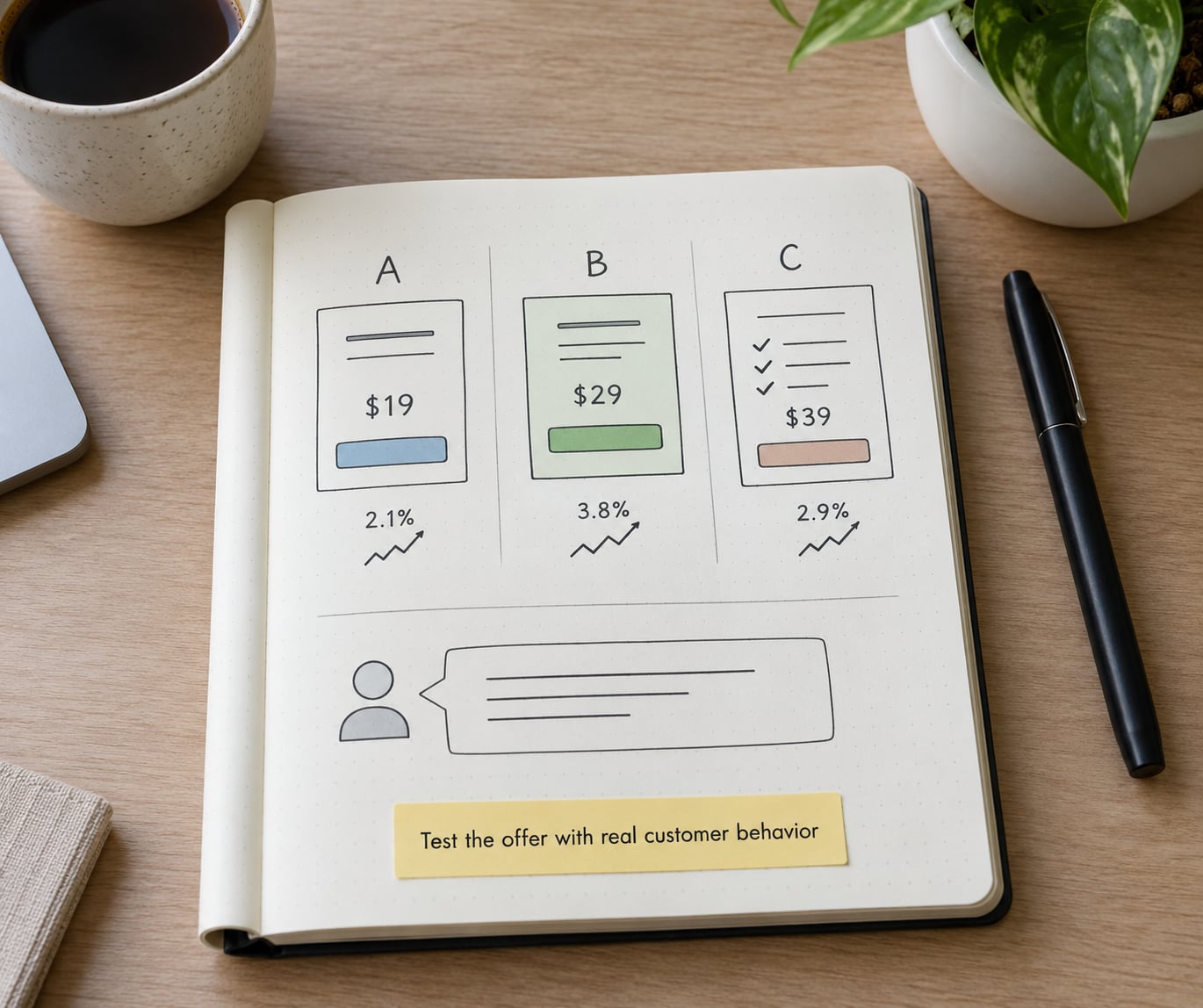
Write the hypothesis before you build anything: target-tier share rises among qualified visitors, refund rate stays flat, and the middle tier attracts a small number of buyers whose needs were previously unmet. That last clause is your tripwire. If the decoy sells well, stop and find out why.
Run a randomised variant where traffic volume allows it, and hold pricing, layout, and copy constant so the only change is the presence of the third option. Judge it on more than conversion rate, because the tactic can win on conversion while quietly damaging everything else.
Read the qualitative channel too. Free-text responses and chat transcripts tell you about confusion that a dashboard smooths over. A comment like I could not tell what the middle option was for is an early warning, and it arrives long before the refund data moves.
Give the test enough traffic to see a real shift in tier mix rather than day-to-day noise, and stop it early if trust metrics move against you regardless of conversion.
Monitor trust, not just sales
Almost nobody tracks the damage side, which is why decoy pricing has such a poor reputation among experienced buyers. Track six things for at least a quarter after launch: refund requests on the target tier, voluntary downgrades, complaint language about fairness or hidden costs, support contacts per account, and review sentiment on the middle tier.
Add one segment split. Cold traffic punishes an obviously engineered decoy far harder than warm traffic, where the buyer already trusts you and reads the tier table as service rather than as a trick. If your traffic mix is mostly cold, the tolerance for cleverness is low.
You know the step worked if target-tier share rose while refunds, downgrades, and fairness complaints held flat or improved. If share rose and complaints about being manipulated also rose, you bought a quarter of lift with a decade of goodwill.
Common Mistakes
Fictional anchoring in the comparison. A crossed-out figure for a tier you never sold, or a claimed saving that no customer could have captured. Fix: every reference price on the page must correspond to something a real customer actually paid.
A decoy nobody could buy. Availability that blocks checkout, or a signup flow that dead-ends. This is the clearest dark-pattern line in ecommerce, because the option exists only to be looked at. Fix: the tier must be genuinely purchasable by the segment it names.
Inconsistent comparisons. One tier quoted per month, the next per year, the third per seat, with no conversion shown. Fix: pick one unit for the whole table and label it plainly.
Hidden terms in the target tier. A middle tier that makes the target look reasonable while the target’s real conditions sit in small print. Fix: put conditions in the comparison itself, not in a tooltip.
Over-emphasis on the decoy. A most popular badge on the middle tier, or a strikethrough designed to make the decoy look like the deal. Fix: if the badge is doing the selling, the target tier is not worth selling and the tier structure needs redesigning, not decorating.
A decoy with no segment behind it. A B2B structure where the supposedly poor-value option kept winning because it matched how clients actually bought, one project at a time, and no amount of polish fixed the mismatch. Fix: check the tier against real procurement behaviour, and treat heavy decoy selection as a fit problem rather than a test failure.
A final check: legal exposure. Pricing rules differ by country and state and change, so confirm your comparison claims with whoever handles regulatory questions in your business. The FTC guidance on deceptive pricing is the US reference point, and the general standard is whether a reasonable buyer would be misled about what they are getting.
Frequently Asked Questions
Is decoy pricing ethical?
Decoy pricing is ethical when the third option is genuinely available, the tiers are described in comparable terms, and the buyer would still be satisfied if that option disappeared. It stops being ethical the moment the option cannot be purchased, the comparison hides conditions, or the reference price was never real. Transparency about which tier suits which customer is what separates choice architecture from manipulation.
Does the decoy effect really work, or is it mostly a replication myth?
Both things are true. The effect is one of the better-supported findings in choice architecture, with a founding experiment from Huber, Payne and Puto in 1982. But Yang and Lynn (2014) went through 91 published attempts and found a minority produced a reliable attraction effect. Practically: expect the effect on some segments, measure it on yours, and treat comparability as the deciding variable.
What is the difference between decoy pricing and price anchoring?
Anchoring uses a high reference point to shift your perception of an absolute number, such as showing the most expensive tier first. Decoy pricing uses a third option that the target beats on every attribute, so the target becomes the easy pick. Anchoring works with one option and a reference. Decoy pricing needs a genuine comparison set, which is why it is easier to detect and easier to get wrong.
How do I know if my decoy is too obvious?
Two signals. First, buyers keep choosing the decoy, which usually means it fits a real need you misjudged. Second, support tickets and reviews describe the middle tier as pointless or bait. If either shows up, the fix is not a subtler decoy. Either redesign the tier around a genuine segment or remove it and invest in good-better-best framing instead.
How many options do I need for a decoy to work?
Three is the working number: cheap option, target, and decoy. With two options there is nothing for the middle option to sit between, so no asymmetry exists. More than four increases decision fatigue and tends to flatten the effect. If your pricing page already carries five or more tiers, adding another is the wrong lever.
How long should I run a decoy pricing A/B test?
Long enough to see a real shift in tier mix rather than daily noise, and long enough to catch refund and complaint effects, which lag conversion by weeks. Practitioners typically run a first read after a couple of weeks and hold the variant through a full billing cycle before deciding. Decide your rollback threshold before launch, so the call is made on the number you agreed on rather than the one you hoped for.
Conclusion
Start with the alternatives customers are genuinely weighing, taken from real conversations rather than a brainstorm. Build a middle tier that has an honest feature gap and a named segment, and check it against the disappearance test before it goes live.
Then validate it with behaviour and trust measures together. Target-tier share means nothing on its own if refunds, downgrades, and fairness complaints move the other way. That paired read is how to use decoy pricing without losing customer trust: the tactic serves your mix only while customers still believe the page is telling them the truth.