
An ideation session with stakeholders works when you treat it as a decision-making workshop, not a brainstorm. You frame one challenge, generate ideas separately before sharing them, cluster what comes out, and narrow it against criteria the group agreed on before the session started. Ninety minutes is enough for one well-framed question, and the room leaves with a ranked shortlist and named owners rather than a wall of sticky notes.
Most of how to facilitate an ideation session with stakeholders is decided before anyone arrives. If you know the decision you need, who actually holds that decision, and how you will capture and rank ideas, you can run the room without fighting it.
Below is the full sequence: what to prepare, a minute-by-minute run-of-show, the technique choices that suit different group sizes, the words to say when the room stalls or one voice takes over, and what to send out within 48 hours so the output survives the week.
Table of Contents
- What You Need for an Ideation Session With Stakeholders
- Step-by-Step
- How to Facilitate an Ideation Session with Stakeholders: Frame the Challenge
- Choose the Right Stakeholders and Roles for the Ideation Session
- Set the Rules for Inclusive Participation
- Run the Idea Generation Activity
- Capture and Cluster Ideas
- Evaluate Ideas Without Killing Creativity
- Close with Decisions and Next Steps
- Common Mistakes
- Frequently Asked Questions
- How long should an ideation session with stakeholders last?
- What is the best ideation method for a large group of stakeholders?
- How do you keep senior stakeholders from dominating an ideation session?
- Should stakeholders vote on ideas during the same session?
- How do you capture and prioritize stakeholder ideas effectively?
- What do you do when an ideation session produces too many ideas?
- Conclusion: Start With a Focused Brief
What You Need for an Ideation Session With Stakeholders
Preparation decides the outcome. Everything below should exist before the invite goes out, not in the hour before the session.
A written challenge statement
One question on one page, phrased as a question. Something like “How might we make the first week with the product feel like a win?” rather than “We need ideas to build the onboarding programme.” If your statement already contains a solution, you have a project meeting, not an ideation session.
The decision you need at the end
Write the decision as a single sentence. “Which two ideas go into the next planning cycle?” “Which of these three routes do we take to the board?” When stakeholders know what they are deciding, participation changes completely.
Three prioritisation criteria
Agree these in advance so nobody renegotiates the scoring rules after seeing the results. Impact, effort and fit with current strategy usually work. Two or three is plenty; five criteria turns ranking into negotiation.
A stakeholder list built by decision role
Separate the people who decide, the people who influence, the people who contribute domain knowledge, and the people who can veto. A room of eighteen where twelve are deciders is not a workshop, it is a steering committee.
Materials and tools
Sticky notes in at least four colours, thick markers, a timer everyone can see, tape, a parking lot board for off-topic points, and a capture surface large enough for every idea to stay legible. For remote sessions, one shared board with the same zones: instructions, prompt, capture area, clustering area, action area.
A capture and ranking method you have rehearsed
Decide in advance how ideas get captured and how they get ranked. Anonymous submission if the room is senior-heavy. Dot voting if the group is larger than twelve. An impact-effort matrix if the sponsor will push back on popularity. Deciding this live is how sessions lose twenty minutes.
A neutral facilitator
If you own the content of the project, you cannot also hold the room. The strongest results come from separating those two jobs, with one person who answers for the work and another who runs the process. A facilitator does not supply ideas.
Step-by-Step
How to Facilitate an Ideation Session with Stakeholders: Frame the Challenge
Start with the sentence you want repeated all session: “We are here to…” Write it, read it aloud, and leave it visible on the wall. Then state the decision, the boundaries, and what is out of scope.
Boundaries matter more than enthusiasm. If the budget is fixed, say so. If legal has already ruled out a channel, say that too. Half the vague ideas in any session come from people hoping a constraint will move if they push hard enough.
Then check the framing against the room in one sentence: “Is that the problem you would put to me?” Silence means the framing is too comfortable. Expect pushback on the first version and revise it on the spot. A challenge statement nobody argues with is a challenge statement nobody believes.
Choose the Right Stakeholders and Roles for the Ideation Session
Build the invite list by role in the decision, then cap the room. Below eight people, almost everyone speaks. Above twelve, use breakout groups and only bring the ideas back. Much of the trouble in stakeholder sessions comes from an attendance list built on rank rather than usefulness.
| Group | Role in the decision | How to involve them | Risk if absent |
|---|---|---|---|
| Deciders | Hold the decision, can commit funding or people | In the room, silent during generation, present for ranking | The session produces ideas nobody can act on |
| Influencers | Advice carries weight with the deciders | In the room, flag early if they will resist | Decisions stall later over invisible objections |
| Contributors | Front-line expertise, customer contact, delivery reality | In the room, and asked to speak first | Ideas are impractical because delivery reality is missing |
| Observers | Interested, no decision rights | Receive the readout, not a seat | None, provided they get the write-up |
| Veto holders | Legal, risk, compliance | Invite directly or get their constraints in advance | A late no kills work that already started |
Give everyone in the room one of five jobs and say them out loud. The facilitator runs the process and protects time. The sponsor opens, closes and confirms the decision. The note-taker captures ideas in the group’s own words. The timekeeper calls each timebox. Everyone else generates and evaluates. Naming roles kills the ambiguity where half the room wonders whether they are allowed to disagree with the sponsor.
Where a key stakeholder cannot attend, name a stand-in who has actually talked to them. Front-line staff standing in for absent end users regularly produce better ideas than a room full of managers guessing what customers want.
Set the Rules for Inclusive Participation
Six rules, written on the board and agreed before the first idea. Agreement out loud matters; a slide nobody has seen does not count.
- Generate first, judge later. Nothing is evaluated during idea generation.
- Every person speaks once per round before anyone speaks twice.
- Build on other people’s ideas rather than only your own.
- Wild ideas are wanted. Osborn’s rule holds that it is easier to tone down a wild idea than to think up a new one.
- Questions about an idea go to the parking lot, not into the discussion.
- Ideas are separated from people. Nobody’s proposal is on trial.
Say plainly that you will interrupt. People who worry about being talked over stay quiet for the whole session otherwise, and you never find out what they thought.
Run the Idea Generation Activity

Silent generation first, always. Two to three minutes of quiet writing removes the anchoring effect of whatever was said out loud first and gives the quieter half of the room a chance to produce something at all. Practitioner experience is consistent on this: silent thinking time before sharing raises both the volume and the originality of what follows.
Then pick a method that matches the problem, not the one you enjoy running.
| Technique | Best for | Time | Ideal group size | Works remote |
|---|---|---|---|---|
| Open brainstorming | Building shared energy and obvious options | 10-15 min | 6-12 | Yes, with chat visible |
| Brainwriting | Shy rooms, senior hierarchies, remote teams | 8-12 min | 8-40 | Excellent |
| 6-3-5 brainwriting | Large groups that need equal airtime | 15-20 min | 10-30 | Good, in breakout rooms |
| SCAMPER | Improving something that already exists | 12-20 min | 5-15 | Yes |
| How Might We | Narrowing a broad problem into usable prompts | 10-15 min | 6-15 | Yes |
| Crazy Eights | Breaking a stuck or overly cautious room | 5-8 min | 4-12 | Yes |
| Worst Possible Idea | Groups too polite to risk a bad suggestion | 8-10 min | 4-10 | Yes |
| Mind mapping | Seeing connections across many threads | 15-20 min | 4-8 pairs | Yes |
In 6-3-5 brainwriting, each person writes six ideas in three minutes, passes the sheet along, then adds five more before passing it on again. After a full round you have roughly 30 ideas from one table, and no idea has an author attached to it. That last part is why it works with senior groups: nobody is defending anything.
Keep rounds to five to seven minutes. Long rounds produce three good ideas and a lot of shopping. When you explain the method, demonstrate it with a boring example first so nobody spends the round working out the instructions.
Capture and Cluster Ideas
Put every idea where everyone can see it, in the contributor’s own words. Paraphrase silently if you must, but never upgrade an idea into something smarter than what was said, because you will defend the paraphrase later instead of the idea.
Cluster once every idea is up. Group by theme, not by team or by department, and let the room name each cluster. Ask for a one-sentence label and write it where the group can see it.
Keep two categories apart while you cluster. Observations describe what happens today: “support calls double in week two.” Suggestions describe what could happen: “a check-in call at day ten.” Mixing them makes evidence look like an idea and ideas look like findings.
The point of clustering is not tidiness. It is that you cannot rank a hundred notes, but you can rank twelve themes in ten minutes.
Evaluate Ideas Without Killing Creativity
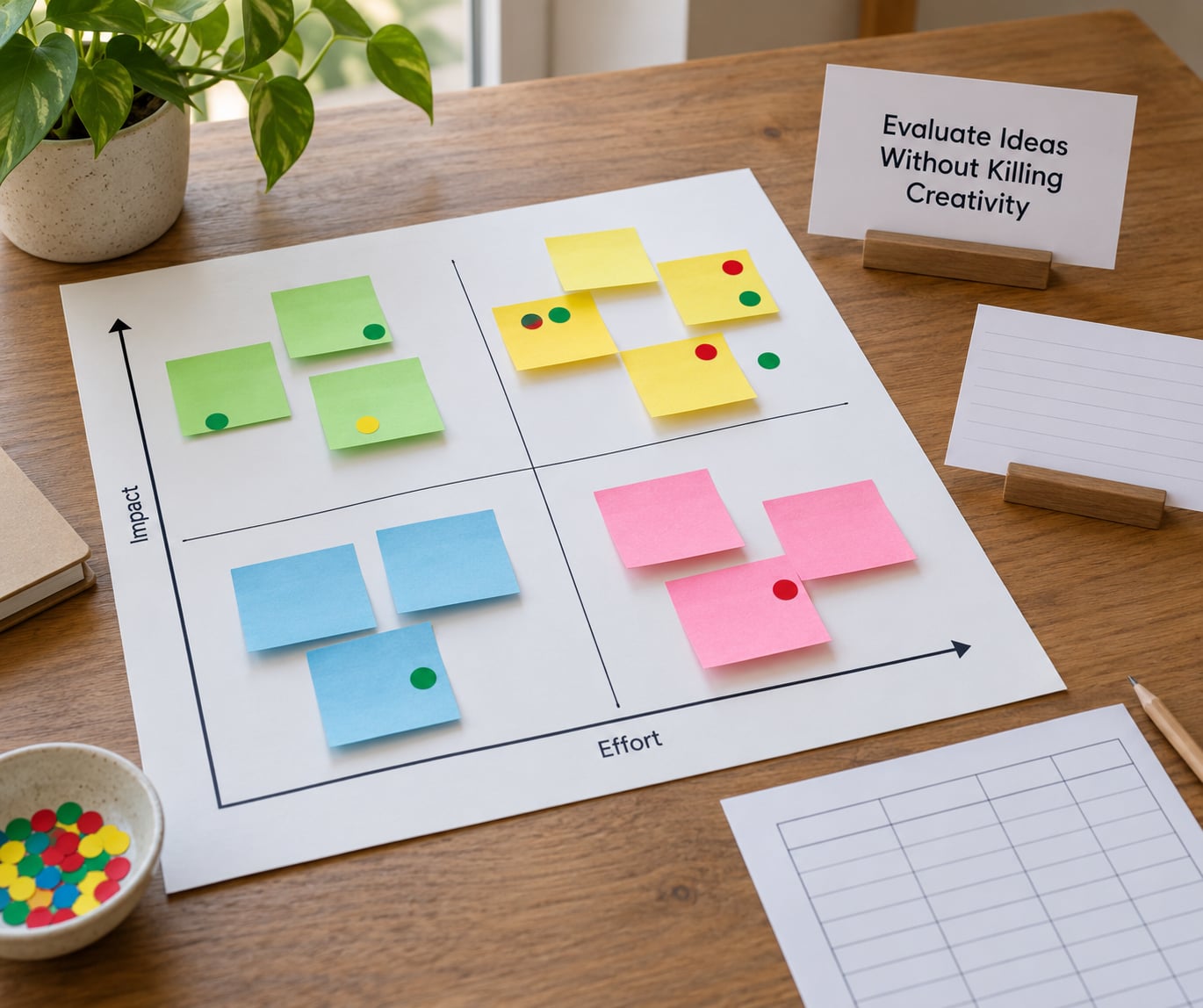
Announce the switch from divergent to convergent out loud. The room has been generating freely and now has to judge, and people need to know the rules changed rather than wondering whether judgement is now allowed.
Use criteria the group agreed in advance and score against those, not against preference. A quick dot voting works well up to about twelve people: three votes each, no talking during the vote, and the vote counts as signal rather than as a decision. Above twelve, use silent scoring on an impact-effort matrix so the loudest person is not weighting the result.
Cut ruthlessly. The useful target from a 90-minute session is two or three ideas, not the top ten. A ranked list of ten ideas is a queue for people to argue about; a short list is something a sponsor can fund.
On the evidence side, facilitated groups have been measured producing five times more ideas than unfacilitated ones across nine procedure variants (Isaksen and Gaulin, Creative Problem Solving Group – Buffalo, as cited by Miro). Gartner, also as cited by Miro, reported a 28% improvement in idea generation among 750 IT leaders who took part in facilitated workshops. The numbers are small in absolute terms; the direction is what matters when you are defending the cost of a facilitator against an afternoon of conversation.
Close with Decisions and Next Steps
The last ten minutes decide whether the session mattered. Read out the shortlist, then read out the notable disagreements without smoothing them over. Say plainly which idea won, which ones are parked and why, and which decision still sits with the sponsor.
Then name an owner and a date for every item. Not a team, a person. “Marketing will pick this up” is how generated ideas quietly die. If something needs research before it can move, that research is itself an action with an owner and a date.
Close the loop on the parking lot too. Read out what was deferred and where it is going. A parked point that never gets mentioned again teaches the room to save their best material for the parking lot next time.
Common Mistakes
Most failed ideation sessions fail in a predictable handful of ways. Each one has a fix you can apply before the invite goes out.
The brief is vague. “Let’s think about the future” produces scattered, unimaginative ideas because there is nothing to push against. Fix: force a single question with a verb in it, and say the decision out loud in the first two minutes.
Too many stakeholders. Eighteen people in a room means three or four do the talking. Fix: cap attendance by decision role, move observers to the readout, and use breakout groups above twelve.
A senior stakeholder shuts it down. Fix: brief that person before the session and ask them to speak last in the first round. If it happens anyway, name it neutrally: “Let’s hold that until the sharing round finishes so everyone gets a turn.”
Evaluation starts too early. The first person to say “we already tried that” ends the session. Fix: state the rule in advance, park the objection visibly, and revisit parked objections during convergence when the idea has evidence behind it.
The agenda runs long. Fix: cut the warm-up and the second technique before you cut the ranking. A session that overruns by fifteen minutes always loses the action-setting, which is the part that mattered.
Nothing happens afterwards. Fix: put the readout in the invite calendar slot of the sponsor, not in a shared drive nobody opens. Send it within 48 hours, to the people in the room and to the stakeholders who were not.
Frequently Asked Questions
How long should an ideation session with stakeholders last?
Ninety minutes is the standard for a single framed question: ten minutes to frame, five to warm up, fifteen to generate, twenty to share and cluster, twenty to prioritise, and ten to assign owners. Go to three hours when you are combining divergent and convergent work or adding a short prototype round, and go to half a day only when you are also testing concepts with real customers. Anything longer than a half day needs a break every 90 minutes or attention drops sharply.
What is the best ideation method for a large group of stakeholders?
Breakout-based brainwriting, specifically 6-3-5, is the most reliable choice above 15 people. Divide into tables of four to six, give each table the same prompt, and have people write six ideas in three minutes before passing paper along to add five more. Collect one sheet per table and cluster the results on the wall. It produces far more ideas than open discussion, gives everyone equal contribution, and removes the author from every idea.
How do you keep senior stakeholders from dominating an ideation session?
Design it out rather than managing it in the moment. Use silent generation so nobody’s idea is spoken first, ask the most senior person to share last, and give every participant one full turn before anyone takes a second. During evaluation, switch to silent dot voting so volume does not translate into influence. If a senior voice still overrides the process, say so neutrally and in advance of the next step rather than letting the room absorb it.
Should stakeholders vote on ideas during the same session?
Yes, if ranking is on the agenda and the criteria were agreed before the session. Voting works best as a tiebreaker between clustered themes, not as a popularity contest between raw sticky notes. Keep it to three votes per person, no talking during the vote, and treat the result as signal rather than as a decision. If the decision sits with one senior sponsor, have them confirm the outcome at the close instead of letting a vote imply a mandate.
How do you capture and prioritize stakeholder ideas effectively?
Capture everything visibly and in the contributor’s own words so nobody has to defend a paraphrase. Cluster the notes into themed groups and label each group out loud, keeping observations about today separate from suggestions about the future. Prioritise the clusters, not the notes, using criteria you agreed in advance such as impact, effort and strategic fit. Target two or three finalists rather than a long list.
What do you do when an ideation session produces too many ideas?
Resist ranking the raw notes and cluster them instead, because you cannot rank a hundred sticky notes but you can rank twelve themes in ten minutes. Give each cluster a short label agreed by the room, then discard duplicates and anything already ruled out by a stated constraint. Apply the criteria you set before the session to the clusters. If you still have too many, force a choice and state openly that you are cutting good ideas for capacity, not quality.
Conclusion: Start With a Focused Brief
If you do one thing differently, write the challenge statement and the decision before you invite anyone. Everything else in this playbook is mechanics, and the mechanics are far easier when the room already knows what question it is answering and what choice it has to make by the end.
After that, invite by decision role rather than by seniority, agree the criteria in advance, and protect silent generation time. You will still have to handle the dominant voice and the tangent. You will have less of both to handle if the frame was right.
And close with owners and dates, then send the readout inside 48 hours to everyone who had a stake in the answer. That last step is what separates an ideation session from a pleasant ninety minutes people forget by Tuesday.