
Free trials convert better than discounts because they hand over ownership before they ask for money. By the time a prospect pays, they have already built data, habits and integrations inside the product, so cancelling feels like a loss rather than a saved cost. Discounts do the opposite: they lower a price, produce relief at the checkout moment, and leave the buyer with nothing to lose and nothing to miss.
That advantage is real but conditional, and the condition is time-to-value. Trials win where a new user reaches a meaningful result inside the trial window, which is why free trial conversion benchmarks swing so widely between products. The rest of this guide breaks down the five mechanisms, the benchmark data with named sources, and the specific situations where a discount is simply the better instrument.
Table of Contents
- What Is the Difference Between a Free Trial and a Discount?
- Why Free Trials Convert Better Than Discounts
- The Behavioral Psychology Behind Higher Trial Conversion
- When Discounts Convert Better Than Free Trials
- How to Choose the Right Offer for Your Product
- Designing a Free Trial That Converts Without Feeling Pushy
- Designing a Discount That Complements Product Value
- How to Measure Which Offer Actually Converts Better
- Frequently Asked Questions
- Are free trials always better than discounts?
- How long should a free trial be for the best conversion?
- Do discounts usually produce more immediate sales than free trials?
- What is a good free-trial conversion rate?
- Should a free trial include every paid feature?
- How can I test free trials against discounts fairly?
- The Short Version: Pick One Instrument and Test It Honestly
What Is the Difference Between a Free Trial and a Discount?
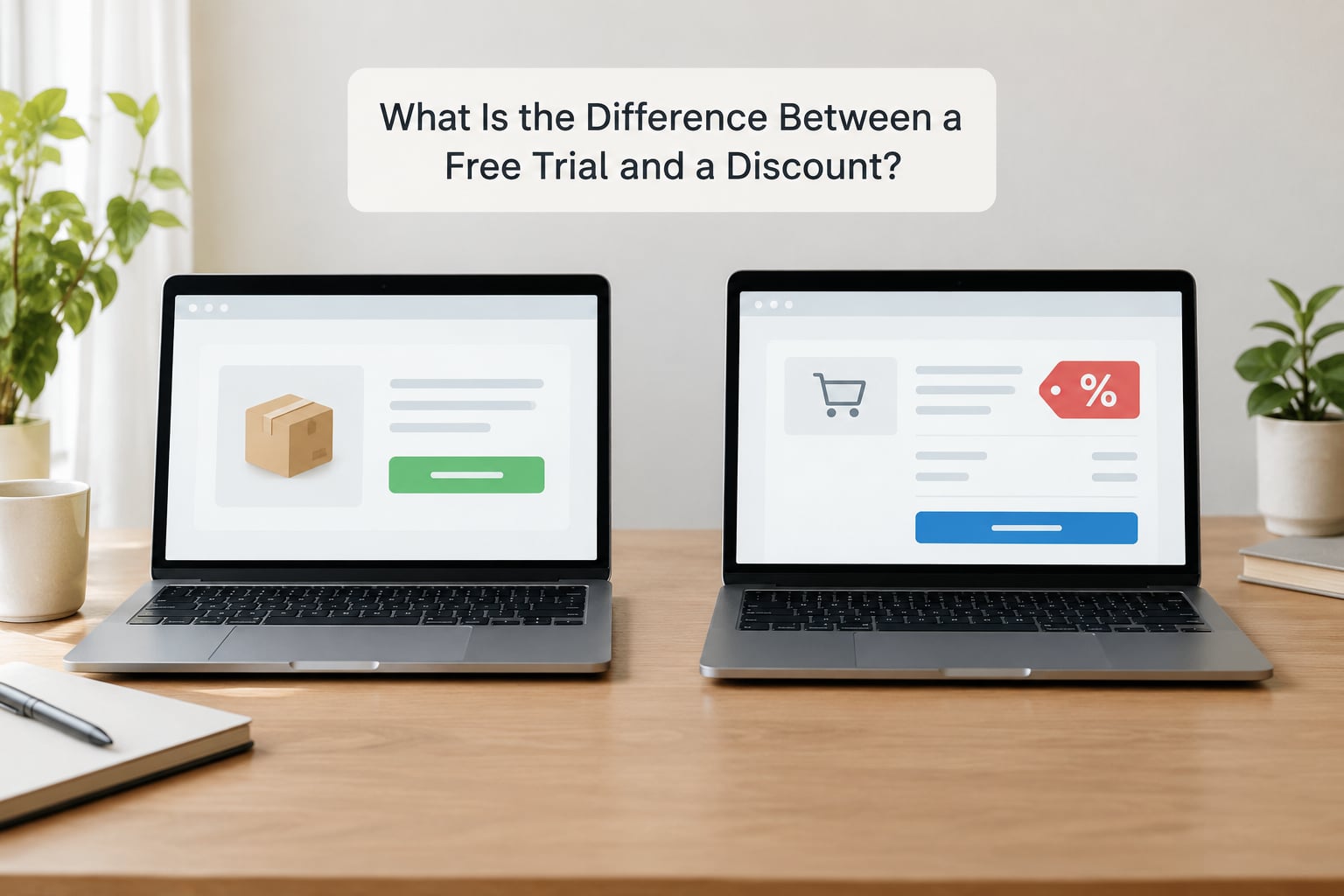
A free trial changes what a buyer gets before they pay anything. A discount changes what a buyer pays once they have already decided to buy. Everything downstream, from friction to retention, follows from that one difference.
A trial gives time-limited access to the product itself, either opt-in (no card, the prospect actively starts it) or opt-out (a card is on file and billing begins when the period ends). Conversion happens later, at a second decision point, and the team has to earn it through onboarding.
A discount is one of four common shapes: introductory pricing on the first period, an annual prepay discount that trades commitment for a lower rate, a win-back offer aimed at lapsed customers, and a targeted or seasonal incentive. Conversion happens immediately, at the point of purchase, and the buyer takes the product on much the same terms as everyone else.
| Dimension | Free trial | Discount |
|---|---|---|
| What changes | Access, experience and time | Price only |
| When the decision happens | Second decision, at the trial end | First decision, at checkout |
| Signup friction | Low to high depending on card requirement | Low, often lower than a card-required trial |
| Core motivation | Ownership, habit and fear of losing access | Fear of overpaying |
| Typical buyer outcome | Higher engagement, stickier cohorts | More price-sensitive signups |
| Main risk | Support load with no return | Training buyers to wait for offers |
Why Free Trials Convert Better Than Discounts
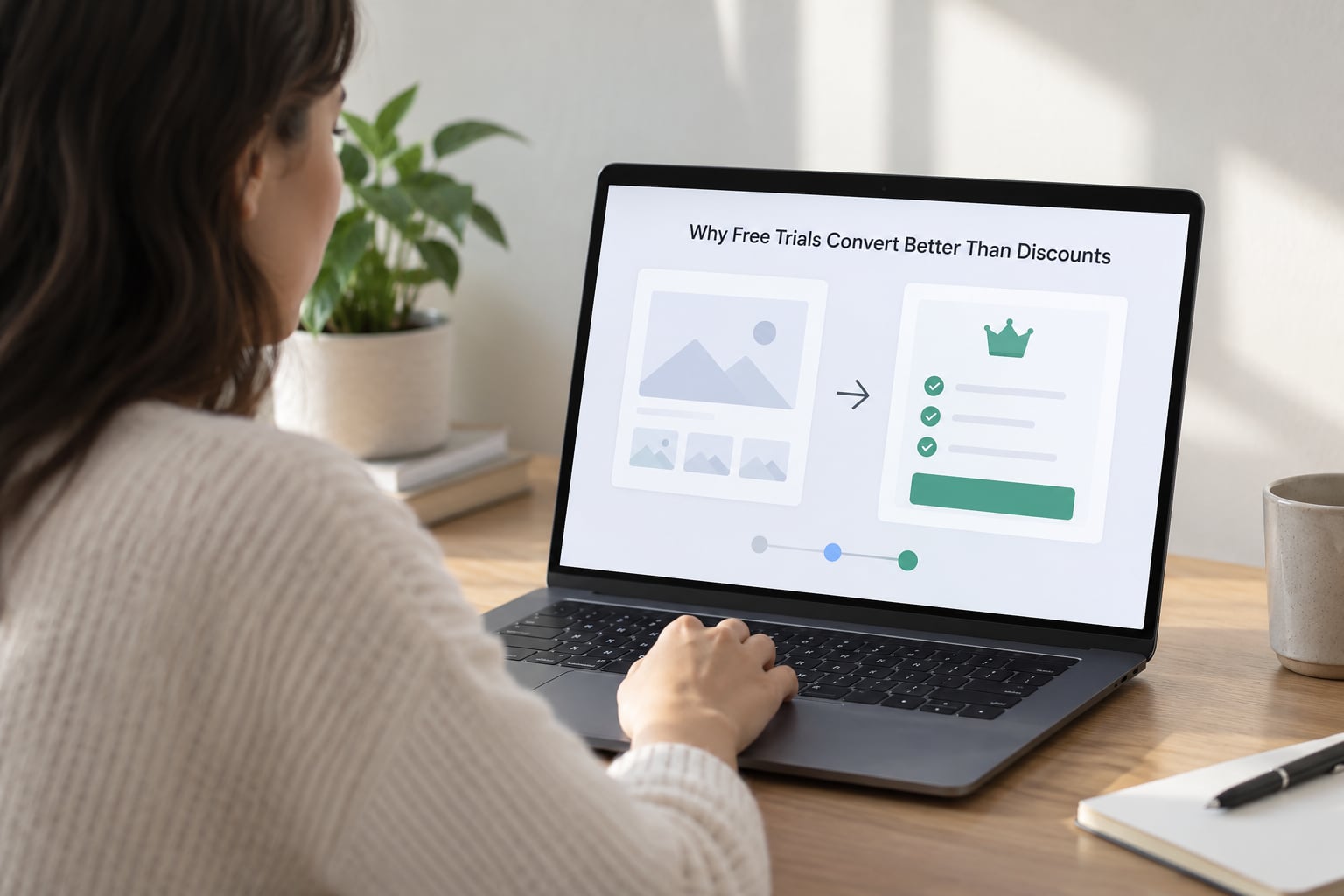
Trials convert better because they let a buyer evaluate the product on evidence instead of on a promise, and they do that while the product is already working for them. Discounts can only lower the price of something the buyer has not yet experienced. The advantage shows up in three places at once: more confident buyers, buyers who churn less, and buyers who are worth more per month.
The five reasons free trials convert better than discounts
- The trial removes risk first, so the buyer decides with evidence instead of marketing claims.
- The buyer uses the product before paying, so value is demonstrated rather than promised.
- Usage creates psychological ownership, which makes cancelling feel like giving something up.
- Setup work becomes a small sunk investment the buyer does not want to abandon.
- A discount rewards the absence of commitment, so it attracts the least loyal buyers.
Notice what is missing from that list: price. The trial is not cheaper for the buyer, it is safer. For most subscription products, safety is the bigger objection, which is why the free-to-paid conversion rate on a well-run trial usually sits well above what the same offer achieves through a checkout discount.
The Behavioral Psychology Behind Higher Trial Conversion
Each mechanism below is ordinary consumer psychology applied to a purchase decision. None of them are marketing tricks; they describe how people weigh an unfamiliar commitment.
Perceived risk falls when the product proves itself
An unfamiliar purchase is a bet on an unknown. A trial shrinks that bet from “will this work for me for years” to “did this work for me this week,” which is a question most buyers can actually answer.
Dropbox, Zoom and Slack all grew their self-serve funnels around letting a team use the product together before anyone committed company budget. The team experiences the workflow, not the feature list, and that removes most of the uncertainty that a price comparison alone cannot.
Endowment effect: ownership arrives before the invoice
The endowment effect is the well-documented tendency to value something more once it feels like yours. Thaler and Kahneman’s classic experiments showed people willing to pay more to keep an object they already held than to acquire the identical object cold.
Inside a trial, ownership builds quietly. Files are uploaded, a workspace is named, a workflow is arranged, a team is invited. None of those steps feel like commitment, but together they turn a tool into something the buyer would have to dismantle to leave.
Loss aversion: the trial creates something to lose
Kahneman and Tversky’s prospect theory puts the loss-aversion coefficient at roughly two, meaning losses weigh about twice as heavily as equivalent gains. A trial turns that asymmetry to your advantage because the buyer is not choosing between paying and saving money, they are choosing between keeping a working setup and discarding it.
A discount does the opposite. It asks the buyer to accept a smaller gain, which is the weakest possible motivation and the one that evaporates as soon as a competitor offers a smaller number.
Commitment and consistency: small steps add up
Behavior research on commitment and consistency shows that people tend to act in line with earlier small commitments. Signing up, connecting a data source and inviting a colleague are three tiny commitments, and each one makes the next slightly more likely.
This is also why activation matters more than signup volume. A trial user who has never imported a file has nothing to lose at the end of the period, and pricing reminders will not fix that gap.
Uncertainty falls, and the reversal-of-free effect does the rest
A trial ends. The moment it does, the buyer either restores access by paying or experiences the loss the psychology section above predicted. That conversion is often described as a reversal of the free effect, and it works best when the trial ends on a genuine deadline rather than a fake countdown.
Practitioners on r/SaaS describe the other side of this constantly: trial users who consume heavy support time, tour the product thoroughly and leave without converting. That is not a trial failing to work. It is a trial with no activation moment, and a discount would likely have attracted the same person in the first place.
When Discounts Convert Better Than Free Trials
Discounts win when a buyer cannot judge the product inside a trial window, or when price is the only real objection. Claiming otherwise would make this article useless, so here is the honest list.
- Slow time-to-value. Products that need a data migration, a procurement cycle or a quarter of usage cannot prove themselves in 14 days.
- Low need, low engagement. If most prospects will not log in during a trial, you are measuring login rates, not product value.
- Hard budget limits. Price-sensitive markets, students, and buyers working inside a fixed allowance respond to a lower number, not to access.
- Enterprise procurement. Buyers with approved vendor lists and negotiated rates are rarely converting on a self-serve trial.
- Win-back and reactivation. An existing customer already knows the product, so a trial has nothing left to teach them.
- Physical goods. When the trial is a free sample, the shipping and handling cost usually outweighs the benefit.
There is one more condition worth separating: card-required trials. Forcing a card raises end-of-trial conversion because it removes the friction of the final step, but it cuts signup volume hard enough that the smaller funnel can erase the advantage at the top of the report. Treat that as a traffic decision, not a conversion decision.
How to Choose the Right Offer for Your Product
Work through these six questions in order and the answer usually falls out. Most products that sit on the fence need a sequencing answer rather than a choice between two offers.
- Can a new user reach a real result within the trial window? If no, start with a discount.
- Does value compound with usage? Tools with data, workflows and team habits reward trials; one-shot utilities do not.
- How long is the purchase cycle? Consumer and team decisions suit trials. Contract and procurement decisions suit discounts.
- How high is price resistance right now? If the objection in your sales calls is cost, the discount is treating the actual symptom.
- What is the cost to serve a non-converting trial? Expensive support or compute during the trial can erase the conversion gain on its own.
- Can you hold a price for a year? If discounts are frequent, buyers will wait, and the trial becomes the better anchor.
When the answers split, sequence instead of choosing. Let the trial do the persuading, then offer a time-boxed incentive at the paywall for buyers who liked the product but balked at the number. That combination is used far more often in practice than either pure model, and almost nobody writes about it.
Designing a Free Trial That Converts Without Feeling Pushy
Good trial design removes uncertainty quickly and pressure slowly. The trial should earn its conversion with clarity rather than pressure, because pressure produces refunds and bad reviews.
Set the length from time-to-value, not from competitors
Seven, fourteen and thirty days all appear constantly in operator threads, and the answer nobody gives is that the correct length is however long it takes a new user to complete the first valuable action, plus a little slack. A simple tool that delivers value in one session does not need fourteen days. A collaborative product with a setup phase does.
Lengthening a trial without fixing onboarding simply extends the trial for people who were never going to convert.
Choose opt-in or opt-out with the benchmarks in front of you
| Trial type | How it works | What to expect |
|---|---|---|
| Opt-in (no card) | Prospect starts the trial manually | More signups, lower conversion per signup |
| Opt-out (card required) | Billing begins automatically at the end | Fewer signups, much higher end-of-trial conversion |
| Reverse trial | Paid features for a period, then downgrade | Strongest activation signal, hardest billing to build |
First Page Sage’s 2022 to 2025 sample of 86 SaaS businesses reports that opt-in trials convert at a materially higher organic rate than opt-out trials, which is why the two rates are worth more when reported separately. Crevio’s review of the same problem puts the overall free-to-paid spread at roughly 17 to 51 percent depending mainly on whether a card is required.
Give access that proves the product, then be honest about the limits
A trial that includes everything creates support load and gives no reason to upgrade. A trial with nothing useful creates no attachment. The middle is a graded access model, or a reverse trial that starts on the paid tier and steps down, so the buyer experiences the upgrade rather than being told about it.
Put the price where the buyer can find it, state the exact date and amount that will be charged, and make cancellation a single obvious action. Surprise charges produce chargebacks, which cost more than the trial earned.
Spend the first days on activation, not on reminders
Guided onboarding, a working sample project and a single in-app nudge toward the activation event do more for conversion than a week of email about expiring access. Reminders that appear only in the final three days reach users who never activated, and those users convert poorly no matter how urgent the message sounds.
Count the cost you are absorbing as well: support tickets from trial users, compute for accounts that will never pay, and the fraud and multi-account abuse that every card-required trial invites. On higher-inference products, those costs can outrun the conversion gain on their own.
Designing a Discount That Complements Product Value
A discount works best when it answers a specific, stated objection at a specific moment. A permanent discount answers nothing, because it teaches the market that your list price is fiction.
- Introductory pricing. A reduced first period or first year that lowers entry cost while keeping the renewal price visible.
- Annual prepay. A real discount for real commitment, and usually the most reliable revenue lever a subscription product has.
- Win-back offers. A targeted incentive for a lapsed customer, where the discount is a cheaper reacquisition than a full acquisition.
- Targeted incentives. First-order pricing for a specific segment, such as students or annual plan switchers, kept narrow enough to stay a segment rather than a floor.
Two guardrails keep a discount from becoming a habit. Time-box it, so the offer has a real end rather than a permanent code. And hold the list price steady for a full year, because a buyer who learned to wait will keep waiting, and the discount will arrive without your help.
The sequencing version is the one worth testing first. Use the trial to build ownership, then offer a single incentive at the moment of expiry for the buyers who engaged and hesitated. It reaches the buyers a discount would have won without teaching your entire audience to wait for the next promotion.
How to Measure Which Offer Actually Converts Better
A conversion rate on its own cannot answer this question, because the two offers bring different numbers of people to the same denominator. You need to normalize the funnel and then follow the cohort for months.
- Per 1,000 visits. Normalize both arms the way Data-Mania does for freemium against trials, roughly 3 paid customers per 1,000 visits against roughly 5.1. The same normalization for a discount arm is the only fair comparison.
- Activation rate. The share of new users who hit the activation event. A trial that never activates cannot be rescued by messaging.
- Trial-to-paid and buyer-to-purchase. Track each separately; a blended rate hides which instrument did the work.
- Retention curve by cohort. Discount buyers often churn sooner. A 90-day view is the minimum.
- ARPU and gross margin. A lower price with lower churn can still win, so compute revenue per user after refunds and cost to serve.
- Refund and chargeback rate. Surprise billing on card-required trials shows up here first.
ChartMogul’s 2026 SaaS Conversion Report, drawn from roughly 200 subscription businesses, shows free-to-paid conversion spread widely and non-linearly, with a large group of products converting below 2.5 percent and a meaningful group above 25 percent. A single benchmark number tells you very little about where your product sits, which is the strongest argument for running the comparison yourself rather than copying a figure from a blog post.
Run the test with the same traffic split, the same period and the same downstream pricing, and keep the arms running long enough to read retention. Changing the price page mid-test is the fastest way to produce a result nobody trusts.
Frequently Asked Questions
Are free trials always better than discounts?
No. Trials win when a new user can reach a real result inside the trial window, because usage creates ownership and makes cancelling feel like a loss. Discounts win when value is slow to arrive, need is low, or price is the stated objection. The honest answer is that trials suit products whose value compounds with usage, and discounts suit products people cannot evaluate in a fortnight.
How long should a free trial be for the best conversion?
Set the length from time-to-value rather than from competitors. Work out how long a brand-new user needs to complete the first valuable action, then add a little slack. A tool that delivers value in one session does not need fourteen days, while a collaborative product with a setup phase does. Lengthening a trial without fixing onboarding only extends it for people who were never going to convert.
Do discounts usually produce more immediate sales than free trials?
Usually yes, and that is their real strength. A discount removes the objection and converts at the checkout moment, so the sale lands today rather than at the end of a trial period. The cost is what happens afterwards. Buyers acquired on price are more price-sensitive, more likely to churn at renewal, and more likely to wait for your next promotion instead of renewing at list.
What is a good free-trial conversion rate?
It depends heavily on whether you require a card. Crevio’s review puts the overall free-to-paid spread at roughly 17 to 51 percent, and First Page Sage’s 2022 to 2025 sample of 86 SaaS businesses finds opt-in trials convert at a materially higher organic rate than opt-out trials. ChartMogul’s 2026 report of about 200 subscription businesses shows the distribution is wide and bimodal, so compare against your own history.
Should a free trial include every paid feature?
Not all of them, and not none of them. Full access gives you no reason to upgrade and drives heavy support load. No access gives the buyer nothing to attach to. A graded model works better, and a reverse trial is the strongest version of it: start users on the paid tier, then step them down, so they experience the upgrade rather than being told about it.
How can I test free trials against discounts fairly?
Split comparable traffic across both offers for the same period, with the same downstream pricing and no changes to the price page mid-test. Then normalize by visits rather than by signups, since each arm brings a different number of people to the page. Track activation, retention curve, ARPU and refund rate alongside the headline rate, and run the test long enough to read a 90-day cohort.
The Short Version: Pick One Instrument and Test It Honestly
Start by measuring how long a new user needs to reach a real result. If it fits inside a trial window, run the trial and spend your effort on onboarding and activation, because that is where the conversion actually comes from. If it does not fit, or if the objection in every sales call is the price, lead with a time-boxed discount and protect the list price. Then run the comparison per 1,000 visits over a full quarter, and let your own retention curve settle it rather than a blog post’s benchmark.